

home to sea birds that need to nest in the vicinity of their fishing areas. Sea gulls,
Albatrosses and Puffins form colonies that nest together on the same cliffs, sometimes with hundreds of thousands of birds at the same time. On some islands the
amount of guano produced by these birds covers entire cliffs and is sometimes mined
by local industries as a resource for fertilizer.
Even forests can develop along rocky shores, for example the pine forests in the
sheltered bays and fjords in Scandinavia or the cloud forests on the eastern shores of
the Azores Archipelago, where Atlantic rainforest reaches the ocean (Elias et al.
2016). In northern California, dense forests of the immense Redwood trees (Sequoia
sempervirens) also cover the rocky shores of the Pacific coasts. Again, here the
system is comparable with a rain forest system but fed by incoming sea mist (Sawyer
et al. 2000).
Natural disasters, pollution and the change in sea water temperature can also have
a negative influence on the biota of rocky shores. Especially mollusc species are
susceptible to pollution. Additionally, exotic, sometimes invasive, species can easily
enter coastal rocky ecosystems.
3.6 Dunes
The transition between sea and land can be either very swift and hard, when we talk
about rocky shores and cliffs or either very gradual and soft when looking at mud
flats and saltmarshes. However, there is also an intermediate system, where sand,
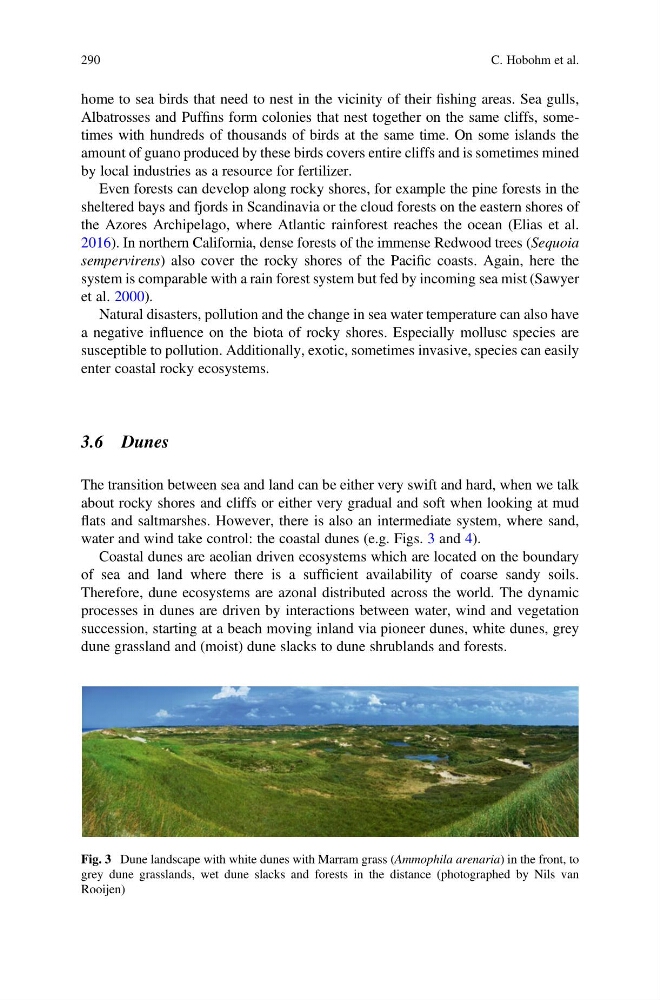
water and wind take control: the coastal dunes (e.g. Figs. 3 and 4).
Coastal dunes are aeolian driven ecosystems which are located on the boundary
of sea and land where there is a sufficient availability of coarse sandy soils.
Therefore, dune ecosystems are azonal distributed across the world. The dynamic
processes in dunes are driven by interactions between water, wind and vegetation
succession, starting at a beach moving inland via pioneer dunes, white dunes, grey
dune grassland and (moist) dune slacks to dune shrublands and forests.
Fig. 3 Dune landscape with white dunes with Marram grass (Ammophila arenaria) in the front, to
grey dune grasslands, wet dune slacks and forests in the distance (photographed by Nils van
Rooijen)
290
C. Hobohm et al.
Albatrosses and Puffins form colonies that nest together on the same cliffs, sometimes with hundreds of thousands of birds at the same time. On some islands the
amount of guano produced by these birds covers entire cliffs and is sometimes mined
by local industries as a resource for fertilizer.
Even forests can develop along rocky shores, for example the pine forests in the
sheltered bays and fjords in Scandinavia or the cloud forests on the eastern shores of
the Azores Archipelago, where Atlantic rainforest reaches the ocean (Elias et al.
2016). In northern California, dense forests of the immense Redwood trees (Sequoia
sempervirens) also cover the rocky shores of the Pacific coasts. Again, here the
system is comparable with a rain forest system but fed by incoming sea mist (Sawyer
et al. 2000).
Natural disasters, pollution and the change in sea water temperature can also have
a negative influence on the biota of rocky shores. Especially mollusc species are
susceptible to pollution. Additionally, exotic, sometimes invasive, species can easily
enter coastal rocky ecosystems.
3.6 Dunes
The transition between sea and land can be either very swift and hard, when we talk
about rocky shores and cliffs or either very gradual and soft when looking at mud
flats and saltmarshes. However, there is also an intermediate system, where sand,
water and wind take control: the coastal dunes (e.g. Figs. 3 and 4).
Coastal dunes are aeolian driven ecosystems which are located on the boundary
of sea and land where there is a sufficient availability of coarse sandy soils.
Therefore, dune ecosystems are azonal distributed across the world. The dynamic
processes in dunes are driven by interactions between water, wind and vegetation
succession, starting at a beach moving inland via pioneer dunes, white dunes, grey
dune grassland and (moist) dune slacks to dune shrublands and forests.
Fig. 3 Dune landscape with white dunes with Marram grass (Ammophila arenaria) in the front, to
grey dune grasslands, wet dune slacks and forests in the distance (photographed by Nils van
Rooijen)
290
C. Hobohm et al.