

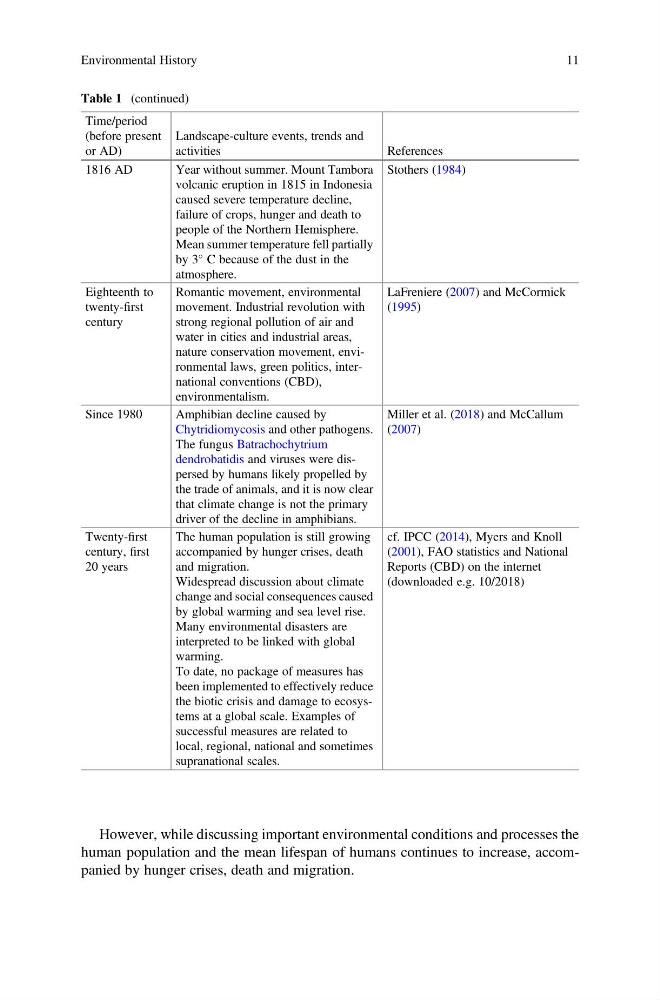
However, while discussing important environmental conditions and processes the
human population and the mean lifespan of humans continues to increase, accompanied by hunger crises, death and migration.
Table 1 (continued)
Time/period
(before present
or AD)
Landscape-culture events, trends and
activities
References
1816 AD
Year without summer. Mount Tambora
volcanic eruption in 1815 in Indonesia
caused severe temperature decline,
failure of crops, hunger and death to
people of the Northern Hemisphere.
Mean summer temperature fell partially
by 3
C because of the dust in the
atmosphere.
Stothers (1984)
Eighteenth to
twenty-first
century
Romantic movement, environmental
movement. Industrial revolution with
strong regional pollution of air and
water in cities and industrial areas,
nature conservation movement, environmental laws, green politics, international conventions (CBD),
environmentalism.
LaFreniere (2007) and McCormick
(1995)
Since 1980
Amphibian decline caused by
Chytridiomycosis and other pathogens.
The fungus Batrachochytrium
dendrobatidis and viruses were dispersed by humans likely propelled by
the trade of animals, and it is now clear
that climate change is not the primary
driver of the decline in amphibians.
Miller et al. (2018) and McCallum
(2007)
Twenty-first
century, first
20 years
The human population is still growing
accompanied by hunger crises, death
and migration.
Widespread discussion about climate
change and social consequences caused
by global warming and sea level rise.
Many environmental disasters are
interpreted to be linked with global
warming.
To date, no package of measures has
been implemented to effectively reduce
the biotic crisis and damage to ecosystems at a global scale. Examples of
successful measures are related to
local, regional, national and sometimes
supranational scales.
cf. IPCC (2014), Myers and Knoll
(2001), FAO statistics and National
Reports (CBD) on the internet
(downloaded e.g. 10/2018)
Environmental History
11
human population and the mean lifespan of humans continues to increase, accompanied by hunger crises, death and migration.
Table 1 (continued)
Time/period
(before present
or AD)
Landscape-culture events, trends and
activities
References
1816 AD
Year without summer. Mount Tambora
volcanic eruption in 1815 in Indonesia
caused severe temperature decline,
failure of crops, hunger and death to
people of the Northern Hemisphere.
Mean summer temperature fell partially
by 3
C because of the dust in the
atmosphere.
Stothers (1984)
Eighteenth to
twenty-first
century
Romantic movement, environmental
movement. Industrial revolution with
strong regional pollution of air and
water in cities and industrial areas,
nature conservation movement, environmental laws, green politics, international conventions (CBD),
environmentalism.
LaFreniere (2007) and McCormick
(1995)
Since 1980
Amphibian decline caused by
Chytridiomycosis and other pathogens.
The fungus Batrachochytrium
dendrobatidis and viruses were dispersed by humans likely propelled by
the trade of animals, and it is now clear
that climate change is not the primary
driver of the decline in amphibians.
Miller et al. (2018) and McCallum
(2007)
Twenty-first
century, first
20 years
The human population is still growing
accompanied by hunger crises, death
and migration.
Widespread discussion about climate
change and social consequences caused
by global warming and sea level rise.
Many environmental disasters are
interpreted to be linked with global
warming.
To date, no package of measures has
been implemented to effectively reduce
the biotic crisis and damage to ecosystems at a global scale. Examples of
successful measures are related to
local, regional, national and sometimes
supranational scales.
cf. IPCC (2014), Myers and Knoll
(2001), FAO statistics and National
Reports (CBD) on the internet
(downloaded e.g. 10/2018)
Environmental History
11