

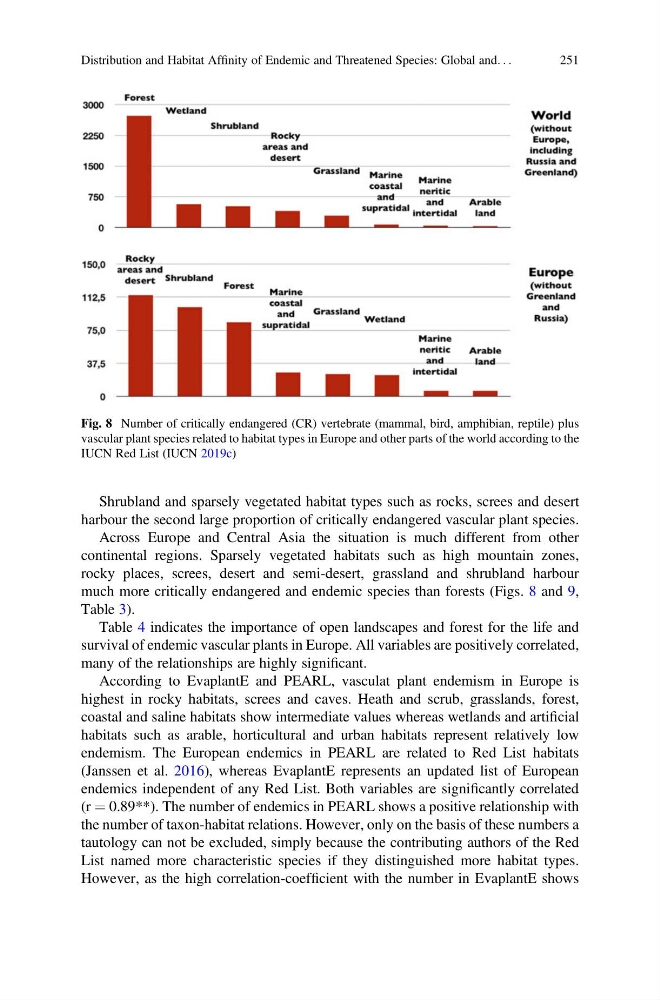
Shrubland and sparsely vegetated habitat types such as rocks, screes and desert
harbour the second large proportion of critically endangered vascular plant species.
Across Europe and Central Asia the situation is much different from other
continental regions. Sparsely vegetated habitats such as high mountain zones,
rocky places, screes, desert and semi-desert, grassland and shrubland harbour
much more critically endangered and endemic species than forests (Figs. 8 and 9,
Table 3).
Table 4 indicates the importance of open landscapes and forest for the life and
survival of endemic vascular plants in Europe. All variables are positively correlated,
many of the relationships are highly significant.
According to EvaplantE and PEARL, vasculat plant endemism in Europe is
highest in rocky habitats, screes and caves. Heath and scrub, grasslands, forest,
coastal and saline habitats show intermediate values whereas wetlands and artificial
habitats such as arable, horticultural and urban habitats represent relatively low
endemism. The European endemics in PEARL are related to Red List habitats
(Janssen et al. 2016), whereas EvaplantE represents an updated list of European
endemics independent of any Red List. Both variables are significantly correlated
(r ¼ 0.89**). The number of endemics in PEARL shows a positive relationship with
the number of taxon-habitat relations. However, only on the basis of these numbers a
tautology can not be excluded, simply because the contributing authors of the Red
List named more characteristic species if they distinguished more habitat types.
However, as the high correlation-coefficient with the number in EvaplantE shows
Fig. 8 Number of critically endangered (CR) vertebrate (mammal, bird, amphibian, reptile) plus
vascular plant species related to habitat types in Europe and other parts of the world according to the
IUCN Red List (IUCN 2019c)
Distribution and Habitat Affinity of Endemic and Threatened Species: Global and. . .
251
harbour the second large proportion of critically endangered vascular plant species.
Across Europe and Central Asia the situation is much different from other
continental regions. Sparsely vegetated habitats such as high mountain zones,
rocky places, screes, desert and semi-desert, grassland and shrubland harbour
much more critically endangered and endemic species than forests (Figs. 8 and 9,
Table 3).
Table 4 indicates the importance of open landscapes and forest for the life and
survival of endemic vascular plants in Europe. All variables are positively correlated,
many of the relationships are highly significant.
According to EvaplantE and PEARL, vasculat plant endemism in Europe is
highest in rocky habitats, screes and caves. Heath and scrub, grasslands, forest,
coastal and saline habitats show intermediate values whereas wetlands and artificial
habitats such as arable, horticultural and urban habitats represent relatively low
endemism. The European endemics in PEARL are related to Red List habitats
(Janssen et al. 2016), whereas EvaplantE represents an updated list of European
endemics independent of any Red List. Both variables are significantly correlated
(r ¼ 0.89**). The number of endemics in PEARL shows a positive relationship with
the number of taxon-habitat relations. However, only on the basis of these numbers a
tautology can not be excluded, simply because the contributing authors of the Red
List named more characteristic species if they distinguished more habitat types.
However, as the high correlation-coefficient with the number in EvaplantE shows
Fig. 8 Number of critically endangered (CR) vertebrate (mammal, bird, amphibian, reptile) plus
vascular plant species related to habitat types in Europe and other parts of the world according to the
IUCN Red List (IUCN 2019c)
Distribution and Habitat Affinity of Endemic and Threatened Species: Global and. . .
251