

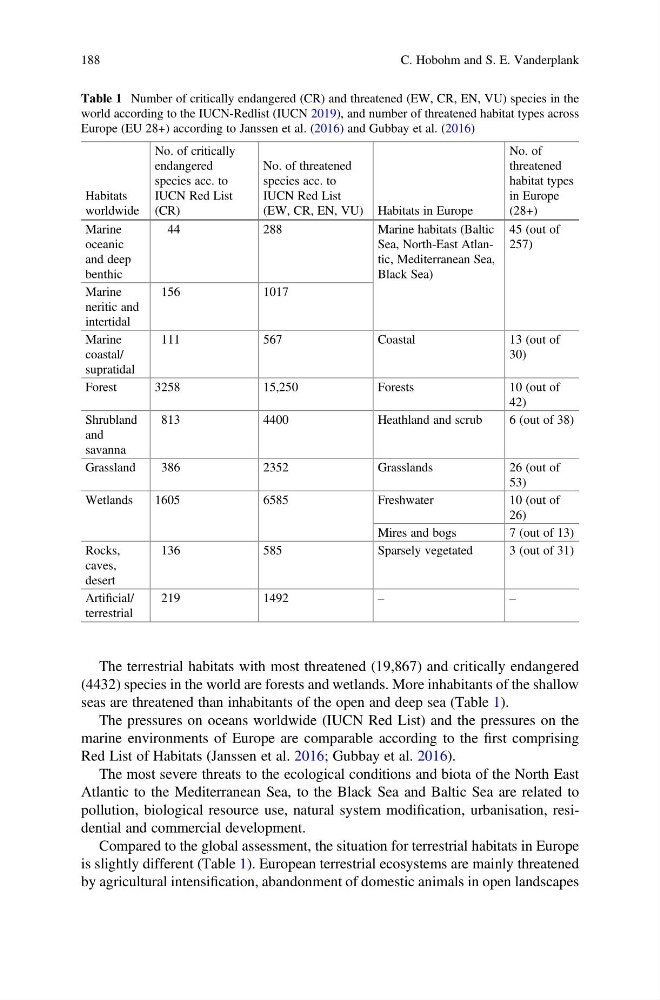
The terrestrial habitats with most threatened (19,867) and critically endangered
(4432) species in the world are forests and wetlands. More inhabitants of the shallow
seas are threatened than inhabitants of the open and deep sea (Table 1).
The pressures on oceans worldwide (IUCN Red List) and the pressures on the
marine environments of Europe are comparable according to the first comprising
Red List of Habitats (Janssen et al. 2016; Gubbay et al. 2016).
The most severe threats to the ecological conditions and biota of the North East
Atlantic to the Mediterranean Sea, to the Black Sea and Baltic Sea are related to
pollution, biological resource use, natural system modification, urbanisation, residential and commercial development.
Compared to the global assessment, the situation for terrestrial habitats in Europe
is slightly different (Table 1). European terrestrial ecosystems are mainly threatened
by agricultural intensification, abandonment of domestic animals in open landscapes
Table 1 Number of critically endangered (CR) and threatened (EW, CR, EN, VU) species in the
world according to the IUCN-Redlist (IUCN 2019), and number of threatened habitat types across
Europe (EU 28+) according to Janssen et al. (2016) and Gubbay et al. (2016)
Habitats
worldwide
No. of critically
endangered
species acc. to
IUCN Red List
(CR)
No. of threatened
species acc. to
IUCN Red List
(EW, CR, EN, VU) Habitats in Europe
No. of
threatened
habitat types
in Europe
(28+)
Marine
oceanic
and deep
benthic
44
288
Marine habitats (Baltic
Sea, North-East Atlantic, Mediterranean Sea,
Black Sea)
45 (out of
257)
Marine
neritic and
intertidal
156
1017
Marine
coastal/
supratidal
111
567
Coastal
13 (out of
30)
Forest
3258
15,250
Forests
10 (out of
42)
Shrubland
and
savanna
813
4400
Heathland and scrub
6 (out of 38)
Grassland
386
2352
Grasslands
26 (out of
53)
Wetlands
1605
6585
Freshwater
10 (out of
26)
Mires and bogs
7 (out of 13)
Rocks,
caves,
desert
136
585
Sparsely vegetated
3 (out of 31)
Artificial/
terrestrial
219
1492
–
–
188
C. Hobohm and S. E. Vanderplank
(4432) species in the world are forests and wetlands. More inhabitants of the shallow
seas are threatened than inhabitants of the open and deep sea (Table 1).
The pressures on oceans worldwide (IUCN Red List) and the pressures on the
marine environments of Europe are comparable according to the first comprising
Red List of Habitats (Janssen et al. 2016; Gubbay et al. 2016).
The most severe threats to the ecological conditions and biota of the North East
Atlantic to the Mediterranean Sea, to the Black Sea and Baltic Sea are related to
pollution, biological resource use, natural system modification, urbanisation, residential and commercial development.
Compared to the global assessment, the situation for terrestrial habitats in Europe
is slightly different (Table 1). European terrestrial ecosystems are mainly threatened
by agricultural intensification, abandonment of domestic animals in open landscapes
Table 1 Number of critically endangered (CR) and threatened (EW, CR, EN, VU) species in the
world according to the IUCN-Redlist (IUCN 2019), and number of threatened habitat types across
Europe (EU 28+) according to Janssen et al. (2016) and Gubbay et al. (2016)
Habitats
worldwide
No. of critically
endangered
species acc. to
IUCN Red List
(CR)
No. of threatened
species acc. to
IUCN Red List
(EW, CR, EN, VU) Habitats in Europe
No. of
threatened
habitat types
in Europe
(28+)
Marine
oceanic
and deep
benthic
44
288
Marine habitats (Baltic
Sea, North-East Atlantic, Mediterranean Sea,
Black Sea)
45 (out of
257)
Marine
neritic and
intertidal
156
1017
Marine
coastal/
supratidal
111
567
Coastal
13 (out of
30)
Forest
3258
15,250
Forests
10 (out of
42)
Shrubland
and
savanna
813
4400
Heathland and scrub
6 (out of 38)
Grassland
386
2352
Grasslands
26 (out of
53)
Wetlands
1605
6585
Freshwater
10 (out of
26)
Mires and bogs
7 (out of 13)
Rocks,
caves,
desert
136
585
Sparsely vegetated
3 (out of 31)
Artificial/
terrestrial
219
1492
–
–
188
C. Hobohm and S. E. Vanderplank