

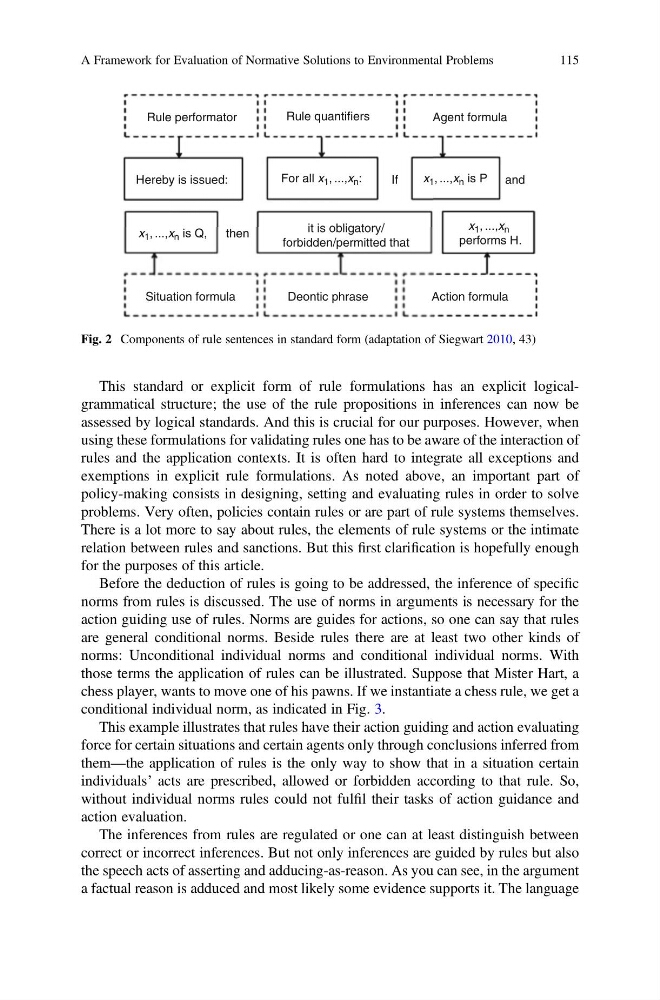
This standard or explicit form of rule formulations has an explicit logicalgrammatical structure; the use of the rule propositions in inferences can now be
assessed by logical standards. And this is crucial for our purposes. However, when
using these formulations for validating rules one has to be aware of the interaction of
rules and the application contexts. It is often hard to integrate all exceptions and
exemptions in explicit rule formulations. As noted above, an important part of
policy-making consists in designing, setting and evaluating rules in order to solve
problems. Very often, policies contain rules or are part of rule systems themselves.
There is a lot more to say about rules, the elements of rule systems or the intimate
relation between rules and sanctions. But this first clarification is hopefully enough
for the purposes of this article.
Before the deduction of rules is going to be addressed, the inference of specific
norms from rules is discussed. The use of norms in arguments is necessary for the
action guiding use of rules. Norms are guides for actions, so one can say that rules
are general conditional norms. Beside rules there are at least two other kinds of
norms: Unconditional individual norms and conditional individual norms. With
those terms the application of rules can be illustrated. Suppose that Mister Hart, a
chess player, wants to move one of his pawns. If we instantiate a chess rule, we get a
conditional individual norm, as indicated in Fig. 3.
This example illustrates that rules have their action guiding and action evaluating
force for certain situations and certain agents only through conclusions inferred from
them—the application of rules is the only way to show that in a situation certain
individuals’ acts are prescribed, allowed or forbidden according to that rule. So,
without individual norms rules could not fulfil their tasks of action guidance and
action evaluation.
The inferences from rules are regulated or one can at least distinguish between
correct or incorrect inferences. But not only inferences are guided by rules but also
the speech acts of asserting and adducing-as-reason. As you can see, in the argument
a factual reason is adduced and most likely some evidence supports it. The language
Rule performator
Hereby is issued:
For all x 1 , ...,x n :
x 1 , ...,x n is P
x 1 , ...,x n is Q,
x 1 , ...,x n
performs H.
Rule quantifiers
Agent formula
If
Action formula
Situation formula
Deontic phrase
it is obligatory/
forbidden/permitted that
and
then
Fig. 2 Components of rule sentences in standard form (adaptation of Siegwart 2010, 43)
A Framework for Evaluation of Normative Solutions to Environmental Problems
115
assessed by logical standards. And this is crucial for our purposes. However, when
using these formulations for validating rules one has to be aware of the interaction of
rules and the application contexts. It is often hard to integrate all exceptions and
exemptions in explicit rule formulations. As noted above, an important part of
policy-making consists in designing, setting and evaluating rules in order to solve
problems. Very often, policies contain rules or are part of rule systems themselves.
There is a lot more to say about rules, the elements of rule systems or the intimate
relation between rules and sanctions. But this first clarification is hopefully enough
for the purposes of this article.
Before the deduction of rules is going to be addressed, the inference of specific
norms from rules is discussed. The use of norms in arguments is necessary for the
action guiding use of rules. Norms are guides for actions, so one can say that rules
are general conditional norms. Beside rules there are at least two other kinds of
norms: Unconditional individual norms and conditional individual norms. With
those terms the application of rules can be illustrated. Suppose that Mister Hart, a
chess player, wants to move one of his pawns. If we instantiate a chess rule, we get a
conditional individual norm, as indicated in Fig. 3.
This example illustrates that rules have their action guiding and action evaluating
force for certain situations and certain agents only through conclusions inferred from
them—the application of rules is the only way to show that in a situation certain
individuals’ acts are prescribed, allowed or forbidden according to that rule. So,
without individual norms rules could not fulfil their tasks of action guidance and
action evaluation.
The inferences from rules are regulated or one can at least distinguish between
correct or incorrect inferences. But not only inferences are guided by rules but also
the speech acts of asserting and adducing-as-reason. As you can see, in the argument
a factual reason is adduced and most likely some evidence supports it. The language
Rule performator
Hereby is issued:
For all x 1 , ...,x n :
x 1 , ...,x n is P
x 1 , ...,x n is Q,
x 1 , ...,x n
performs H.
Rule quantifiers
Agent formula
If
Action formula
Situation formula
Deontic phrase
it is obligatory/
forbidden/permitted that
and
then
Fig. 2 Components of rule sentences in standard form (adaptation of Siegwart 2010, 43)
A Framework for Evaluation of Normative Solutions to Environmental Problems
115