

Highly effective use of resources may maximize growth rate, competitive power
and reproduction of individuals of the community. The disadvantage could be that
maximal resource exploitation can result in emptiness, i.e. in total elimination of one
or more resources. Moderate long-term use, in contrary, guarantees not to eliminate
the resource and might maximize the prospects of survival for the metapopulation.
The roots of the debate about this dichotomy are hundred years old, when ecologists
discussed the individualistic concept with a pronounciation of competition (Gleason
1926) and the organismal concept, pronouncing the meaning of positive effects for
the community, i.e. mutualism and facilitation (Clements 1916; Tansley 1920).
Optimization of the resource use means adaptation and maximization of biological processes by accumulating, recycling and investing as many resources as
possible, and minimizing their loss. It is clearly not the only power forming the
assembly or constituting the ecosystem since neutral effects such as genetic drift
exist, and even negative effects can be observed.
The resource use by plants, animals and humans can normally be optimized under
constant, regularly oscillating, and more or less normal environmental (dry/wet,
warm/cold, day/night, etc.) conditions. However, where in the nature would it be
possible to find constancy or stability? The law of conservation of mass is more or
less true for chemical elements at global scales. It says that the mass of elements is
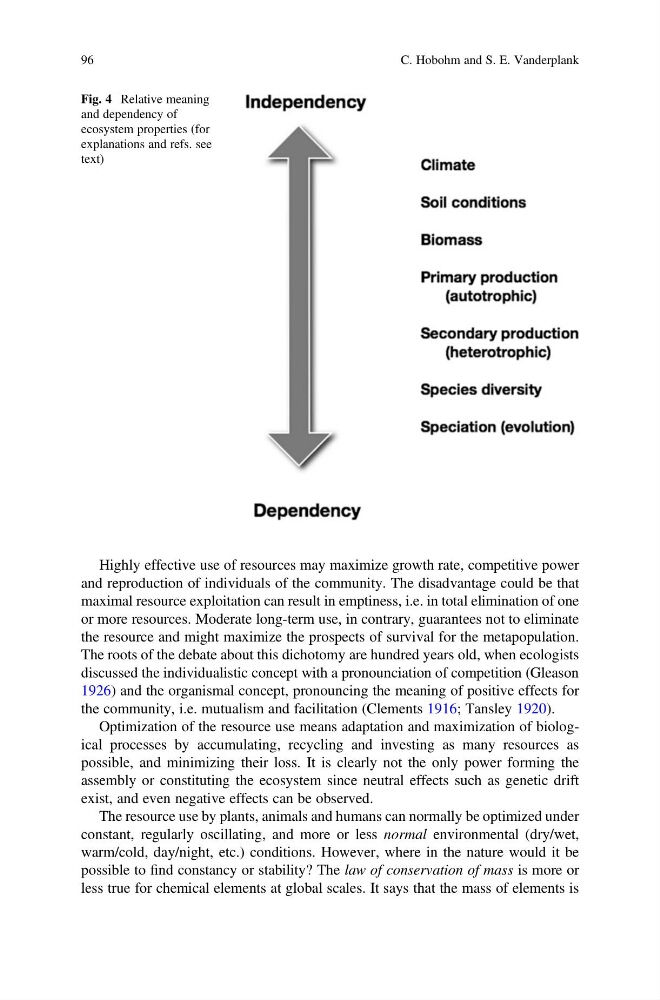
Fig. 4 Relative meaning
and dependency of
ecosystem properties (for
explanations and refs. see
text)
96
C. Hobohm and S. E. Vanderplank
and reproduction of individuals of the community. The disadvantage could be that
maximal resource exploitation can result in emptiness, i.e. in total elimination of one
or more resources. Moderate long-term use, in contrary, guarantees not to eliminate
the resource and might maximize the prospects of survival for the metapopulation.
The roots of the debate about this dichotomy are hundred years old, when ecologists
discussed the individualistic concept with a pronounciation of competition (Gleason
1926) and the organismal concept, pronouncing the meaning of positive effects for
the community, i.e. mutualism and facilitation (Clements 1916; Tansley 1920).
Optimization of the resource use means adaptation and maximization of biological processes by accumulating, recycling and investing as many resources as
possible, and minimizing their loss. It is clearly not the only power forming the
assembly or constituting the ecosystem since neutral effects such as genetic drift
exist, and even negative effects can be observed.
The resource use by plants, animals and humans can normally be optimized under
constant, regularly oscillating, and more or less normal environmental (dry/wet,
warm/cold, day/night, etc.) conditions. However, where in the nature would it be
possible to find constancy or stability? The law of conservation of mass is more or
less true for chemical elements at global scales. It says that the mass of elements is
Fig. 4 Relative meaning
and dependency of
ecosystem properties (for
explanations and refs. see
text)
96
C. Hobohm and S. E. Vanderplank