

has been attributed to the influence of disturbance, abiotic conditions (water, energy,
climate, soil), dispersal, niche specialisation, interspecific relationships, and trait
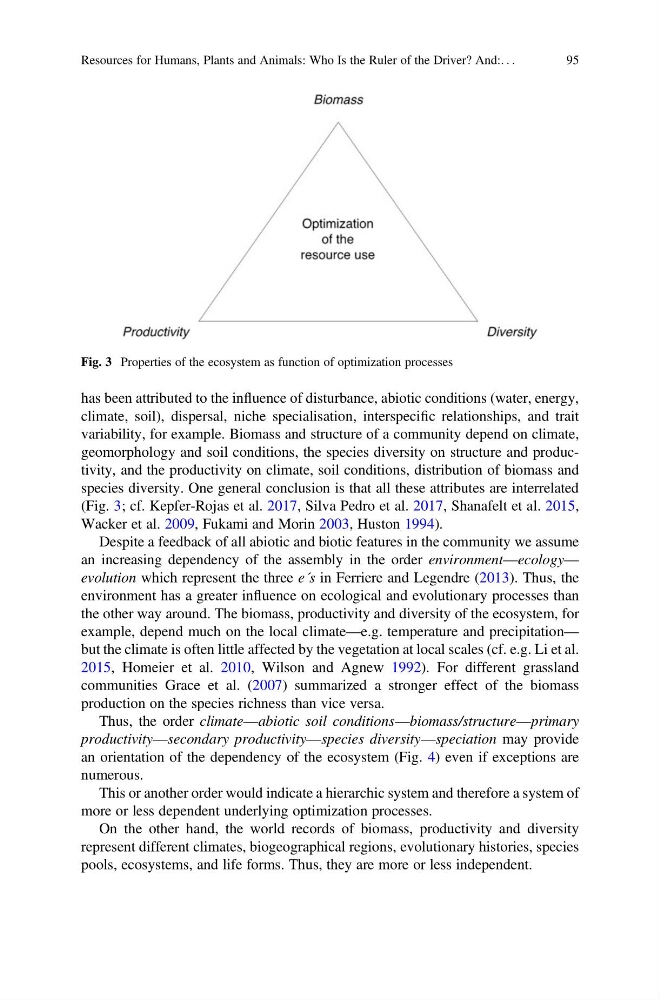
variability, for example. Biomass and structure of a community depend on climate,
geomorphology and soil conditions, the species diversity on structure and productivity, and the productivity on climate, soil conditions, distribution of biomass and
species diversity. One general conclusion is that all these attributes are interrelated
(Fig. 3; cf. Kepfer-Rojas et al. 2017, Silva Pedro et al. 2017, Shanafelt et al. 2015,
Wacker et al. 2009, Fukami and Morin 2003, Huston 1994).
Despite a feedback of all abiotic and biotic features in the community we assume
an increasing dependency of the assembly in the order environment—ecology—
evolution which represent the three e´s in Ferriere and Legendre (2013). Thus, the
environment has a greater influence on ecological and evolutionary processes than
the other way around. The biomass, productivity and diversity of the ecosystem, for
example, depend much on the local climate—e.g. temperature and precipitation—
but the climate is often little affected by the vegetation at local scales (cf. e.g. Li et al.
2015, Homeier et al. 2010, Wilson and Agnew 1992). For different grassland
communities Grace et al. (2007) summarized a stronger effect of the biomass
production on the species richness than vice versa.
Thus, the order climate—abiotic soil conditions—biomass/structure—primary
productivity—secondary productivity—species diversity—speciation may provide
an orientation of the dependency of the ecosystem (Fig. 4) even if exceptions are
numerous.
This or another order would indicate a hierarchic system and therefore a system of
more or less dependent underlying optimization processes.
On the other hand, the world records of biomass, productivity and diversity
represent different climates, biogeographical regions, evolutionary histories, species
pools, ecosystems, and life forms. Thus, they are more or less independent.
Fig. 3 Properties of the ecosystem as function of optimization processes
Resources for Humans, Plants and Animals: Who Is the Ruler of the Driver? And:. . .
95
climate, soil), dispersal, niche specialisation, interspecific relationships, and trait
variability, for example. Biomass and structure of a community depend on climate,
geomorphology and soil conditions, the species diversity on structure and productivity, and the productivity on climate, soil conditions, distribution of biomass and
species diversity. One general conclusion is that all these attributes are interrelated
(Fig. 3; cf. Kepfer-Rojas et al. 2017, Silva Pedro et al. 2017, Shanafelt et al. 2015,
Wacker et al. 2009, Fukami and Morin 2003, Huston 1994).
Despite a feedback of all abiotic and biotic features in the community we assume
an increasing dependency of the assembly in the order environment—ecology—
evolution which represent the three e´s in Ferriere and Legendre (2013). Thus, the
environment has a greater influence on ecological and evolutionary processes than
the other way around. The biomass, productivity and diversity of the ecosystem, for
example, depend much on the local climate—e.g. temperature and precipitation—
but the climate is often little affected by the vegetation at local scales (cf. e.g. Li et al.
2015, Homeier et al. 2010, Wilson and Agnew 1992). For different grassland
communities Grace et al. (2007) summarized a stronger effect of the biomass
production on the species richness than vice versa.
Thus, the order climate—abiotic soil conditions—biomass/structure—primary
productivity—secondary productivity—species diversity—speciation may provide
an orientation of the dependency of the ecosystem (Fig. 4) even if exceptions are
numerous.
This or another order would indicate a hierarchic system and therefore a system of
more or less dependent underlying optimization processes.
On the other hand, the world records of biomass, productivity and diversity
represent different climates, biogeographical regions, evolutionary histories, species
pools, ecosystems, and life forms. Thus, they are more or less independent.
Fig. 3 Properties of the ecosystem as function of optimization processes
Resources for Humans, Plants and Animals: Who Is the Ruler of the Driver? And:. . .
95