

4 Stepwise Two-Photon Photochromism
75
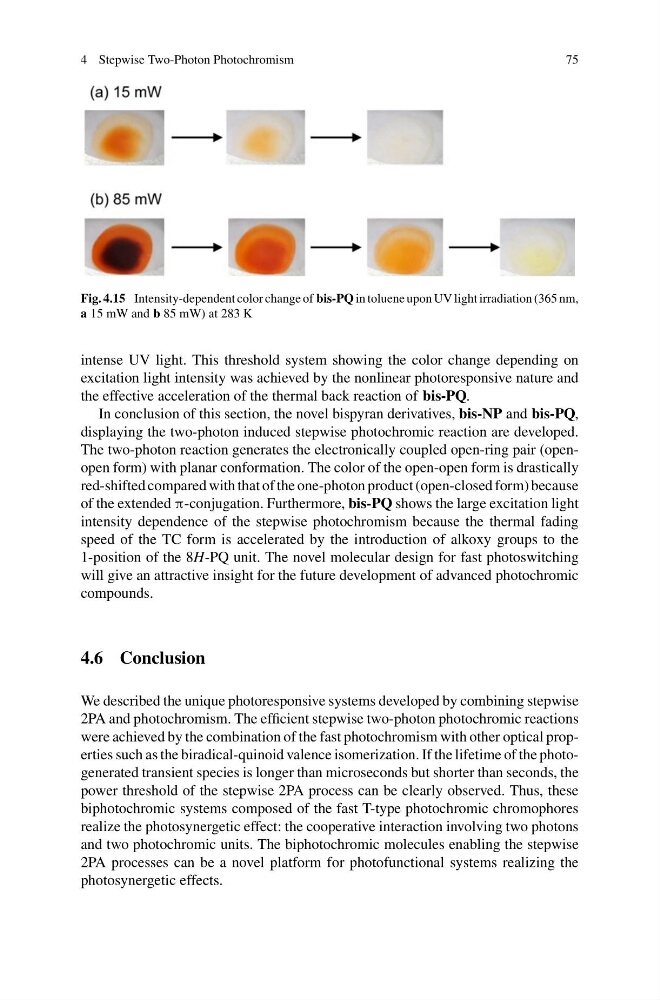
Fig. 4.15 Intensity-dependent color change of bis-PQ in toluene upon UV light irradiation (365 nm,
a 15 mW and b 85 mW) at 283 K
intense UV light. This threshold system showing the color change depending on
excitation light intensity was achieved by the nonlinear photoresponsive nature and
the effective acceleration of the thermal back reaction of bis-PQ.
In conclusion of this section, the novel bispyran derivatives, bis-NP and bis-PQ,
displaying the two-photon induced stepwise photochromic reaction are developed.
The two-photon reaction generates the electronically coupled open-ring pair (openopen form) with planar conformation. The color of the open-open form is drastically
red-shifted compared with that of the one-photon product (open-closed form) because
of the extended π-conjugation. Furthermore, bis-PQ shows the large excitation light
intensity dependence of the stepwise photochromism because the thermal fading
speed of the TC form is accelerated by the introduction of alkoxy groups to the
1-position of the 8H-PQ unit. The novel molecular design for fast photoswitching
will give an attractive insight for the future development of advanced photochromic
compounds.
4.6 Conclusion
We described the unique photoresponsive systems developed by combining stepwise
2PA and photochromism. The efficient stepwise two-photon photochromic reactions
were achieved by the combination of the fast photochromism with other optical properties such as the biradical-quinoid valence isomerization. If the lifetime of the photogenerated transient species is longer than microseconds but shorter than seconds, the
power threshold of the stepwise 2PA process can be clearly observed. Thus, these
biphotochromic systems composed of the fast T-type photochromic chromophores
realize the photosynergetic effect: the cooperative interaction involving two photons
and two photochromic units. The biphotochromic molecules enabling the stepwise
2PA processes can be a novel platform for photofunctional systems realizing the
photosynergetic effects.
75
Fig. 4.15 Intensity-dependent color change of bis-PQ in toluene upon UV light irradiation (365 nm,
a 15 mW and b 85 mW) at 283 K
intense UV light. This threshold system showing the color change depending on
excitation light intensity was achieved by the nonlinear photoresponsive nature and
the effective acceleration of the thermal back reaction of bis-PQ.
In conclusion of this section, the novel bispyran derivatives, bis-NP and bis-PQ,
displaying the two-photon induced stepwise photochromic reaction are developed.
The two-photon reaction generates the electronically coupled open-ring pair (openopen form) with planar conformation. The color of the open-open form is drastically
red-shifted compared with that of the one-photon product (open-closed form) because
of the extended π-conjugation. Furthermore, bis-PQ shows the large excitation light
intensity dependence of the stepwise photochromism because the thermal fading
speed of the TC form is accelerated by the introduction of alkoxy groups to the
1-position of the 8H-PQ unit. The novel molecular design for fast photoswitching
will give an attractive insight for the future development of advanced photochromic
compounds.
4.6 Conclusion
We described the unique photoresponsive systems developed by combining stepwise
2PA and photochromism. The efficient stepwise two-photon photochromic reactions
were achieved by the combination of the fast photochromism with other optical properties such as the biradical-quinoid valence isomerization. If the lifetime of the photogenerated transient species is longer than microseconds but shorter than seconds, the
power threshold of the stepwise 2PA process can be clearly observed. Thus, these
biphotochromic systems composed of the fast T-type photochromic chromophores
realize the photosynergetic effect: the cooperative interaction involving two photons
and two photochromic units. The biphotochromic molecules enabling the stepwise
2PA processes can be a novel platform for photofunctional systems realizing the
photosynergetic effects.