

4 Stepwise Two-Photon Photochromism
73
toluene at 298 K. The similar absorption spectral shape and the almost twice larger
molar extinction coefficient of Bis-NP in UVA region, compared with that of 3HNP, indicate the two pyran units of bis-NP which are electronically independent. In
contrast, the large red-shift of the absorption bands of bis-PQ was observed. This is
presumably because of the introduction of the electron-donating n-butoxy groups to
the 8H-PQ units. The time-resolved absorption spectroscopy was conducted to investigate the excitation light intensity and the temperature dependence of the stepwise
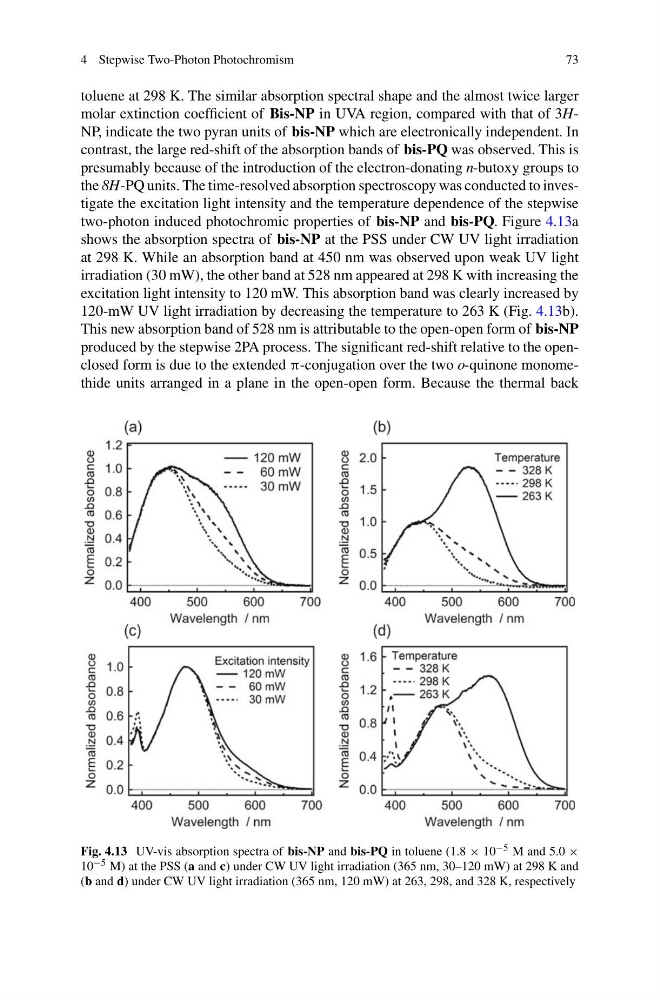
two-photon induced photochromic properties of bis-NP and bis-PQ. Figure 4.13a
shows the absorption spectra of bis-NP at the PSS under CW UV light irradiation
at 298 K. While an absorption band at 450 nm was observed upon weak UV light
irradiation (30 mW), the other band at 528 nm appeared at 298 K with increasing the
excitation light intensity to 120 mW. This absorption band was clearly increased by
120-mW UV light irradiation by decreasing the temperature to 263 K (Fig. 4.13b).
This new absorption band of 528 nm is attributable to the open-open form of bis-NP
produced by the stepwise 2PA process. The significant red-shift relative to the openclosed form is due to the extended π-conjugation over the two o-quinone monomethide units arranged in a plane in the open-open form. Because the thermal back
Fig. 4.13 UV-vis absorption spectra of bis-NP and bis-PQ in toluene (1.8 × 10 −5 M and 5.0 ×
10 −5 M) at the PSS (a and c) under CW UV light irradiation (365 nm, 30–120 mW) at 298 K and
(b and d) under CW UV light irradiation (365 nm, 120 mW) at 263, 298, and 328 K, respectively
73
toluene at 298 K. The similar absorption spectral shape and the almost twice larger
molar extinction coefficient of Bis-NP in UVA region, compared with that of 3HNP, indicate the two pyran units of bis-NP which are electronically independent. In
contrast, the large red-shift of the absorption bands of bis-PQ was observed. This is
presumably because of the introduction of the electron-donating n-butoxy groups to
the 8H-PQ units. The time-resolved absorption spectroscopy was conducted to investigate the excitation light intensity and the temperature dependence of the stepwise
two-photon induced photochromic properties of bis-NP and bis-PQ. Figure 4.13a
shows the absorption spectra of bis-NP at the PSS under CW UV light irradiation
at 298 K. While an absorption band at 450 nm was observed upon weak UV light
irradiation (30 mW), the other band at 528 nm appeared at 298 K with increasing the
excitation light intensity to 120 mW. This absorption band was clearly increased by
120-mW UV light irradiation by decreasing the temperature to 263 K (Fig. 4.13b).
This new absorption band of 528 nm is attributable to the open-open form of bis-NP
produced by the stepwise 2PA process. The significant red-shift relative to the openclosed form is due to the extended π-conjugation over the two o-quinone monomethide units arranged in a plane in the open-open form. Because the thermal back
Fig. 4.13 UV-vis absorption spectra of bis-NP and bis-PQ in toluene (1.8 × 10 −5 M and 5.0 ×
10 −5 M) at the PSS (a and c) under CW UV light irradiation (365 nm, 30–120 mW) at 298 K and
(b and d) under CW UV light irradiation (365 nm, 120 mW) at 263, 298, and 328 K, respectively