

64
J. Abe et al.
broad absorption band due to the biradical form with a half-life of 90 ms, a small
absorption band remained at ~600 nm. The absorption band gradually increases
with prolonged irradiation of the UV light. The spectral similarity of the absorption
spectrum at around 600 nm and the Fourier-transformed infrared (FT-IR) spectrum
between the photogenerated species and BDPI-2Y suggests that the quinoidal form
was generated through the photogenerated biradical form in a stepwise manner. The
absorption band of the quinoidal form gradually decreases and fades out completely
within four days at room temperature.
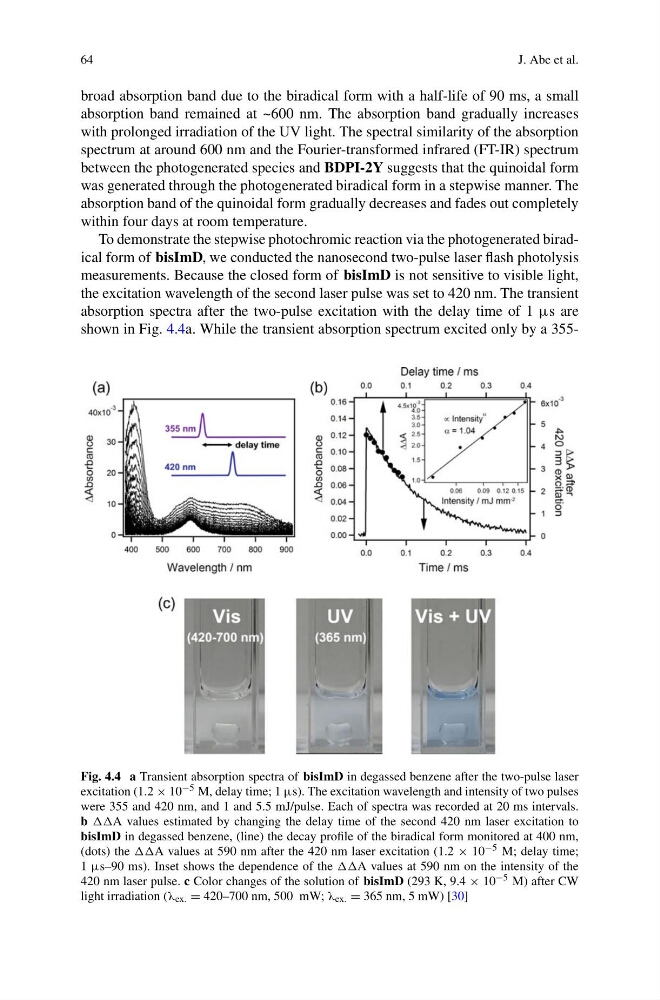
To demonstrate the stepwise photochromic reaction via the photogenerated biradical form of bisImD, we conducted the nanosecond two-pulse laser flash photolysis
measurements. Because the closed form of bisImD is not sensitive to visible light,
the excitation wavelength of the second laser pulse was set to 420 nm. The transient
absorption spectra after the two-pulse excitation with the delay time of 1 μs are
shown in Fig. 4.4a. While the transient absorption spectrum excited only by a 355Fig. 4.4 a Transient absorption spectra of bisImD in degassed benzene after the two-pulse laser
excitation (1.2 × 10 −5 M, delay time; 1 μs). The excitation wavelength and intensity of two pulses
were 355 and 420 nm, and 1 and 5.5 mJ/pulse. Each of spectra was recorded at 20 ms intervals.
b A values estimated by changing the delay time of the second 420 nm laser excitation to
bisImD in degassed benzene, (line) the decay profile of the biradical form monitored at 400 nm,
(dots) the A values at 590 nm after the 420 nm laser excitation (1.2 × 10 −5 M; delay time;
1 μs–90 ms). Inset shows the dependence of the A values at 590 nm on the intensity of the
420 nm laser pulse. c Color changes of the solution of bisImD (293 K, 9.4 × 10 −5 M) after CW
light irradiation (λ ex. = 420–700 nm, 500 mW; λ ex. = 365 nm, 5 mW) [30]
J. Abe et al.
broad absorption band due to the biradical form with a half-life of 90 ms, a small
absorption band remained at ~600 nm. The absorption band gradually increases
with prolonged irradiation of the UV light. The spectral similarity of the absorption
spectrum at around 600 nm and the Fourier-transformed infrared (FT-IR) spectrum
between the photogenerated species and BDPI-2Y suggests that the quinoidal form
was generated through the photogenerated biradical form in a stepwise manner. The
absorption band of the quinoidal form gradually decreases and fades out completely
within four days at room temperature.
To demonstrate the stepwise photochromic reaction via the photogenerated biradical form of bisImD, we conducted the nanosecond two-pulse laser flash photolysis
measurements. Because the closed form of bisImD is not sensitive to visible light,
the excitation wavelength of the second laser pulse was set to 420 nm. The transient
absorption spectra after the two-pulse excitation with the delay time of 1 μs are
shown in Fig. 4.4a. While the transient absorption spectrum excited only by a 355Fig. 4.4 a Transient absorption spectra of bisImD in degassed benzene after the two-pulse laser
excitation (1.2 × 10 −5 M, delay time; 1 μs). The excitation wavelength and intensity of two pulses
were 355 and 420 nm, and 1 and 5.5 mJ/pulse. Each of spectra was recorded at 20 ms intervals.
b A values estimated by changing the delay time of the second 420 nm laser excitation to
bisImD in degassed benzene, (line) the decay profile of the biradical form monitored at 400 nm,
(dots) the A values at 590 nm after the 420 nm laser excitation (1.2 × 10 −5 M; delay time;
1 μs–90 ms). Inset shows the dependence of the A values at 590 nm on the intensity of the
420 nm laser pulse. c Color changes of the solution of bisImD (293 K, 9.4 × 10 −5 M) after CW
light irradiation (λ ex. = 420–700 nm, 500 mW; λ ex. = 365 nm, 5 mW) [30]