

4 Stepwise Two-Photon Photochromism
63
CW LEDs and sunlight. To further reduce the power threshold, one of the solutions is to utilize reversible stepwise photochemical reactions: photochromism [28].
T-type photochromic reactions generate a colored form upon light irradiation, and
the generated colored form thermally reverts to the initial form. Because the lifetimes of the colored forms are usually much longer than microseconds, the power
threshold of the stepwise 2PA process can be greatly reduced if the photogenerated
colored formed are used for the intermediated state of the stepwise 2PA process.
The simple molecular design to combine photochromic reactions and stepwise 2PA
processes is to incorporate two photochromic units in a molecule. In this strategy,
the key feature is the efficient mutual interaction between the two photochromic
units to achieve the distinct photoresponses depending on the excitation intensity.
Although a number of multi-switchable photochromic systems have been reported in
azobenzenes, naphthopyrans, and diarylethenes, the electronic structures of the most
of these derivatives were merely the superposition of the two photochromic units
[29]. Besides, the switching of one photochromic unit sometimes hindered the other
photochromic reaction due to the energy transfer between the two photochromic
units.
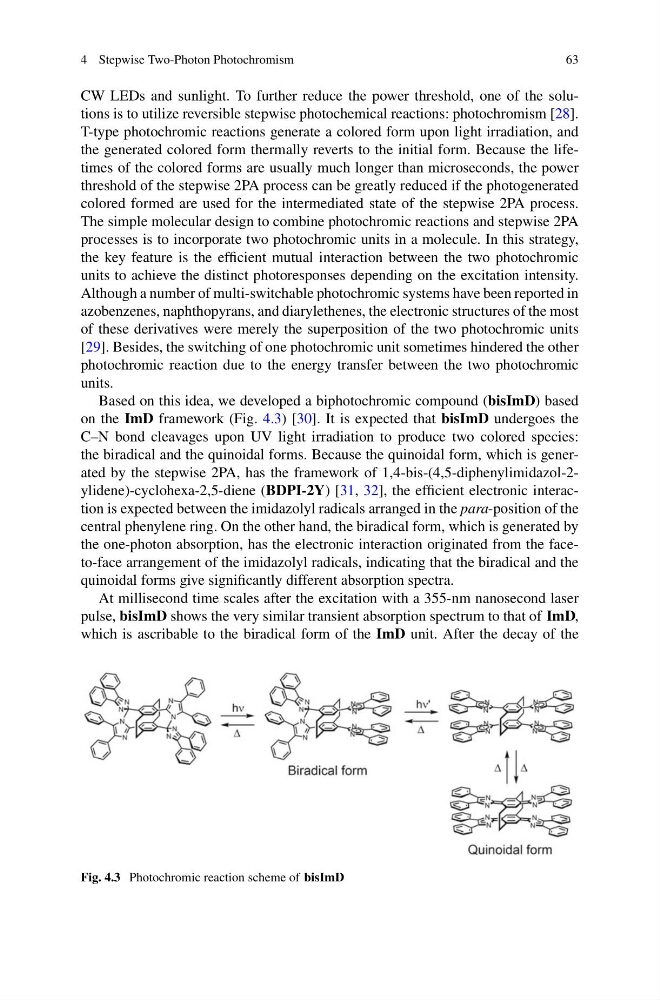
Based on this idea, we developed a biphotochromic compound (bisImD) based
on the ImD framework (Fig. 4.3) [30]. It is expected that bisImD undergoes the
C–N bond cleavages upon UV light irradiation to produce two colored species:
the biradical and the quinoidal forms. Because the quinoidal form, which is generated by the stepwise 2PA, has the framework of 1,4-bis-(4,5-diphenylimidazol-2ylidene)-cyclohexa-2,5-diene (BDPI-2Y) [31, 32], the efficient electronic interaction is expected between the imidazolyl radicals arranged in the para-position of the
central phenylene ring. On the other hand, the biradical form, which is generated by
the one-photon absorption, has the electronic interaction originated from the faceto-face arrangement of the imidazolyl radicals, indicating that the biradical and the
quinoidal forms give significantly different absorption spectra.
At millisecond time scales after the excitation with a 355-nm nanosecond laser
pulse, bisImD shows the very similar transient absorption spectrum to that of ImD,
which is ascribable to the biradical form of the ImD unit. After the decay of the
Fig. 4.3 Photochromic reaction scheme of bisImD
63
CW LEDs and sunlight. To further reduce the power threshold, one of the solutions is to utilize reversible stepwise photochemical reactions: photochromism [28].
T-type photochromic reactions generate a colored form upon light irradiation, and
the generated colored form thermally reverts to the initial form. Because the lifetimes of the colored forms are usually much longer than microseconds, the power
threshold of the stepwise 2PA process can be greatly reduced if the photogenerated
colored formed are used for the intermediated state of the stepwise 2PA process.
The simple molecular design to combine photochromic reactions and stepwise 2PA
processes is to incorporate two photochromic units in a molecule. In this strategy,
the key feature is the efficient mutual interaction between the two photochromic
units to achieve the distinct photoresponses depending on the excitation intensity.
Although a number of multi-switchable photochromic systems have been reported in
azobenzenes, naphthopyrans, and diarylethenes, the electronic structures of the most
of these derivatives were merely the superposition of the two photochromic units
[29]. Besides, the switching of one photochromic unit sometimes hindered the other
photochromic reaction due to the energy transfer between the two photochromic
units.
Based on this idea, we developed a biphotochromic compound (bisImD) based
on the ImD framework (Fig. 4.3) [30]. It is expected that bisImD undergoes the
C–N bond cleavages upon UV light irradiation to produce two colored species:
the biradical and the quinoidal forms. Because the quinoidal form, which is generated by the stepwise 2PA, has the framework of 1,4-bis-(4,5-diphenylimidazol-2ylidene)-cyclohexa-2,5-diene (BDPI-2Y) [31, 32], the efficient electronic interaction is expected between the imidazolyl radicals arranged in the para-position of the
central phenylene ring. On the other hand, the biradical form, which is generated by
the one-photon absorption, has the electronic interaction originated from the faceto-face arrangement of the imidazolyl radicals, indicating that the biradical and the
quinoidal forms give significantly different absorption spectra.
At millisecond time scales after the excitation with a 355-nm nanosecond laser
pulse, bisImD shows the very similar transient absorption spectrum to that of ImD,
which is ascribable to the biradical form of the ImD unit. After the decay of the
Fig. 4.3 Photochromic reaction scheme of bisImD