

582
K. Tawa et al.
34.1 Introduction
Diarylethene (DAE) [1–3] is one of the most representative photochromic compounds
together with spiropyrans [4, 5], azobenzenes [6–9], and hexaarylbiimidazole
(HABI) [10]. Many studies on DAE have been conducted for more than half a century.
Physical and chemical properties of various DAE derivatives synthesized have been
investigated by spectroscopy [11, 12], electrochemistry [13, 14], and crystallography
[15–18], etc. Generally, the open-ring form of DAE converts to the closed-ring form
under the ultraviolet (UV) light. The closed-ring form reconverts to the open-ring
with visible light. The photoinduced reversible formation of microfibrils on a DAE
microcrystalline surface has been reported by Uchida et al. [19–22]. Change in the
photoinduced morphology can provide super hydrophobic properties such as in lotus
and taro leaves [23]. Micrometer-scale rods or projections indicate a super waterrepellent property and the large contact angle of a water droplet is 160° [24–26]. In the
previous studies by Uchida et al., the photoinduced tuning of the surface wettability
was reported due to the morphological changes in a crystal of photochromic DAE, and
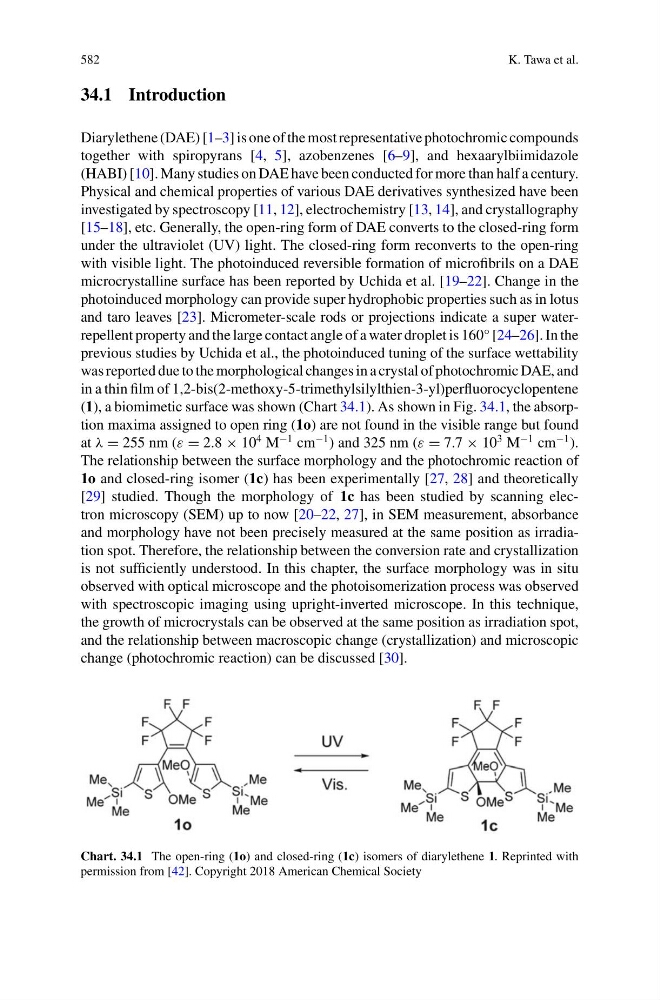
in a thin film of 1,2-bis(2-methoxy-5-trimethylsilylthien-3-yl)perfluorocyclopentene
(1), a biomimetic surface was shown (Chart 34.1). As shown in Fig. 34.1, the absorption maxima assigned to open ring (1o) are not found in the visible range but found
at λ = 255 nm (ε = 2.8 × 10
4 M
−1 cm
−1 ) and 325 nm (ε = 7.7 × 10
3 M
−1 cm
−1 ).
The relationship between the surface morphology and the photochromic reaction of
1o and closed-ring isomer (1c) has been experimentally [27, 28] and theoretically
[29] studied. Though the morphology of 1c has been studied by scanning electron microscopy (SEM) up to now [20–22, 27], in SEM measurement, absorbance
and morphology have not been precisely measured at the same position as irradiation spot. Therefore, the relationship between the conversion rate and crystallization
is not sufficiently understood. In this chapter, the surface morphology was in situ
observed with optical microscope and the photoisomerization process was observed
with spectroscopic imaging using upright-inverted microscope. In this technique,
the growth of microcrystals can be observed at the same position as irradiation spot,
and the relationship between macroscopic change (crystallization) and microscopic
change (photochromic reaction) can be discussed [30].
Chart. 34.1 The open-ring (1o) and closed-ring (1c) isomers of diarylethene 1. Reprinted with
permission from [42]. Copyright 2018 American Chemical Society
K. Tawa et al.
34.1 Introduction
Diarylethene (DAE) [1–3] is one of the most representative photochromic compounds
together with spiropyrans [4, 5], azobenzenes [6–9], and hexaarylbiimidazole
(HABI) [10]. Many studies on DAE have been conducted for more than half a century.
Physical and chemical properties of various DAE derivatives synthesized have been
investigated by spectroscopy [11, 12], electrochemistry [13, 14], and crystallography
[15–18], etc. Generally, the open-ring form of DAE converts to the closed-ring form
under the ultraviolet (UV) light. The closed-ring form reconverts to the open-ring
with visible light. The photoinduced reversible formation of microfibrils on a DAE
microcrystalline surface has been reported by Uchida et al. [19–22]. Change in the
photoinduced morphology can provide super hydrophobic properties such as in lotus
and taro leaves [23]. Micrometer-scale rods or projections indicate a super waterrepellent property and the large contact angle of a water droplet is 160° [24–26]. In the
previous studies by Uchida et al., the photoinduced tuning of the surface wettability
was reported due to the morphological changes in a crystal of photochromic DAE, and
in a thin film of 1,2-bis(2-methoxy-5-trimethylsilylthien-3-yl)perfluorocyclopentene
(1), a biomimetic surface was shown (Chart 34.1). As shown in Fig. 34.1, the absorption maxima assigned to open ring (1o) are not found in the visible range but found
at λ = 255 nm (ε = 2.8 × 10
4 M
−1 cm
−1 ) and 325 nm (ε = 7.7 × 10
3 M
−1 cm
−1 ).
The relationship between the surface morphology and the photochromic reaction of
1o and closed-ring isomer (1c) has been experimentally [27, 28] and theoretically
[29] studied. Though the morphology of 1c has been studied by scanning electron microscopy (SEM) up to now [20–22, 27], in SEM measurement, absorbance
and morphology have not been precisely measured at the same position as irradiation spot. Therefore, the relationship between the conversion rate and crystallization
is not sufficiently understood. In this chapter, the surface morphology was in situ
observed with optical microscope and the photoisomerization process was observed
with spectroscopic imaging using upright-inverted microscope. In this technique,
the growth of microcrystals can be observed at the same position as irradiation spot,
and the relationship between macroscopic change (crystallization) and microscopic
change (photochromic reaction) can be discussed [30].
Chart. 34.1 The open-ring (1o) and closed-ring (1c) isomers of diarylethene 1. Reprinted with
permission from [42]. Copyright 2018 American Chemical Society