

3 Enhanced and Selective Two-Photon Excitation of Molecular …
49
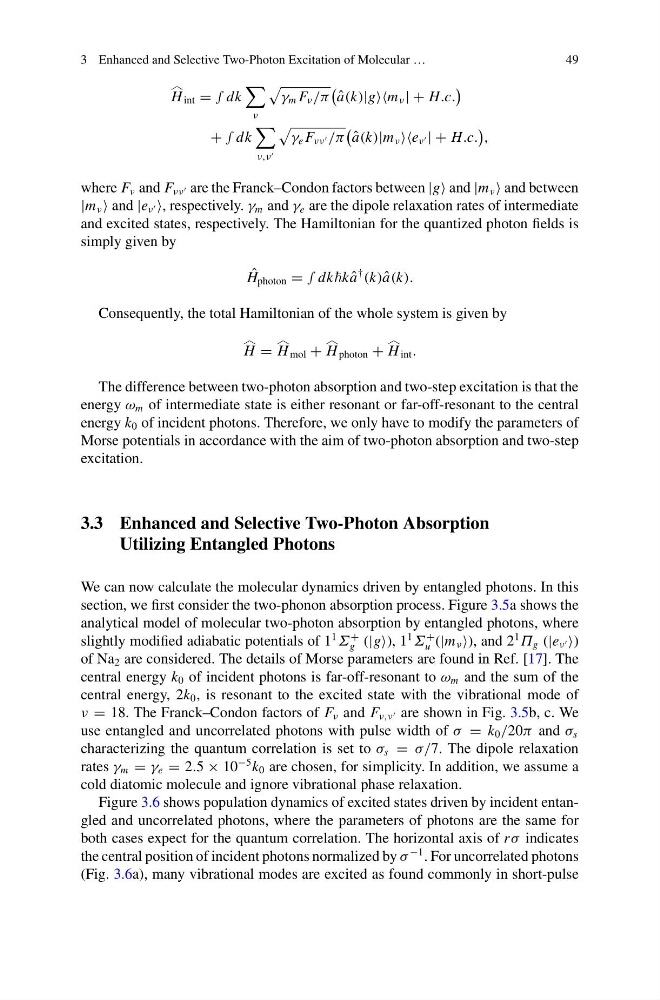
H
int = ∫ dk
ν
γ m F ν /π
ˆ
a(k)|gm ν | + H.c.
+ ∫ dk
ν,ν
γ e F νν /π
ˆ
a(k)|m ν e ν | + H.c.
,
where F ν and F νν are the Franck–Condon factors between |g and |m ν and between
|m ν and |e ν , respectively. γ m and γ e are the dipole relaxation rates of intermediate
and excited states, respectively. The Hamiltonian for the quantized photon fields is
simply given by
ˆ
H photon = ∫ dkk ˆ
a
†
(k) ˆ
a(k).
Consequently, the total Hamiltonian of the whole system is given by
H
= H
mol + H
photon + H
int .
The difference between two-photon absorption and two-step excitation is that the
energy ω m of intermediate state is either resonant or far-off-resonant to the central
energy k 0 of incident photons. Therefore, we only have to modify the parameters of
Morse potentials in accordance with the aim of two-photon absorption and two-step
excitation.
3.3 Enhanced and Selective Two-Photon Absorption
Utilizing Entangled Photons
We can now calculate the molecular dynamics driven by entangled photons. In this
section, we first consider the two-phonon absorption process. Figure 3.5a shows the
analytical model of molecular two-photon absorption by entangled photons, where
slightly modified adiabatic potentials of 1
1
Σ
+
g (|g), 1
1
Σ
+
u (|m ν ), and 2
1
Π g (|e ν )
of Na 2 are considered. The details of Morse parameters are found in Ref. [17]. The
central energy k 0 of incident photons is far-off-resonant to ω m and the sum of the
central energy, 2k 0 , is resonant to the excited state with the vibrational mode of
ν = 18. The Franck–Condon factors of F ν and F ν,ν are shown in Fig. 3.5b, c. We
use entangled and uncorrelated photons with pulse width of σ = k 0 /20π and σ s
characterizing the quantum correlation is set to σ s = σ/7. The dipole relaxation
rates γ m = γ e = 2.5 × 10
−5 k 0 are chosen, for simplicity. In addition, we assume a
cold diatomic molecule and ignore vibrational phase relaxation.
Figure 3.6 shows population dynamics of excited states driven by incident entangled and uncorrelated photons, where the parameters of photons are the same for
both cases expect for the quantum correlation. The horizontal axis of r σ indicates
the central position of incident photons normalized by σ
−1 . For uncorrelated photons
(Fig. 3.6a), many vibrational modes are excited as found commonly in short-pulse
49
H
int = ∫ dk
ν
γ m F ν /π
ˆ
a(k)|gm ν | + H.c.
+ ∫ dk
ν,ν
γ e F νν /π
ˆ
a(k)|m ν e ν | + H.c.
,
where F ν and F νν are the Franck–Condon factors between |g and |m ν and between
|m ν and |e ν , respectively. γ m and γ e are the dipole relaxation rates of intermediate
and excited states, respectively. The Hamiltonian for the quantized photon fields is
simply given by
ˆ
H photon = ∫ dkk ˆ
a
†
(k) ˆ
a(k).
Consequently, the total Hamiltonian of the whole system is given by
H
= H
mol + H
photon + H
int .
The difference between two-photon absorption and two-step excitation is that the
energy ω m of intermediate state is either resonant or far-off-resonant to the central
energy k 0 of incident photons. Therefore, we only have to modify the parameters of
Morse potentials in accordance with the aim of two-photon absorption and two-step
excitation.
3.3 Enhanced and Selective Two-Photon Absorption
Utilizing Entangled Photons
We can now calculate the molecular dynamics driven by entangled photons. In this
section, we first consider the two-phonon absorption process. Figure 3.5a shows the
analytical model of molecular two-photon absorption by entangled photons, where
slightly modified adiabatic potentials of 1
1
Σ
+
g (|g), 1
1
Σ
+
u (|m ν ), and 2
1
Π g (|e ν )
of Na 2 are considered. The details of Morse parameters are found in Ref. [17]. The
central energy k 0 of incident photons is far-off-resonant to ω m and the sum of the
central energy, 2k 0 , is resonant to the excited state with the vibrational mode of
ν = 18. The Franck–Condon factors of F ν and F ν,ν are shown in Fig. 3.5b, c. We
use entangled and uncorrelated photons with pulse width of σ = k 0 /20π and σ s
characterizing the quantum correlation is set to σ s = σ/7. The dipole relaxation
rates γ m = γ e = 2.5 × 10
−5 k 0 are chosen, for simplicity. In addition, we assume a
cold diatomic molecule and ignore vibrational phase relaxation.
Figure 3.6 shows population dynamics of excited states driven by incident entangled and uncorrelated photons, where the parameters of photons are the same for
both cases expect for the quantum correlation. The horizontal axis of r σ indicates
the central position of incident photons normalized by σ
−1 . For uncorrelated photons
(Fig. 3.6a), many vibrational modes are excited as found commonly in short-pulse