

48
H. Oka
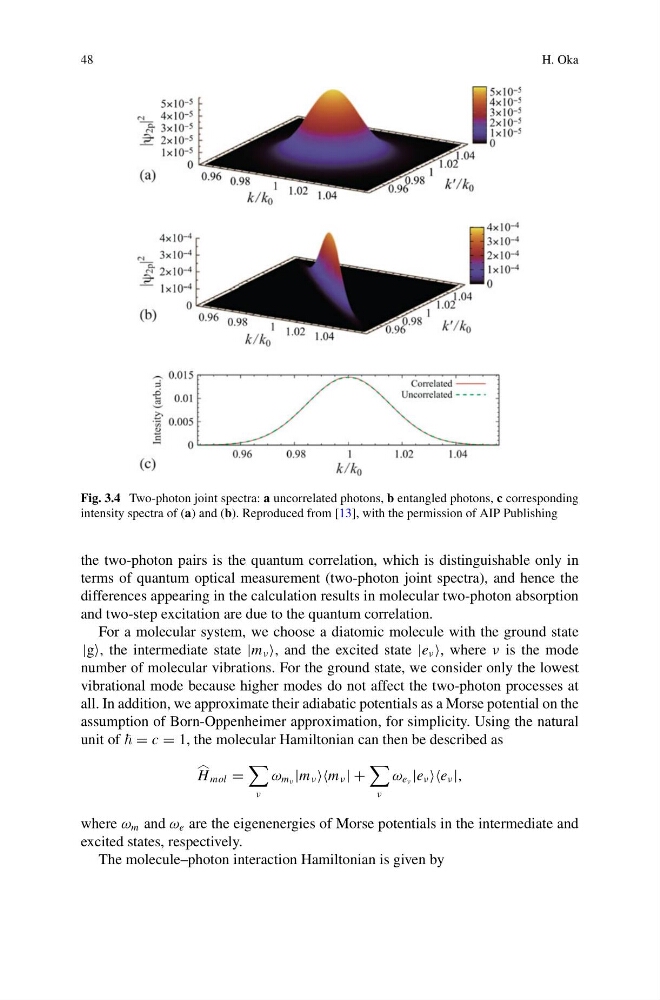
Fig. 3.4 Two-photon joint spectra: a uncorrelated photons, b entangled photons, c corresponding
intensity spectra of (a) and (b). Reproduced from [13], with the permission of AIP Publishing
the two-photon pairs is the quantum correlation, which is distinguishable only in
terms of quantum optical measurement (two-photon joint spectra), and hence the
differences appearing in the calculation results in molecular two-photon absorption
and two-step excitation are due to the quantum correlation.
For a molecular system, we choose a diatomic molecule with the ground state
|g, the intermediate state |m ν , and the excited state |e ν , where ν is the mode
number of molecular vibrations. For the ground state, we consider only the lowest
vibrational mode because higher modes do not affect the two-photon processes at
all. In addition, we approximate their adiabatic potentials as a Morse potential on the
assumption of Born-Oppenheimer approximation, for simplicity. Using the natural
unit of = c = 1, the molecular Hamiltonian can then be described as
H
mol =
ν
ω m ν |m ν m ν | +
ν
ω e ν |e ν e ν |,
where ω m and ω e are the eigenenergies of Morse potentials in the intermediate and
excited states, respectively.
The molecule–photon interaction Hamiltonian is given by
H. Oka
Fig. 3.4 Two-photon joint spectra: a uncorrelated photons, b entangled photons, c corresponding
intensity spectra of (a) and (b). Reproduced from [13], with the permission of AIP Publishing
the two-photon pairs is the quantum correlation, which is distinguishable only in
terms of quantum optical measurement (two-photon joint spectra), and hence the
differences appearing in the calculation results in molecular two-photon absorption
and two-step excitation are due to the quantum correlation.
For a molecular system, we choose a diatomic molecule with the ground state
|g, the intermediate state |m ν , and the excited state |e ν , where ν is the mode
number of molecular vibrations. For the ground state, we consider only the lowest
vibrational mode because higher modes do not affect the two-photon processes at
all. In addition, we approximate their adiabatic potentials as a Morse potential on the
assumption of Born-Oppenheimer approximation, for simplicity. Using the natural
unit of = c = 1, the molecular Hamiltonian can then be described as
H
mol =
ν
ω m ν |m ν m ν | +
ν
ω e ν |e ν e ν |,
where ω m and ω e are the eigenenergies of Morse potentials in the intermediate and
excited states, respectively.
The molecule–photon interaction Hamiltonian is given by