

31 Cooperative and Hierarchal Photoresponses of Molecular …
541
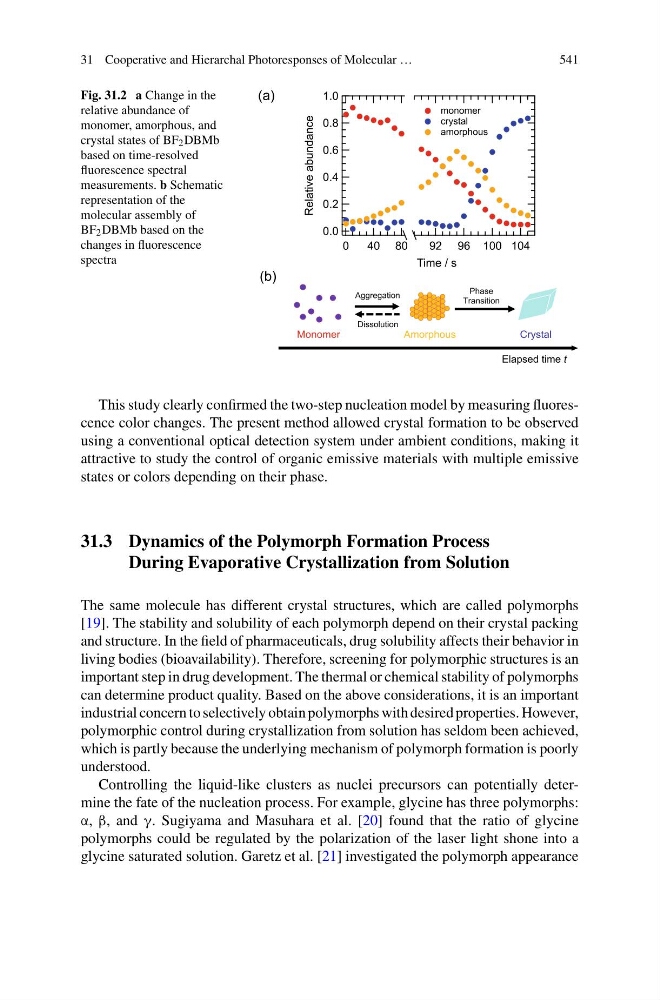
Fig. 31.2 a Change in the
relative abundance of
monomer, amorphous, and
crystal states of BF 2 DBMb
based on time-resolved
fluorescence spectral
measurements. b Schematic
representation of the
molecular assembly of
BF 2 DBMb based on the
changes in fluorescence
spectra
This study clearly confirmed the two-step nucleation model by measuring fluorescence color changes. The present method allowed crystal formation to be observed
using a conventional optical detection system under ambient conditions, making it
attractive to study the control of organic emissive materials with multiple emissive
states or colors depending on their phase.
31.3 Dynamics of the Polymorph Formation Process
During Evaporative Crystallization from Solution
The same molecule has different crystal structures, which are called polymorphs
[19]. The stability and solubility of each polymorph depend on their crystal packing
and structure. In the field of pharmaceuticals, drug solubility affects their behavior in
living bodies (bioavailability). Therefore, screening for polymorphic structures is an
important step in drug development. The thermal or chemical stability of polymorphs
can determine product quality. Based on the above considerations, it is an important
industrial concern to selectively obtain polymorphs with desired properties. However,
polymorphic control during crystallization from solution has seldom been achieved,
which is partly because the underlying mechanism of polymorph formation is poorly
understood.
Controlling the liquid-like clusters as nuclei precursors can potentially determine the fate of the nucleation process. For example, glycine has three polymorphs:
α, β, and γ. Sugiyama and Masuhara et al. [20] found that the ratio of glycine
polymorphs could be regulated by the polarization of the laser light shone into a
glycine saturated solution. Garetz et al. [21] investigated the polymorph appearance
541
Fig. 31.2 a Change in the
relative abundance of
monomer, amorphous, and
crystal states of BF 2 DBMb
based on time-resolved
fluorescence spectral
measurements. b Schematic
representation of the
molecular assembly of
BF 2 DBMb based on the
changes in fluorescence
spectra
This study clearly confirmed the two-step nucleation model by measuring fluorescence color changes. The present method allowed crystal formation to be observed
using a conventional optical detection system under ambient conditions, making it
attractive to study the control of organic emissive materials with multiple emissive
states or colors depending on their phase.
31.3 Dynamics of the Polymorph Formation Process
During Evaporative Crystallization from Solution
The same molecule has different crystal structures, which are called polymorphs
[19]. The stability and solubility of each polymorph depend on their crystal packing
and structure. In the field of pharmaceuticals, drug solubility affects their behavior in
living bodies (bioavailability). Therefore, screening for polymorphic structures is an
important step in drug development. The thermal or chemical stability of polymorphs
can determine product quality. Based on the above considerations, it is an important
industrial concern to selectively obtain polymorphs with desired properties. However,
polymorphic control during crystallization from solution has seldom been achieved,
which is partly because the underlying mechanism of polymorph formation is poorly
understood.
Controlling the liquid-like clusters as nuclei precursors can potentially determine the fate of the nucleation process. For example, glycine has three polymorphs:
α, β, and γ. Sugiyama and Masuhara et al. [20] found that the ratio of glycine
polymorphs could be regulated by the polarization of the laser light shone into a
glycine saturated solution. Garetz et al. [21] investigated the polymorph appearance