

540
F. Ito
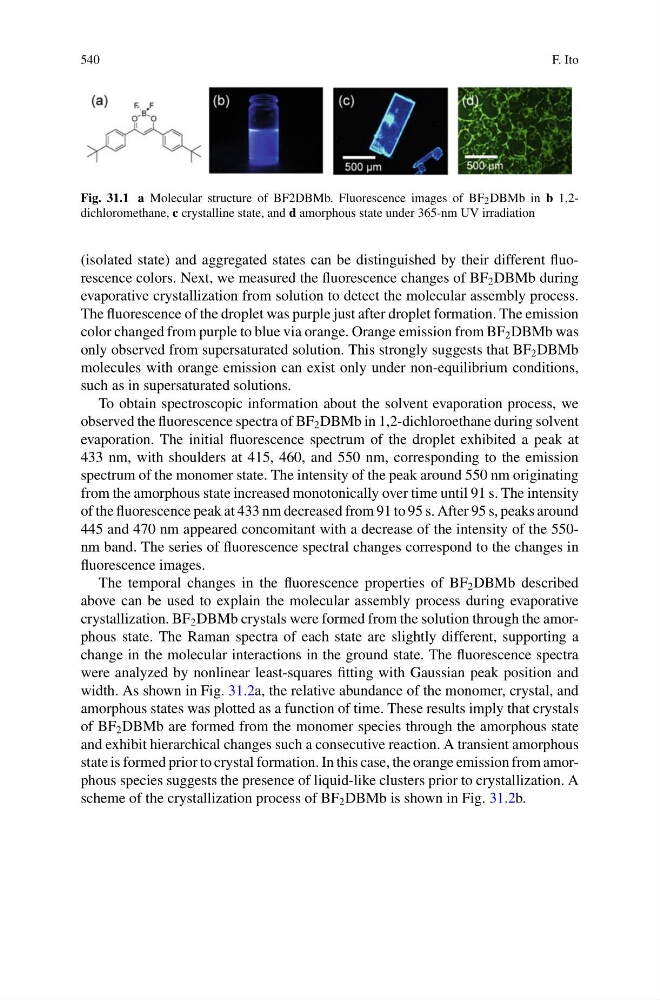
Fig. 31.1 a Molecular structure of BF2DBMb. Fluorescence images of BF 2 DBMb in b 1,2dichloromethane, c crystalline state, and d amorphous state under 365-nm UV irradiation
(isolated state) and aggregated states can be distinguished by their different fluorescence colors. Next, we measured the fluorescence changes of BF 2 DBMb during
evaporative crystallization from solution to detect the molecular assembly process.
The fluorescence of the droplet was purple just after droplet formation. The emission
color changed from purple to blue via orange. Orange emission from BF 2 DBMb was
only observed from supersaturated solution. This strongly suggests that BF 2 DBMb
molecules with orange emission can exist only under non-equilibrium conditions,
such as in supersaturated solutions.
To obtain spectroscopic information about the solvent evaporation process, we
observed the fluorescence spectra of BF 2 DBMb in 1,2-dichloroethane during solvent
evaporation. The initial fluorescence spectrum of the droplet exhibited a peak at
433 nm, with shoulders at 415, 460, and 550 nm, corresponding to the emission
spectrum of the monomer state. The intensity of the peak around 550 nm originating
from the amorphous state increased monotonically over time until 91 s. The intensity
of the fluorescence peak at 433 nm decreased from 91 to 95 s. After 95 s, peaks around
445 and 470 nm appeared concomitant with a decrease of the intensity of the 550nm band. The series of fluorescence spectral changes correspond to the changes in
fluorescence images.
The temporal changes in the fluorescence properties of BF 2 DBMb described
above can be used to explain the molecular assembly process during evaporative
crystallization. BF 2 DBMb crystals were formed from the solution through the amorphous state. The Raman spectra of each state are slightly different, supporting a
change in the molecular interactions in the ground state. The fluorescence spectra
were analyzed by nonlinear least-squares fitting with Gaussian peak position and
width. As shown in Fig. 31.2a, the relative abundance of the monomer, crystal, and
amorphous states was plotted as a function of time. These results imply that crystals
of BF 2 DBMb are formed from the monomer species through the amorphous state
and exhibit hierarchical changes such a consecutive reaction. A transient amorphous
state is formed prior to crystal formation. In this case, the orange emission from amorphous species suggests the presence of liquid-like clusters prior to crystallization. A
scheme of the crystallization process of BF 2 DBMb is shown in Fig. 31.2b.
F. Ito
Fig. 31.1 a Molecular structure of BF2DBMb. Fluorescence images of BF 2 DBMb in b 1,2dichloromethane, c crystalline state, and d amorphous state under 365-nm UV irradiation
(isolated state) and aggregated states can be distinguished by their different fluorescence colors. Next, we measured the fluorescence changes of BF 2 DBMb during
evaporative crystallization from solution to detect the molecular assembly process.
The fluorescence of the droplet was purple just after droplet formation. The emission
color changed from purple to blue via orange. Orange emission from BF 2 DBMb was
only observed from supersaturated solution. This strongly suggests that BF 2 DBMb
molecules with orange emission can exist only under non-equilibrium conditions,
such as in supersaturated solutions.
To obtain spectroscopic information about the solvent evaporation process, we
observed the fluorescence spectra of BF 2 DBMb in 1,2-dichloroethane during solvent
evaporation. The initial fluorescence spectrum of the droplet exhibited a peak at
433 nm, with shoulders at 415, 460, and 550 nm, corresponding to the emission
spectrum of the monomer state. The intensity of the peak around 550 nm originating
from the amorphous state increased monotonically over time until 91 s. The intensity
of the fluorescence peak at 433 nm decreased from 91 to 95 s. After 95 s, peaks around
445 and 470 nm appeared concomitant with a decrease of the intensity of the 550nm band. The series of fluorescence spectral changes correspond to the changes in
fluorescence images.
The temporal changes in the fluorescence properties of BF 2 DBMb described
above can be used to explain the molecular assembly process during evaporative
crystallization. BF 2 DBMb crystals were formed from the solution through the amorphous state. The Raman spectra of each state are slightly different, supporting a
change in the molecular interactions in the ground state. The fluorescence spectra
were analyzed by nonlinear least-squares fitting with Gaussian peak position and
width. As shown in Fig. 31.2a, the relative abundance of the monomer, crystal, and
amorphous states was plotted as a function of time. These results imply that crystals
of BF 2 DBMb are formed from the monomer species through the amorphous state
and exhibit hierarchical changes such a consecutive reaction. A transient amorphous
state is formed prior to crystal formation. In this case, the orange emission from amorphous species suggests the presence of liquid-like clusters prior to crystallization. A
scheme of the crystallization process of BF 2 DBMb is shown in Fig. 31.2b.