

498
Y. Ishibashi and T. Asahi
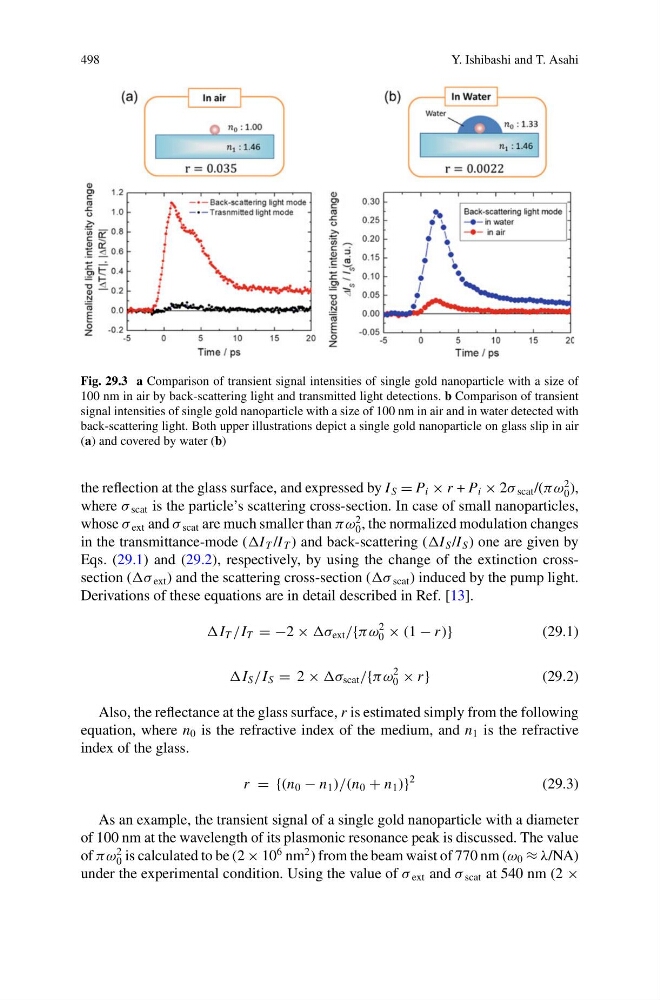
Fig. 29.3 a Comparison of transient signal intensities of single gold nanoparticle with a size of
100 nm in air by back-scattering light and transmitted light detections. b Comparison of transient
signal intensities of single gold nanoparticle with a size of 100 nm in air and in water detected with
back-scattering light. Both upper illustrations depict a single gold nanoparticle on glass slip in air
(a) and covered by water (b)
the reflection at the glass surface, and expressed by I S = P i × r + P i × 2σ scat /(πω
2
0 ),
where σ scat is the particle’s scattering cross-section. In case of small nanoparticles,
whose σ ext and σ scat are much smaller than πω
2
0 , the normalized modulation changes
in the transmittance-mode (I T /I T ) and back-scattering (I S /I S ) one are given by
Eqs. (29.1) and (29.2), respectively, by using the change of the extinction crosssection (σ ext ) and the scattering cross-section (σ scat ) induced by the pump light.
Derivations of these equations are in detail described in Ref. [13].
I T /I T = −2 × σ ext /{πω
2
0 × (1 − r )}
(29.1)
I S /I S = 2 × σ scat /{πω
2
0 × r }
(29.2)
Also, the reflectance at the glass surface, r is estimated simply from the following
equation, where n 0 is the refractive index of the medium, and n 1 is the refractive
index of the glass.
r = {(n 0 − n 1 )/(n 0 + n 1 )}
2
(29.3)
As an example, the transient signal of a single gold nanoparticle with a diameter
of 100 nm at the wavelength of its plasmonic resonance peak is discussed. The value
of πω
2
0 is calculated to be (2 × 10
6 nm
2 ) from the beam waist of 770 nm (ω 0 ≈ λ/NA)
under the experimental condition. Using the value of σ ext and σ scat at 540 nm (2 ×
Y. Ishibashi and T. Asahi
Fig. 29.3 a Comparison of transient signal intensities of single gold nanoparticle with a size of
100 nm in air by back-scattering light and transmitted light detections. b Comparison of transient
signal intensities of single gold nanoparticle with a size of 100 nm in air and in water detected with
back-scattering light. Both upper illustrations depict a single gold nanoparticle on glass slip in air
(a) and covered by water (b)
the reflection at the glass surface, and expressed by I S = P i × r + P i × 2σ scat /(πω
2
0 ),
where σ scat is the particle’s scattering cross-section. In case of small nanoparticles,
whose σ ext and σ scat are much smaller than πω
2
0 , the normalized modulation changes
in the transmittance-mode (I T /I T ) and back-scattering (I S /I S ) one are given by
Eqs. (29.1) and (29.2), respectively, by using the change of the extinction crosssection (σ ext ) and the scattering cross-section (σ scat ) induced by the pump light.
Derivations of these equations are in detail described in Ref. [13].
I T /I T = −2 × σ ext /{πω
2
0 × (1 − r )}
(29.1)
I S /I S = 2 × σ scat /{πω
2
0 × r }
(29.2)
Also, the reflectance at the glass surface, r is estimated simply from the following
equation, where n 0 is the refractive index of the medium, and n 1 is the refractive
index of the glass.
r = {(n 0 − n 1 )/(n 0 + n 1 )}
2
(29.3)
As an example, the transient signal of a single gold nanoparticle with a diameter
of 100 nm at the wavelength of its plasmonic resonance peak is discussed. The value
of πω
2
0 is calculated to be (2 × 10
6 nm
2 ) from the beam waist of 770 nm (ω 0 ≈ λ/NA)
under the experimental condition. Using the value of σ ext and σ scat at 540 nm (2 ×