

408
K. Uchida et al.
UV irradiation, 1o is converted to 1c. When the molar ratio of 1c exceeds 22%,
crystal of 1c with fibril structure grows on the film surface. The surface covered with
needle-shaped crystals of 1c showed superhydrophobicity on which contact angle
(CA) and sliding angle (SA) of a water droplet are 163° and 2°, respectively. They
are almost the same as those on natural lotus leaf. Therefore, photocontrol of the
superhydrophobicity (CA is larger than 150°) of the surface was achieved [3, 5, 6].
Such photoinduced topographical changes are observed for the other
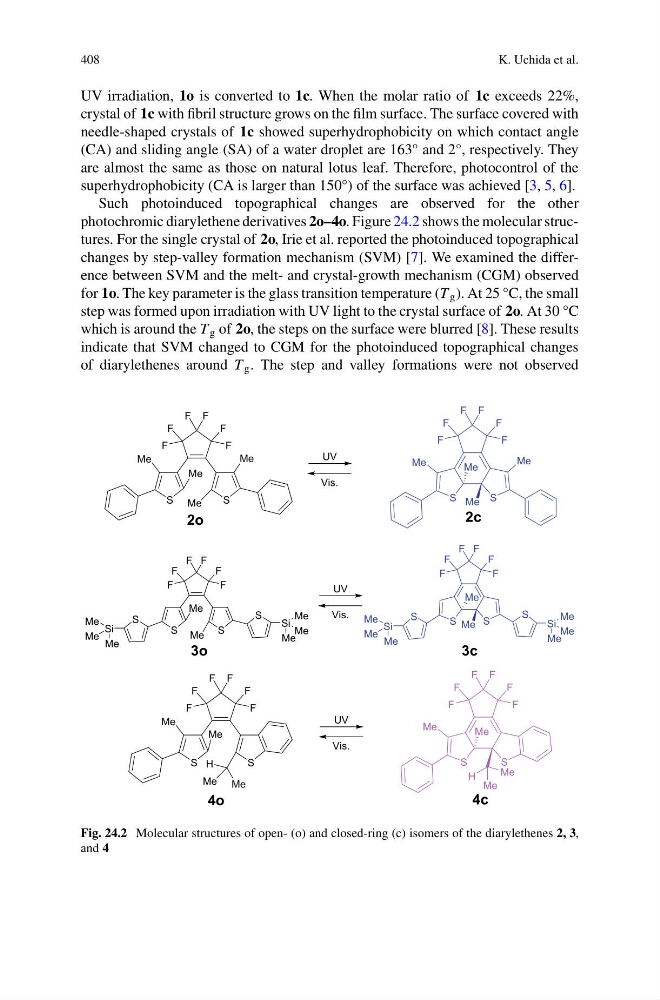
photochromic diarylethene derivatives 2o–4o. Figure 24.2 shows the molecular structures. For the single crystal of 2o, Irie et al. reported the photoinduced topographical
changes by step-valley formation mechanism (SVM) [7]. We examined the difference between SVM and the melt- and crystal-growth mechanism (CGM) observed
for 1o. The key parameter is the glass transition temperature (T g ). At 25 °C, the small
step was formed upon irradiation with UV light to the crystal surface of 2o. At 30 °C
which is around the T g of 2o, the steps on the surface were blurred [8]. These results
indicate that SVM changed to CGM for the photoinduced topographical changes
of diarylethenes around T g . The step and valley formations were not observed
S
S
S
S
F
F
F
F
F
F
F
F
F
F
F
F
S
S
F
F
F
F
F
F
S
S
F
F
F
F
F
F
S
S
F
F
F
F
F
F
S
S
F
F
F
F
F
F
Me
Me
Me
Me
Me
Me
Me
Me
Me
Me
Me
S
S
Si
Si
Me
Me
Me
Me
Me
Me
Me
Me
S
S
Si
Si
Me
Me
Me
Me
Me
Me
Me
Me
Me
Me
Me
Me
Me
H
H
UV
Vis.
UV
Vis.
UV
Vis.
2o
3o
4o
2c
3c
4c
Fig. 24.2 Molecular structures of open- (o) and closed-ring (c) isomers of the diarylethenes 2, 3,
and 4
K. Uchida et al.
UV irradiation, 1o is converted to 1c. When the molar ratio of 1c exceeds 22%,
crystal of 1c with fibril structure grows on the film surface. The surface covered with
needle-shaped crystals of 1c showed superhydrophobicity on which contact angle
(CA) and sliding angle (SA) of a water droplet are 163° and 2°, respectively. They
are almost the same as those on natural lotus leaf. Therefore, photocontrol of the
superhydrophobicity (CA is larger than 150°) of the surface was achieved [3, 5, 6].
Such photoinduced topographical changes are observed for the other
photochromic diarylethene derivatives 2o–4o. Figure 24.2 shows the molecular structures. For the single crystal of 2o, Irie et al. reported the photoinduced topographical
changes by step-valley formation mechanism (SVM) [7]. We examined the difference between SVM and the melt- and crystal-growth mechanism (CGM) observed
for 1o. The key parameter is the glass transition temperature (T g ). At 25 °C, the small
step was formed upon irradiation with UV light to the crystal surface of 2o. At 30 °C
which is around the T g of 2o, the steps on the surface were blurred [8]. These results
indicate that SVM changed to CGM for the photoinduced topographical changes
of diarylethenes around T g . The step and valley formations were not observed
S
S
S
S
F
F
F
F
F
F
F
F
F
F
F
F
S
S
F
F
F
F
F
F
S
S
F
F
F
F
F
F
S
S
F
F
F
F
F
F
S
S
F
F
F
F
F
F
Me
Me
Me
Me
Me
Me
Me
Me
Me
Me
Me
S
S
Si
Si
Me
Me
Me
Me
Me
Me
Me
Me
S
S
Si
Si
Me
Me
Me
Me
Me
Me
Me
Me
Me
Me
Me
Me
Me
H
H
UV
Vis.
UV
Vis.
UV
Vis.
2o
3o
4o
2c
3c
4c
Fig. 24.2 Molecular structures of open- (o) and closed-ring (c) isomers of the diarylethenes 2, 3,
and 4