

32
T. Yanai
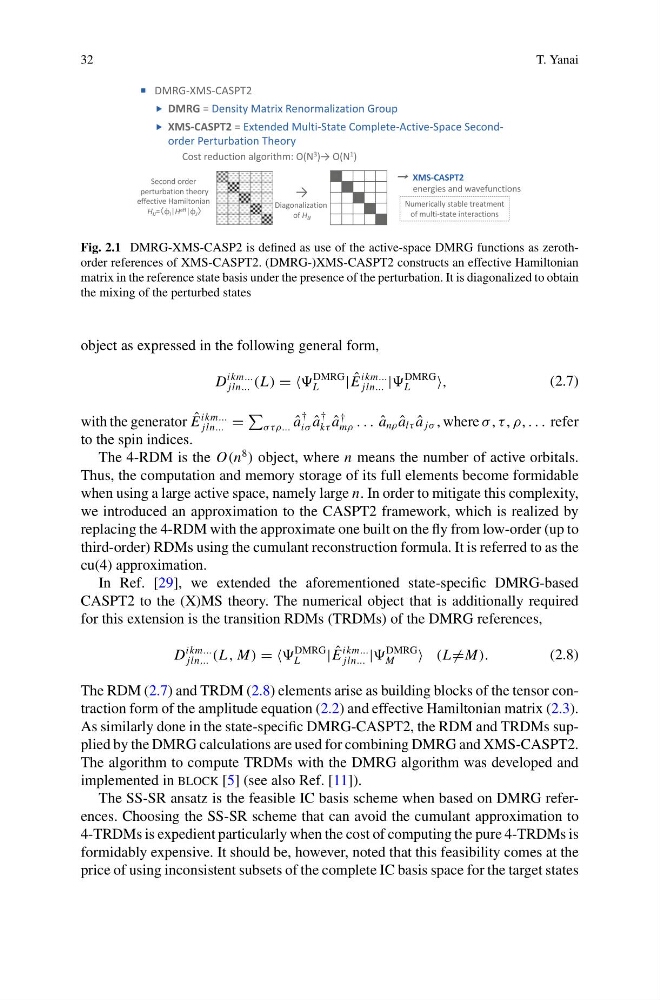
Fig. 2.1 DMRG-XMS-CASP2 is defined as use of the active-space DMRG functions as zerothorder references of XMS-CASPT2. (DMRG-)XMS-CASPT2 constructs an effective Hamiltonian
matrix in the reference state basis under the presence of the perturbation. It is diagonalized to obtain
the mixing of the perturbed states
object as expressed in the following general form,
D
ikm...
jln... (L) = =
DMRG
L
| ˆ
E
ikm...
jln... |
DMRG
L
,
(2.7)
with the generator ˆ
E
ikm...
jln... =
σ τρ... ˆ
a
†
iσ ˆ
a
†
kτ ˆ
a
†
mρ . . . ˆ
a nρ ˆ
a lτ ˆ
a jσ , where σ , τ , ρ, . . . refer
to the spin indices.
The 4-RDM is the O(n
8
) object, where n means the number of active orbitals.
Thus, the computation and memory storage of its full elements become formidable
when using a large active space, namely large n. In order to mitigate this complexity,
we introduced an approximation to the CASPT2 framework, which is realized by
replacing the 4-RDM with the approximate one built on the fly from low-order (up to
third-order) RDMs using the cumulant reconstruction formula. It is referred to as the
cu(4) approximation.
In Ref. [29], we extended the aforementioned state-specific DMRG-based
CASPT2 to the (X)MS theory. The numerical object that is additionally required
for this extension is the transition RDMs (TRDMs) of the DMRG references,
D
ikm...
jln... (L , M) = =
DMRG
L
| ˆ
E
ikm...
jln... |
DMRG
M
(L =M).
(2.8)
The RDM (2.7) and TRDM (2.8) elements arise as building blocks of the tensor contraction form of the amplitude equation (2.2) and effective Hamiltonian matrix (2.3).
As similarly done in the state-specific DMRG-CASPT2, the RDM and TRDMs supplied by the DMRG calculations are used for combining DMRG and XMS-CASPT2.
The algorithm to compute TRDMs with the DMRG algorithm was developed and
implemented in block [5] (see also Ref. [11]).
The SS-SR ansatz is the feasible IC basis scheme when based on DMRG references. Choosing the SS-SR scheme that can avoid the cumulant approximation to
4-TRDMs is expedient particularly when the cost of computing the pure 4-TRDMs is
formidably expensive. It should be, however, noted that this feasibility comes at the
price of using inconsistent subsets of the complete IC basis space for the target states
T. Yanai
Fig. 2.1 DMRG-XMS-CASP2 is defined as use of the active-space DMRG functions as zerothorder references of XMS-CASPT2. (DMRG-)XMS-CASPT2 constructs an effective Hamiltonian
matrix in the reference state basis under the presence of the perturbation. It is diagonalized to obtain
the mixing of the perturbed states
object as expressed in the following general form,
D
ikm...
jln... (L) = =
DMRG
L
| ˆ
E
ikm...
jln... |
DMRG
L
,
(2.7)
with the generator ˆ
E
ikm...
jln... =
σ τρ... ˆ
a
†
iσ ˆ
a
†
kτ ˆ
a
†
mρ . . . ˆ
a nρ ˆ
a lτ ˆ
a jσ , where σ , τ , ρ, . . . refer
to the spin indices.
The 4-RDM is the O(n
8
) object, where n means the number of active orbitals.
Thus, the computation and memory storage of its full elements become formidable
when using a large active space, namely large n. In order to mitigate this complexity,
we introduced an approximation to the CASPT2 framework, which is realized by
replacing the 4-RDM with the approximate one built on the fly from low-order (up to
third-order) RDMs using the cumulant reconstruction formula. It is referred to as the
cu(4) approximation.
In Ref. [29], we extended the aforementioned state-specific DMRG-based
CASPT2 to the (X)MS theory. The numerical object that is additionally required
for this extension is the transition RDMs (TRDMs) of the DMRG references,
D
ikm...
jln... (L , M) = =
DMRG
L
| ˆ
E
ikm...
jln... |
DMRG
M
(L =M).
(2.8)
The RDM (2.7) and TRDM (2.8) elements arise as building blocks of the tensor contraction form of the amplitude equation (2.2) and effective Hamiltonian matrix (2.3).
As similarly done in the state-specific DMRG-CASPT2, the RDM and TRDMs supplied by the DMRG calculations are used for combining DMRG and XMS-CASPT2.
The algorithm to compute TRDMs with the DMRG algorithm was developed and
implemented in block [5] (see also Ref. [11]).
The SS-SR ansatz is the feasible IC basis scheme when based on DMRG references. Choosing the SS-SR scheme that can avoid the cumulant approximation to
4-TRDMs is expedient particularly when the cost of computing the pure 4-TRDMs is
formidably expensive. It should be, however, noted that this feasibility comes at the
price of using inconsistent subsets of the complete IC basis space for the target states