

2 Advanced Electronic Structure Theory for High-Accuracy …
31
|
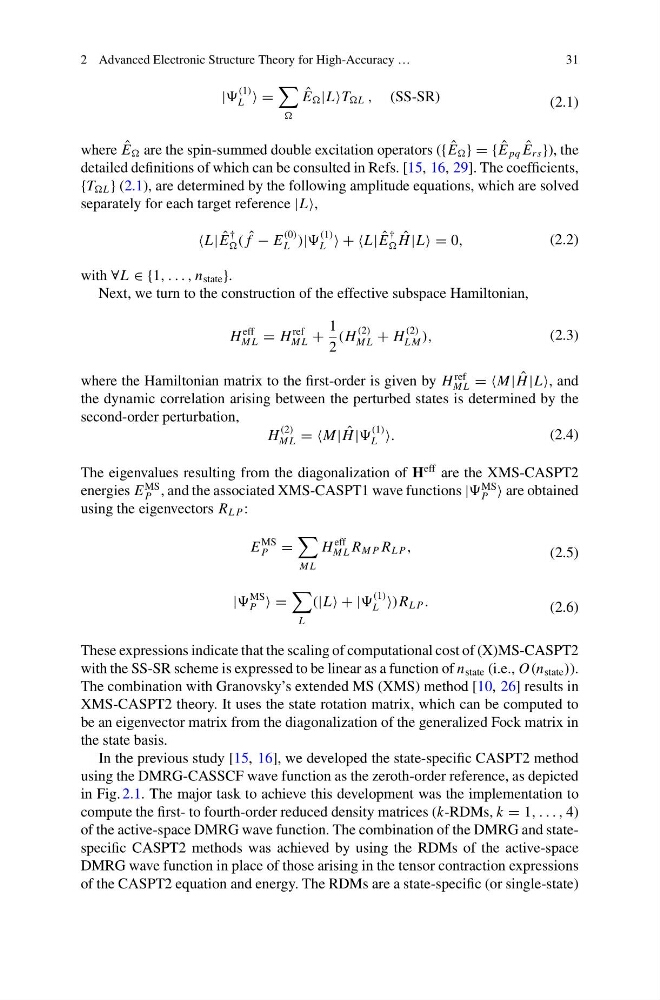
(1)
L =
ˆ
E |LT L , (SS-SR)
(2.1)
where ˆ
E are the spin-summed double excitation operators ({ ˆ
E } = { ˆ
E pq ˆ
E rs }), the
detailed definitions of which can be consulted in Refs. [15, 16, 29]. The coefficients,
{T L } (2.1), are determined by the following amplitude equations, which are solved
separately for each target reference |L,
L| ˆ
E
†
( ˆ
f − E
(0)
L )|
(1)
L + +L| ˆ
E
†
ˆ
H |L = 0,
(2.2)
with ∀L ∈ {1, . . . , n state }.
Next, we turn to the construction of the effective subspace Hamiltonian,
H
eff
M L = H
ref
M L +
1
2
(H
(2)
M L + H
(2)
L M ),
(2.3)
where the Hamiltonian matrix to the first-order is given by H
ref
M L = =M| ˆ
H |L, and
the dynamic correlation arising between the perturbed states is determined by the
second-order perturbation,
H
(2)
M L = =M| ˆ
H |
(1)
L .
(2.4)
The eigenvalues resulting from the diagonalization of H
eff are the XMS-CASPT2
energies E
MS
P , and the associated XMS-CASPT1 wave functions |
MS
P are obtained
using the eigenvectors R L P :
E
MS
P =
M L
H
eff
M L R M P R L P ,
(2.5)
|
MS
P =
L
(|L + |
(1)
L )R L P .
(2.6)
These expressions indicate that the scaling of computational cost of (X)MS-CASPT2
with the SS-SR scheme is expressed to be linear as a function of n state (i.e., O(n state )).
The combination with Granovsky’s extended MS (XMS) method [10, 26] results in
XMS-CASPT2 theory. It uses the state rotation matrix, which can be computed to
be an eigenvector matrix from the diagonalization of the generalized Fock matrix in
the state basis.
In the previous study [15, 16], we developed the state-specific CASPT2 method
using the DMRG-CASSCF wave function as the zeroth-order reference, as depicted
in Fig. 2.1. The major task to achieve this development was the implementation to
compute the first- to fourth-order reduced density matrices (k-RDMs, k = 1, . . . , 4)
of the active-space DMRG wave function. The combination of the DMRG and statespecific CASPT2 methods was achieved by using the RDMs of the active-space
DMRG wave function in place of those arising in the tensor contraction expressions
of the CASPT2 equation and energy. The RDMs are a state-specific (or single-state)
31
|
(1)
L =
ˆ
E |LT L , (SS-SR)
(2.1)
where ˆ
E are the spin-summed double excitation operators ({ ˆ
E } = { ˆ
E pq ˆ
E rs }), the
detailed definitions of which can be consulted in Refs. [15, 16, 29]. The coefficients,
{T L } (2.1), are determined by the following amplitude equations, which are solved
separately for each target reference |L,
L| ˆ
E
†
( ˆ
f − E
(0)
L )|
(1)
L + +L| ˆ
E
†
ˆ
H |L = 0,
(2.2)
with ∀L ∈ {1, . . . , n state }.
Next, we turn to the construction of the effective subspace Hamiltonian,
H
eff
M L = H
ref
M L +
1
2
(H
(2)
M L + H
(2)
L M ),
(2.3)
where the Hamiltonian matrix to the first-order is given by H
ref
M L = =M| ˆ
H |L, and
the dynamic correlation arising between the perturbed states is determined by the
second-order perturbation,
H
(2)
M L = =M| ˆ
H |
(1)
L .
(2.4)
The eigenvalues resulting from the diagonalization of H
eff are the XMS-CASPT2
energies E
MS
P , and the associated XMS-CASPT1 wave functions |
MS
P are obtained
using the eigenvectors R L P :
E
MS
P =
M L
H
eff
M L R M P R L P ,
(2.5)
|
MS
P =
L
(|L + |
(1)
L )R L P .
(2.6)
These expressions indicate that the scaling of computational cost of (X)MS-CASPT2
with the SS-SR scheme is expressed to be linear as a function of n state (i.e., O(n state )).
The combination with Granovsky’s extended MS (XMS) method [10, 26] results in
XMS-CASPT2 theory. It uses the state rotation matrix, which can be computed to
be an eigenvector matrix from the diagonalization of the generalized Fock matrix in
the state basis.
In the previous study [15, 16], we developed the state-specific CASPT2 method
using the DMRG-CASSCF wave function as the zeroth-order reference, as depicted
in Fig. 2.1. The major task to achieve this development was the implementation to
compute the first- to fourth-order reduced density matrices (k-RDMs, k = 1, . . . , 4)
of the active-space DMRG wave function. The combination of the DMRG and statespecific CASPT2 methods was achieved by using the RDMs of the active-space
DMRG wave function in place of those arising in the tensor contraction expressions
of the CASPT2 equation and energy. The RDMs are a state-specific (or single-state)