

394
T. Dewa et al.
also assignable to this pathway. The time constant of 23 ps is ascribed to the direct
energy transfer of A647 → B850. Considering the position of A647s attached to
LH2α-polypeptide, those attached to N- and C-terminal regions, where B800 and
B850 are, respectively, in the vicinity, should be responsible for the faster and slower
transfer pathways. The longest time constant of 1.2 ns corresponds to the lifetime of
A647 and B850.
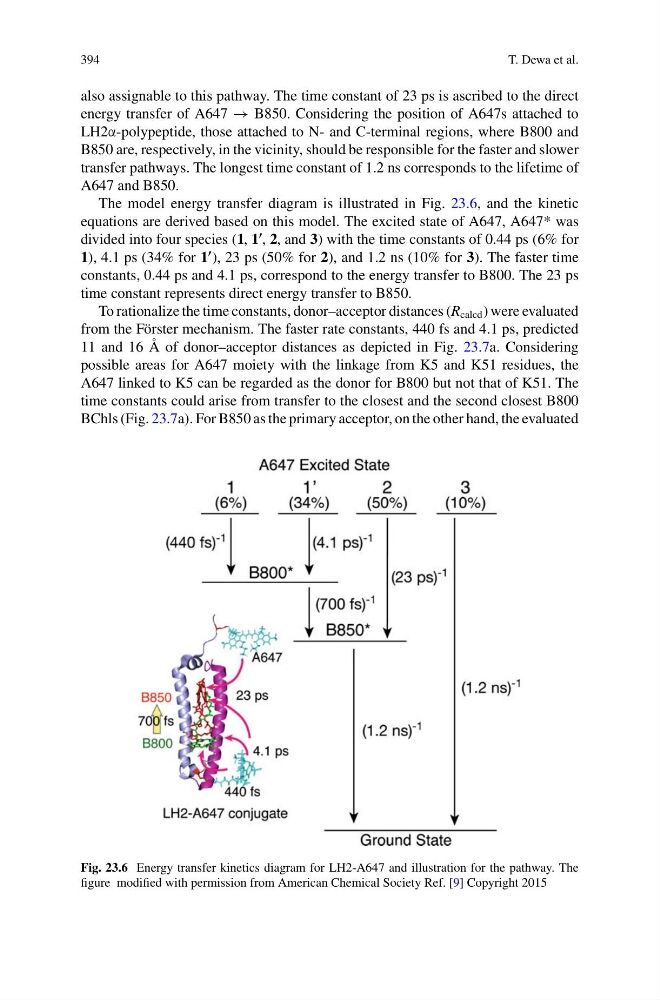
The model energy transfer diagram is illustrated in Fig. 23.6, and the kinetic
equations are derived based on this model. The excited state of A647, A647* was
divided into four species (1, 1
, 2, and 3) with the time constants of 0.44 ps (6% for
1), 4.1 ps (34% for 1
), 23 ps (50% for 2), and 1.2 ns (10% for 3). The faster time
constants, 0.44 ps and 4.1 ps, correspond to the energy transfer to B800. The 23 ps
time constant represents direct energy transfer to B850.
To rationalize the time constants, donor–acceptor distances (R calcd ) were evaluated
from the Förster mechanism. The faster rate constants, 440 fs and 4.1 ps, predicted
11 and 16 Å of donor–acceptor distances as depicted in Fig. 23.7a. Considering
possible areas for A647 moiety with the linkage from K5 and K51 residues, the
A647 linked to K5 can be regarded as the donor for B800 but not that of K51. The
time constants could arise from transfer to the closest and the second closest B800
BChls (Fig. 23.7a). For B850 as the primary acceptor, on the other hand, the evaluated
Fig. 23.6 Energy transfer kinetics diagram for LH2-A647 and illustration for the pathway. The
figure modified with permission from American Chemical Society Ref. [9] Copyright 2015
T. Dewa et al.
also assignable to this pathway. The time constant of 23 ps is ascribed to the direct
energy transfer of A647 → B850. Considering the position of A647s attached to
LH2α-polypeptide, those attached to N- and C-terminal regions, where B800 and
B850 are, respectively, in the vicinity, should be responsible for the faster and slower
transfer pathways. The longest time constant of 1.2 ns corresponds to the lifetime of
A647 and B850.
The model energy transfer diagram is illustrated in Fig. 23.6, and the kinetic
equations are derived based on this model. The excited state of A647, A647* was
divided into four species (1, 1
, 2, and 3) with the time constants of 0.44 ps (6% for
1), 4.1 ps (34% for 1
), 23 ps (50% for 2), and 1.2 ns (10% for 3). The faster time
constants, 0.44 ps and 4.1 ps, correspond to the energy transfer to B800. The 23 ps
time constant represents direct energy transfer to B850.
To rationalize the time constants, donor–acceptor distances (R calcd ) were evaluated
from the Förster mechanism. The faster rate constants, 440 fs and 4.1 ps, predicted
11 and 16 Å of donor–acceptor distances as depicted in Fig. 23.7a. Considering
possible areas for A647 moiety with the linkage from K5 and K51 residues, the
A647 linked to K5 can be regarded as the donor for B800 but not that of K51. The
time constants could arise from transfer to the closest and the second closest B800
BChls (Fig. 23.7a). For B850 as the primary acceptor, on the other hand, the evaluated
Fig. 23.6 Energy transfer kinetics diagram for LH2-A647 and illustration for the pathway. The
figure modified with permission from American Chemical Society Ref. [9] Copyright 2015