

23 Ultrafast Energy Transfer of Biohybrid Photosynthetic Antenna …
393
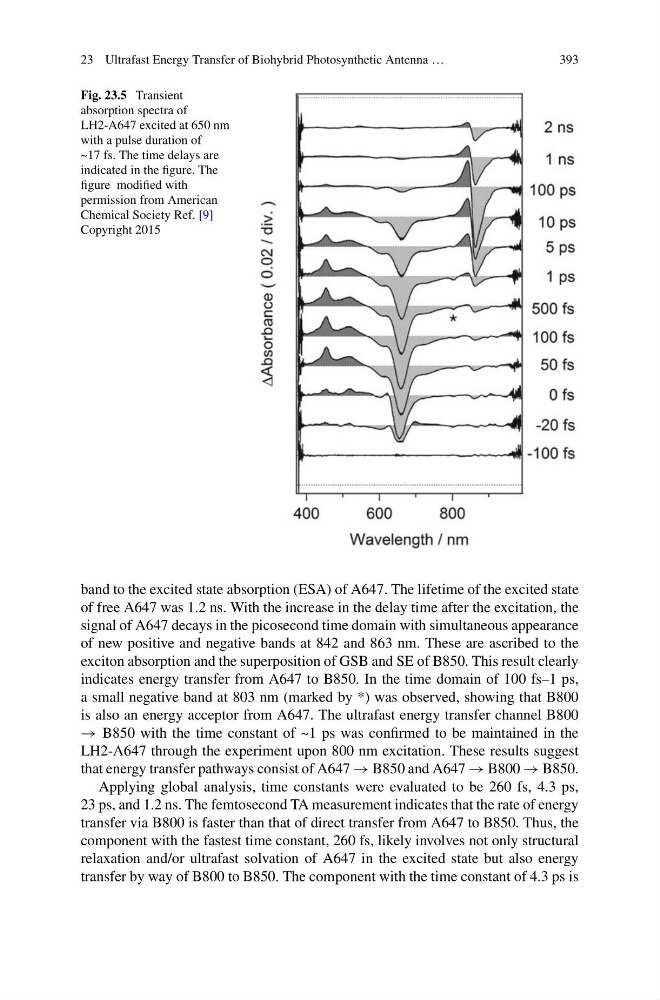
Fig. 23.5 Transient
absorption spectra of
LH2-A647 excited at 650 nm
with a pulse duration of
~17 fs. The time delays are
indicated in the figure. The
figure modified with
permission from American
Chemical Society Ref. [9]
Copyright 2015
band to the excited state absorption (ESA) of A647. The lifetime of the excited state
of free A647 was 1.2 ns. With the increase in the delay time after the excitation, the
signal of A647 decays in the picosecond time domain with simultaneous appearance
of new positive and negative bands at 842 and 863 nm. These are ascribed to the
exciton absorption and the superposition of GSB and SE of B850. This result clearly
indicates energy transfer from A647 to B850. In the time domain of 100 fs–1 ps,
a small negative band at 803 nm (marked by *) was observed, showing that B800
is also an energy acceptor from A647. The ultrafast energy transfer channel B800
→ B850 with the time constant of ~1 ps was confirmed to be maintained in the
LH2-A647 through the experiment upon 800 nm excitation. These results suggest
that energy transfer pathways consist of A647 → B850 and A647 → B800 → B850.
Applying global analysis, time constants were evaluated to be 260 fs, 4.3 ps,
23 ps, and 1.2 ns. The femtosecond TA measurement indicates that the rate of energy
transfer via B800 is faster than that of direct transfer from A647 to B850. Thus, the
component with the fastest time constant, 260 fs, likely involves not only structural
relaxation and/or ultrafast solvation of A647 in the excited state but also energy
transfer by way of B800 to B850. The component with the time constant of 4.3 ps is
393
Fig. 23.5 Transient
absorption spectra of
LH2-A647 excited at 650 nm
with a pulse duration of
~17 fs. The time delays are
indicated in the figure. The
figure modified with
permission from American
Chemical Society Ref. [9]
Copyright 2015
band to the excited state absorption (ESA) of A647. The lifetime of the excited state
of free A647 was 1.2 ns. With the increase in the delay time after the excitation, the
signal of A647 decays in the picosecond time domain with simultaneous appearance
of new positive and negative bands at 842 and 863 nm. These are ascribed to the
exciton absorption and the superposition of GSB and SE of B850. This result clearly
indicates energy transfer from A647 to B850. In the time domain of 100 fs–1 ps,
a small negative band at 803 nm (marked by *) was observed, showing that B800
is also an energy acceptor from A647. The ultrafast energy transfer channel B800
→ B850 with the time constant of ~1 ps was confirmed to be maintained in the
LH2-A647 through the experiment upon 800 nm excitation. These results suggest
that energy transfer pathways consist of A647 → B850 and A647 → B800 → B850.
Applying global analysis, time constants were evaluated to be 260 fs, 4.3 ps,
23 ps, and 1.2 ns. The femtosecond TA measurement indicates that the rate of energy
transfer via B800 is faster than that of direct transfer from A647 to B850. Thus, the
component with the fastest time constant, 260 fs, likely involves not only structural
relaxation and/or ultrafast solvation of A647 in the excited state but also energy
transfer by way of B800 to B850. The component with the time constant of 4.3 ps is