

23 Ultrafast Energy Transfer of Biohybrid Photosynthetic Antenna …
391
23.2 Strategy of Conjugation of Fluorescent Dye to LH2
We chose two types of LH2; one is LH2 from Rps. acidophila strain 10050 and the
other is the engineered LH2 bearing Cys as reactive site on the N-terminal region of
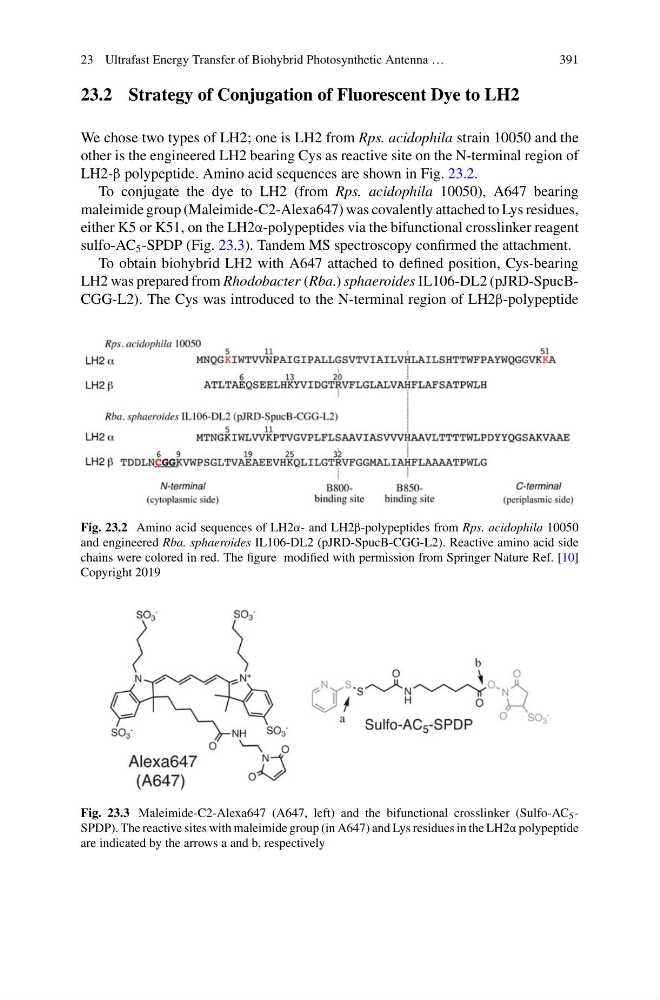
LH2-β polypeptide. Amino acid sequences are shown in Fig. 23.2.
To conjugate the dye to LH2 (from Rps. acidophila 10050), A647 bearing
maleimide group (Maleimide-C2-Alexa647) was covalently attached to Lys residues,
either K5 or K51, on the LH2α-polypeptides via the bifunctional crosslinker reagent
sulfo-AC 5 -SPDP (Fig. 23.3). Tandem MS spectroscopy confirmed the attachment.
To obtain biohybrid LH2 with A647 attached to defined position, Cys-bearing
LH2 was prepared from Rhodobacter (Rba.) sphaeroides IL106-DL2 (pJRD-SpucBCGG-L2). The Cys was introduced to the N-terminal region of LH2β-polypeptide
Fig. 23.2 Amino acid sequences of LH2α- and LH2β-polypeptides from Rps. acidophila 10050
and engineered Rba. sphaeroides IL106-DL2 (pJRD-SpucB-CGG-L2). Reactive amino acid side
chains were colored in red. The figure modified with permission from Springer Nature Ref. [10]
Copyright 2019
Fig. 23.3 Maleimide-C2-Alexa647 (A647, left) and the bifunctional crosslinker (Sulfo-AC 5 -
SPDP). The reactive sites with maleimide group (in A647) and Lys residues in the LH2α polypeptide
are indicated by the arrows a and b, respectively
391
23.2 Strategy of Conjugation of Fluorescent Dye to LH2
We chose two types of LH2; one is LH2 from Rps. acidophila strain 10050 and the
other is the engineered LH2 bearing Cys as reactive site on the N-terminal region of
LH2-β polypeptide. Amino acid sequences are shown in Fig. 23.2.
To conjugate the dye to LH2 (from Rps. acidophila 10050), A647 bearing
maleimide group (Maleimide-C2-Alexa647) was covalently attached to Lys residues,
either K5 or K51, on the LH2α-polypeptides via the bifunctional crosslinker reagent
sulfo-AC 5 -SPDP (Fig. 23.3). Tandem MS spectroscopy confirmed the attachment.
To obtain biohybrid LH2 with A647 attached to defined position, Cys-bearing
LH2 was prepared from Rhodobacter (Rba.) sphaeroides IL106-DL2 (pJRD-SpucBCGG-L2). The Cys was introduced to the N-terminal region of LH2β-polypeptide
Fig. 23.2 Amino acid sequences of LH2α- and LH2β-polypeptides from Rps. acidophila 10050
and engineered Rba. sphaeroides IL106-DL2 (pJRD-SpucB-CGG-L2). Reactive amino acid side
chains were colored in red. The figure modified with permission from Springer Nature Ref. [10]
Copyright 2019
Fig. 23.3 Maleimide-C2-Alexa647 (A647, left) and the bifunctional crosslinker (Sulfo-AC 5 -
SPDP). The reactive sites with maleimide group (in A647) and Lys residues in the LH2α polypeptide
are indicated by the arrows a and b, respectively