

390
T. Dewa et al.
23.1 Introduction
Enhancing the light-harvesting potential of antenna components in a system of solar
energy conversion is an important topic in the field of artificial photosynthesis [1].
For the purpose of energy conversion, the essence of light-harvesting strategy is (1)
use of multiple chromophores to absorb photons in the broad solar spectrum and (2)
to transfer excitation energy between the chromophores within subpico–few picoseconds to a photocatalytic component [2]. Photosynthetic organisms have diverse
light-harvesting antenna systems that have been developed to adapt to their habitats
with different or variable intensities and colors of light [3–5]. Such photosynthetic
antennae are based on the strategy (1) and (2).
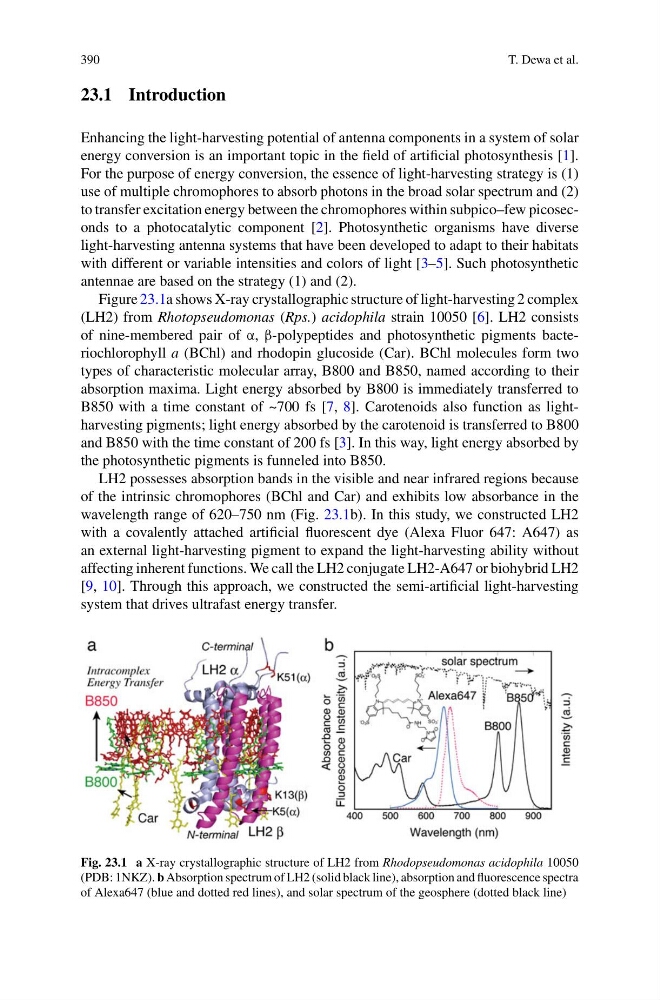
Figure 23.1a shows X-ray crystallographic structure of light-harvesting 2 complex
(LH2) from Rhotopseudomonas (Rps.) acidophila strain 10050 [6]. LH2 consists
of nine-membered pair of α, β-polypeptides and photosynthetic pigments bacteriochlorophyll a (BChl) and rhodopin glucoside (Car). BChl molecules form two
types of characteristic molecular array, B800 and B850, named according to their
absorption maxima. Light energy absorbed by B800 is immediately transferred to
B850 with a time constant of ~700 fs [7, 8]. Carotenoids also function as lightharvesting pigments; light energy absorbed by the carotenoid is transferred to B800
and B850 with the time constant of 200 fs [3]. In this way, light energy absorbed by
the photosynthetic pigments is funneled into B850.
LH2 possesses absorption bands in the visible and near infrared regions because
of the intrinsic chromophores (BChl and Car) and exhibits low absorbance in the
wavelength range of 620–750 nm (Fig. 23.1b). In this study, we constructed LH2
with a covalently attached artificial fluorescent dye (Alexa Fluor 647: A647) as
an external light-harvesting pigment to expand the light-harvesting ability without
affecting inherent functions. We call the LH2 conjugate LH2-A647 or biohybrid LH2
[9, 10]. Through this approach, we constructed the semi-artificial light-harvesting
system that drives ultrafast energy transfer.
Fig. 23.1 a X-ray crystallographic structure of LH2 from Rhodopseudomonas acidophila 10050
(PDB: 1NKZ). b Absorption spectrum of LH2 (solid black line), absorption and fluorescence spectra
of Alexa647 (blue and dotted red lines), and solar spectrum of the geosphere (dotted black line)
T. Dewa et al.
23.1 Introduction
Enhancing the light-harvesting potential of antenna components in a system of solar
energy conversion is an important topic in the field of artificial photosynthesis [1].
For the purpose of energy conversion, the essence of light-harvesting strategy is (1)
use of multiple chromophores to absorb photons in the broad solar spectrum and (2)
to transfer excitation energy between the chromophores within subpico–few picoseconds to a photocatalytic component [2]. Photosynthetic organisms have diverse
light-harvesting antenna systems that have been developed to adapt to their habitats
with different or variable intensities and colors of light [3–5]. Such photosynthetic
antennae are based on the strategy (1) and (2).
Figure 23.1a shows X-ray crystallographic structure of light-harvesting 2 complex
(LH2) from Rhotopseudomonas (Rps.) acidophila strain 10050 [6]. LH2 consists
of nine-membered pair of α, β-polypeptides and photosynthetic pigments bacteriochlorophyll a (BChl) and rhodopin glucoside (Car). BChl molecules form two
types of characteristic molecular array, B800 and B850, named according to their
absorption maxima. Light energy absorbed by B800 is immediately transferred to
B850 with a time constant of ~700 fs [7, 8]. Carotenoids also function as lightharvesting pigments; light energy absorbed by the carotenoid is transferred to B800
and B850 with the time constant of 200 fs [3]. In this way, light energy absorbed by
the photosynthetic pigments is funneled into B850.
LH2 possesses absorption bands in the visible and near infrared regions because
of the intrinsic chromophores (BChl and Car) and exhibits low absorbance in the
wavelength range of 620–750 nm (Fig. 23.1b). In this study, we constructed LH2
with a covalently attached artificial fluorescent dye (Alexa Fluor 647: A647) as
an external light-harvesting pigment to expand the light-harvesting ability without
affecting inherent functions. We call the LH2 conjugate LH2-A647 or biohybrid LH2
[9, 10]. Through this approach, we constructed the semi-artificial light-harvesting
system that drives ultrafast energy transfer.
Fig. 23.1 a X-ray crystallographic structure of LH2 from Rhodopseudomonas acidophila 10050
(PDB: 1NKZ). b Absorption spectrum of LH2 (solid black line), absorption and fluorescence spectra
of Alexa647 (blue and dotted red lines), and solar spectrum of the geosphere (dotted black line)