

20 Functional Photoactive Materials Based on Flexible π Molecules
357
Columnar liquid crystal
Isotropic liquid
Heat
160°C
UV (365 nm)
Destabilized packing
Spontaneous
disorganization
70–135°C
(a)
(b)
(c)
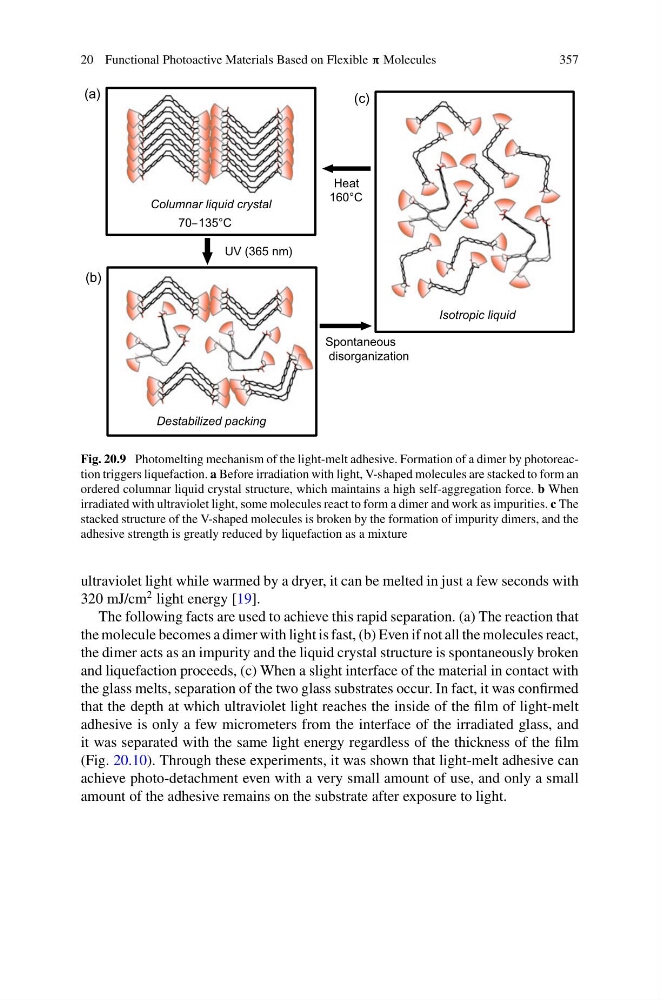
Fig. 20.9 Photomelting mechanism of the light-melt adhesive. Formation of a dimer by photoreaction triggers liquefaction. a Before irradiation with light, V-shaped molecules are stacked to form an
ordered columnar liquid crystal structure, which maintains a high self-aggregation force. b When
irradiated with ultraviolet light, some molecules react to form a dimer and work as impurities. c The
stacked structure of the V-shaped molecules is broken by the formation of impurity dimers, and the
adhesive strength is greatly reduced by liquefaction as a mixture
ultraviolet light while warmed by a dryer, it can be melted in just a few seconds with
320 mJ/cm
2 light energy [19].
The following facts are used to achieve this rapid separation. (a) The reaction that
the molecule becomes a dimer with light is fast, (b) Even if not all the molecules react,
the dimer acts as an impurity and the liquid crystal structure is spontaneously broken
and liquefaction proceeds, (c) When a slight interface of the material in contact with
the glass melts, separation of the two glass substrates occur. In fact, it was confirmed
that the depth at which ultraviolet light reaches the inside of the film of light-melt
adhesive is only a few micrometers from the interface of the irradiated glass, and
it was separated with the same light energy regardless of the thickness of the film
(Fig. 20.10). Through these experiments, it was shown that light-melt adhesive can
achieve photo-detachment even with a very small amount of use, and only a small
amount of the adhesive remains on the substrate after exposure to light.
357
Columnar liquid crystal
Isotropic liquid
Heat
160°C
UV (365 nm)
Destabilized packing
Spontaneous
disorganization
70–135°C
(a)
(b)
(c)
Fig. 20.9 Photomelting mechanism of the light-melt adhesive. Formation of a dimer by photoreaction triggers liquefaction. a Before irradiation with light, V-shaped molecules are stacked to form an
ordered columnar liquid crystal structure, which maintains a high self-aggregation force. b When
irradiated with ultraviolet light, some molecules react to form a dimer and work as impurities. c The
stacked structure of the V-shaped molecules is broken by the formation of impurity dimers, and the
adhesive strength is greatly reduced by liquefaction as a mixture
ultraviolet light while warmed by a dryer, it can be melted in just a few seconds with
320 mJ/cm
2 light energy [19].
The following facts are used to achieve this rapid separation. (a) The reaction that
the molecule becomes a dimer with light is fast, (b) Even if not all the molecules react,
the dimer acts as an impurity and the liquid crystal structure is spontaneously broken
and liquefaction proceeds, (c) When a slight interface of the material in contact with
the glass melts, separation of the two glass substrates occur. In fact, it was confirmed
that the depth at which ultraviolet light reaches the inside of the film of light-melt
adhesive is only a few micrometers from the interface of the irradiated glass, and
it was separated with the same light energy regardless of the thickness of the film
(Fig. 20.10). Through these experiments, it was shown that light-melt adhesive can
achieve photo-detachment even with a very small amount of use, and only a small
amount of the adhesive remains on the substrate after exposure to light.