

19 Photoinduced Morphological Transformation and Photodriven …
345
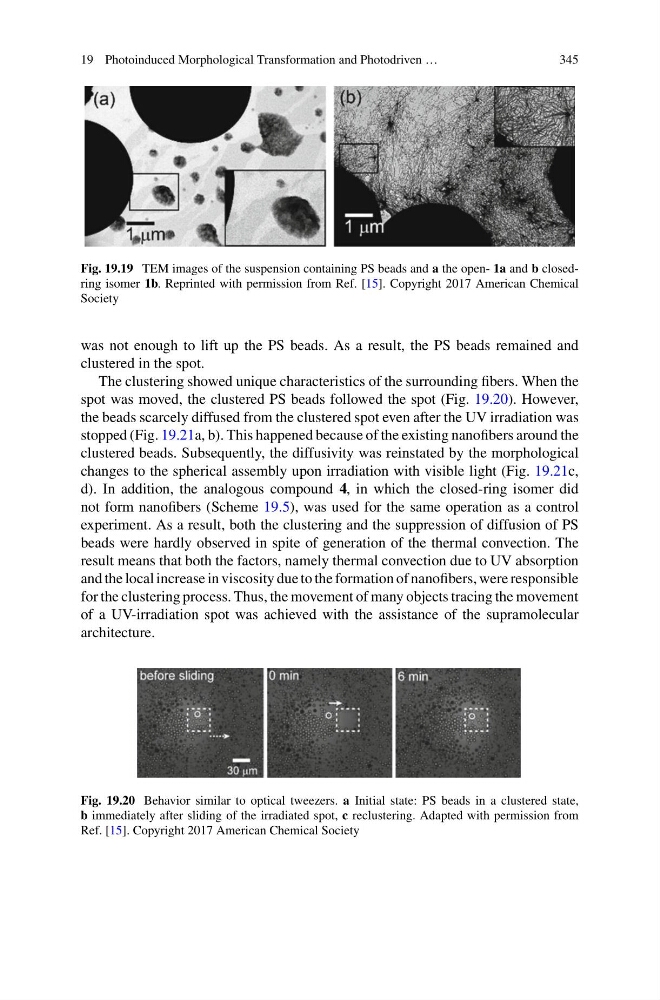
Fig. 19.19 TEM images of the suspension containing PS beads and a the open- 1a and b closedring isomer 1b. Reprinted with permission from Ref. [15]. Copyright 2017 American Chemical
Society
was not enough to lift up the PS beads. As a result, the PS beads remained and
clustered in the spot.
The clustering showed unique characteristics of the surrounding fibers. When the
spot was moved, the clustered PS beads followed the spot (Fig. 19.20). However,
the beads scarcely diffused from the clustered spot even after the UV irradiation was
stopped (Fig. 19.21a, b). This happened because of the existing nanofibers around the
clustered beads. Subsequently, the diffusivity was reinstated by the morphological
changes to the spherical assembly upon irradiation with visible light (Fig. 19.21c,
d). In addition, the analogous compound 4, in which the closed-ring isomer did
not form nanofibers (Scheme 19.5), was used for the same operation as a control
experiment. As a result, both the clustering and the suppression of diffusion of PS
beads were hardly observed in spite of generation of the thermal convection. The
result means that both the factors, namely thermal convection due to UV absorption
and the local increase in viscosity due to the formation of nanofibers, were responsible
for the clustering process. Thus, the movement of many objects tracing the movement
of a UV-irradiation spot was achieved with the assistance of the supramolecular
architecture.
Fig. 19.20 Behavior similar to optical tweezers. a Initial state: PS beads in a clustered state,
b immediately after sliding of the irradiated spot, c reclustering. Adapted with permission from
Ref. [15]. Copyright 2017 American Chemical Society
345
Fig. 19.19 TEM images of the suspension containing PS beads and a the open- 1a and b closedring isomer 1b. Reprinted with permission from Ref. [15]. Copyright 2017 American Chemical
Society
was not enough to lift up the PS beads. As a result, the PS beads remained and
clustered in the spot.
The clustering showed unique characteristics of the surrounding fibers. When the
spot was moved, the clustered PS beads followed the spot (Fig. 19.20). However,
the beads scarcely diffused from the clustered spot even after the UV irradiation was
stopped (Fig. 19.21a, b). This happened because of the existing nanofibers around the
clustered beads. Subsequently, the diffusivity was reinstated by the morphological
changes to the spherical assembly upon irradiation with visible light (Fig. 19.21c,
d). In addition, the analogous compound 4, in which the closed-ring isomer did
not form nanofibers (Scheme 19.5), was used for the same operation as a control
experiment. As a result, both the clustering and the suppression of diffusion of PS
beads were hardly observed in spite of generation of the thermal convection. The
result means that both the factors, namely thermal convection due to UV absorption
and the local increase in viscosity due to the formation of nanofibers, were responsible
for the clustering process. Thus, the movement of many objects tracing the movement
of a UV-irradiation spot was achieved with the assistance of the supramolecular
architecture.
Fig. 19.20 Behavior similar to optical tweezers. a Initial state: PS beads in a clustered state,
b immediately after sliding of the irradiated spot, c reclustering. Adapted with permission from
Ref. [15]. Copyright 2017 American Chemical Society