

19 Photoinduced Morphological Transformation and Photodriven …
343
300
4 00
5 00
600
7 00
8 00
0
100 00
2 00 00
300 00
40 00 0
500 00
6 000 0
70 00 0
80 00 0
0
0.1
0.2
0.3
0.4
0.5
0.6
S
S
F
F
F
F
F
F
O
O
O
O
O
361 nm
S
S
F
F
F
F
F
F
O
O
O
O
O
(a)
(b)
361 nm
377 nm
Oscillator strength
Wavelength / nm
377 nm
polarized 365 nm light
(c)
stable
unstable
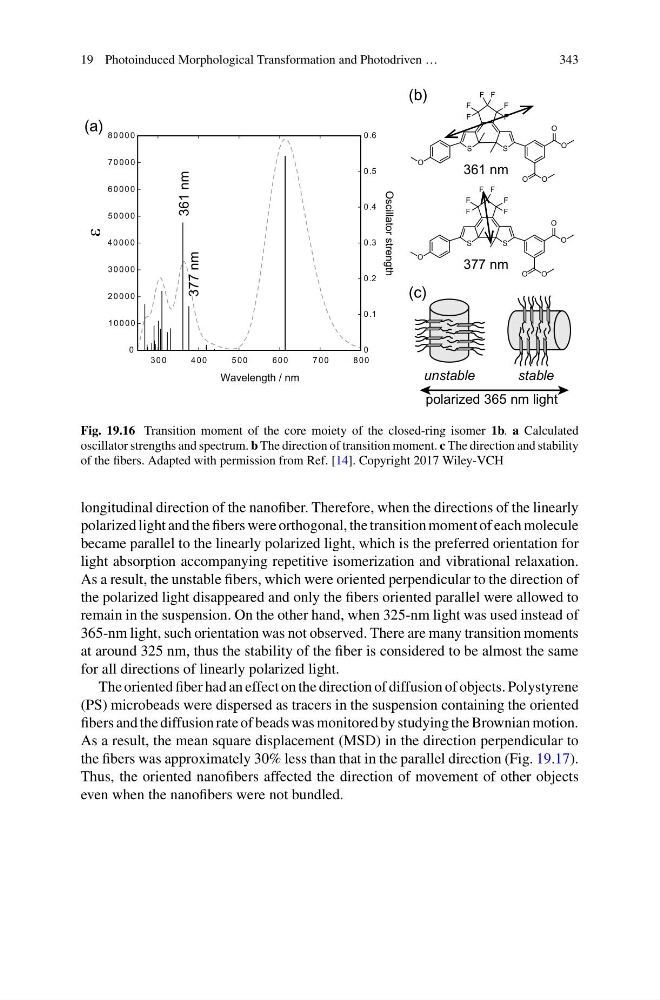
Fig. 19.16 Transition moment of the core moiety of the closed-ring isomer 1b. a Calculated
oscillator strengths and spectrum. b The direction of transition moment. c The direction and stability
of the fibers. Adapted with permission from Ref. [14]. Copyright 2017 Wiley-VCH
longitudinal direction of the nanofiber. Therefore, when the directions of the linearly
polarized light and the fibers were orthogonal, the transition moment of each molecule
became parallel to the linearly polarized light, which is the preferred orientation for
light absorption accompanying repetitive isomerization and vibrational relaxation.
As a result, the unstable fibers, which were oriented perpendicular to the direction of
the polarized light disappeared and only the fibers oriented parallel were allowed to
remain in the suspension. On the other hand, when 325-nm light was used instead of
365-nm light, such orientation was not observed. There are many transition moments
at around 325 nm, thus the stability of the fiber is considered to be almost the same
for all directions of linearly polarized light.
The oriented fiber had an effect on the direction of diffusion of objects. Polystyrene
(PS) microbeads were dispersed as tracers in the suspension containing the oriented
fibers and the diffusion rate of beads was monitored by studying the Brownian motion.
As a result, the mean square displacement (MSD) in the direction perpendicular to
the fibers was approximately 30% less than that in the parallel direction (Fig. 19.17).
Thus, the oriented nanofibers affected the direction of movement of other objects
even when the nanofibers were not bundled.
343
300
4 00
5 00
600
7 00
8 00
0
100 00
2 00 00
300 00
40 00 0
500 00
6 000 0
70 00 0
80 00 0
0
0.1
0.2
0.3
0.4
0.5
0.6
S
S
F
F
F
F
F
F
O
O
O
O
O
361 nm
S
S
F
F
F
F
F
F
O
O
O
O
O
(a)
(b)
361 nm
377 nm
Oscillator strength
Wavelength / nm
377 nm
polarized 365 nm light
(c)
stable
unstable
Fig. 19.16 Transition moment of the core moiety of the closed-ring isomer 1b. a Calculated
oscillator strengths and spectrum. b The direction of transition moment. c The direction and stability
of the fibers. Adapted with permission from Ref. [14]. Copyright 2017 Wiley-VCH
longitudinal direction of the nanofiber. Therefore, when the directions of the linearly
polarized light and the fibers were orthogonal, the transition moment of each molecule
became parallel to the linearly polarized light, which is the preferred orientation for
light absorption accompanying repetitive isomerization and vibrational relaxation.
As a result, the unstable fibers, which were oriented perpendicular to the direction of
the polarized light disappeared and only the fibers oriented parallel were allowed to
remain in the suspension. On the other hand, when 325-nm light was used instead of
365-nm light, such orientation was not observed. There are many transition moments
at around 325 nm, thus the stability of the fiber is considered to be almost the same
for all directions of linearly polarized light.
The oriented fiber had an effect on the direction of diffusion of objects. Polystyrene
(PS) microbeads were dispersed as tracers in the suspension containing the oriented
fibers and the diffusion rate of beads was monitored by studying the Brownian motion.
As a result, the mean square displacement (MSD) in the direction perpendicular to
the fibers was approximately 30% less than that in the parallel direction (Fig. 19.17).
Thus, the oriented nanofibers affected the direction of movement of other objects
even when the nanofibers were not bundled.