

336
K. Higashiguchi and K. Matsuda
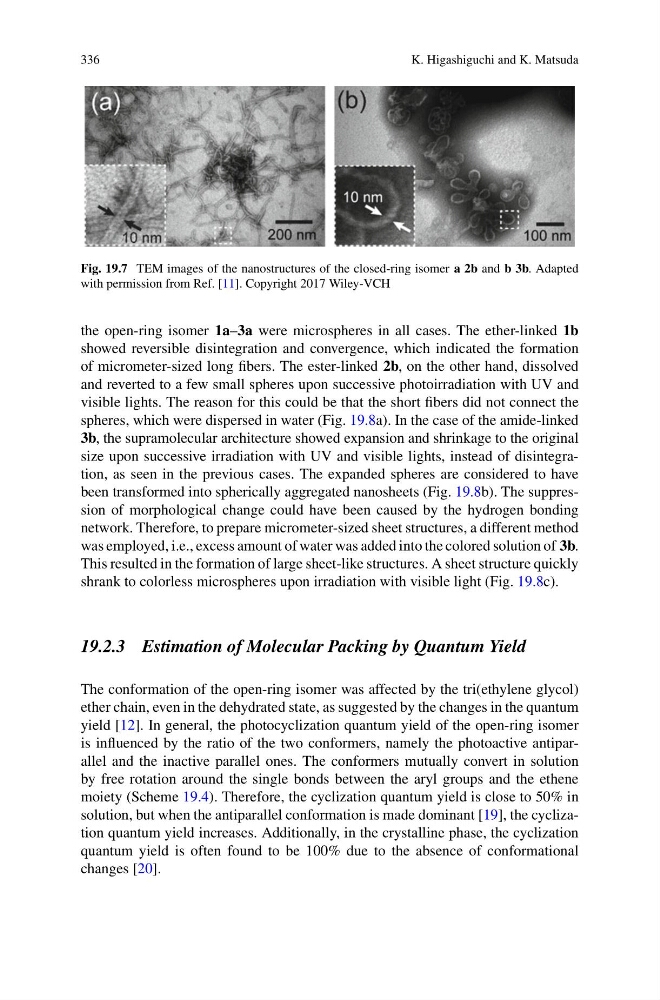
Fig. 19.7 TEM images of the nanostructures of the closed-ring isomer a 2b and b 3b. Adapted
with permission from Ref. [11]. Copyright 2017 Wiley-VCH
the open-ring isomer 1a–3a were microspheres in all cases. The ether-linked 1b
showed reversible disintegration and convergence, which indicated the formation
of micrometer-sized long fibers. The ester-linked 2b, on the other hand, dissolved
and reverted to a few small spheres upon successive photoirradiation with UV and
visible lights. The reason for this could be that the short fibers did not connect the
spheres, which were dispersed in water (Fig. 19.8a). In the case of the amide-linked
3b, the supramolecular architecture showed expansion and shrinkage to the original
size upon successive irradiation with UV and visible lights, instead of disintegration, as seen in the previous cases. The expanded spheres are considered to have
been transformed into spherically aggregated nanosheets (Fig. 19.8b). The suppression of morphological change could have been caused by the hydrogen bonding
network. Therefore, to prepare micrometer-sized sheet structures, a different method
was employed, i.e., excess amount of water was added into the colored solution of 3b.
This resulted in the formation of large sheet-like structures. A sheet structure quickly
shrank to colorless microspheres upon irradiation with visible light (Fig. 19.8c).
19.2.3 Estimation of Molecular Packing by Quantum Yield
The conformation of the open-ring isomer was affected by the tri(ethylene glycol)
ether chain, even in the dehydrated state, as suggested by the changes in the quantum
yield [12]. In general, the photocyclization quantum yield of the open-ring isomer
is influenced by the ratio of the two conformers, namely the photoactive antiparallel and the inactive parallel ones. The conformers mutually convert in solution
by free rotation around the single bonds between the aryl groups and the ethene
moiety (Scheme 19.4). Therefore, the cyclization quantum yield is close to 50% in
solution, but when the antiparallel conformation is made dominant [19], the cyclization quantum yield increases. Additionally, in the crystalline phase, the cyclization
quantum yield is often found to be 100% due to the absence of conformational
changes [20].
K. Higashiguchi and K. Matsuda
Fig. 19.7 TEM images of the nanostructures of the closed-ring isomer a 2b and b 3b. Adapted
with permission from Ref. [11]. Copyright 2017 Wiley-VCH
the open-ring isomer 1a–3a were microspheres in all cases. The ether-linked 1b
showed reversible disintegration and convergence, which indicated the formation
of micrometer-sized long fibers. The ester-linked 2b, on the other hand, dissolved
and reverted to a few small spheres upon successive photoirradiation with UV and
visible lights. The reason for this could be that the short fibers did not connect the
spheres, which were dispersed in water (Fig. 19.8a). In the case of the amide-linked
3b, the supramolecular architecture showed expansion and shrinkage to the original
size upon successive irradiation with UV and visible lights, instead of disintegration, as seen in the previous cases. The expanded spheres are considered to have
been transformed into spherically aggregated nanosheets (Fig. 19.8b). The suppression of morphological change could have been caused by the hydrogen bonding
network. Therefore, to prepare micrometer-sized sheet structures, a different method
was employed, i.e., excess amount of water was added into the colored solution of 3b.
This resulted in the formation of large sheet-like structures. A sheet structure quickly
shrank to colorless microspheres upon irradiation with visible light (Fig. 19.8c).
19.2.3 Estimation of Molecular Packing by Quantum Yield
The conformation of the open-ring isomer was affected by the tri(ethylene glycol)
ether chain, even in the dehydrated state, as suggested by the changes in the quantum
yield [12]. In general, the photocyclization quantum yield of the open-ring isomer
is influenced by the ratio of the two conformers, namely the photoactive antiparallel and the inactive parallel ones. The conformers mutually convert in solution
by free rotation around the single bonds between the aryl groups and the ethene
moiety (Scheme 19.4). Therefore, the cyclization quantum yield is close to 50% in
solution, but when the antiparallel conformation is made dominant [19], the cyclization quantum yield increases. Additionally, in the crystalline phase, the cyclization
quantum yield is often found to be 100% due to the absence of conformational
changes [20].