

296
T. Mori
of 9,10-diphenylanthracene as an efficient emitter owing to the proper energy level
alignment. Inspired by beautiful and functional cyclic structures of light-harvesting
proteins mentioned above, as well as recent investigation on cyclic array of nanowires [55, 56], we tried to realize the effective energy migration and hopping based
on the HAB scaffold with this pair that should eventually be applied for an effective
TTA-based photon upconverter. Derivatives of HAB in which two pyrene units are
fused in adjacent location were already reported [57], and the fluorescence behavior
was found considerably different depending on the anti/syn orientation of pyrene
units, while the absorption spectra kept comparable.
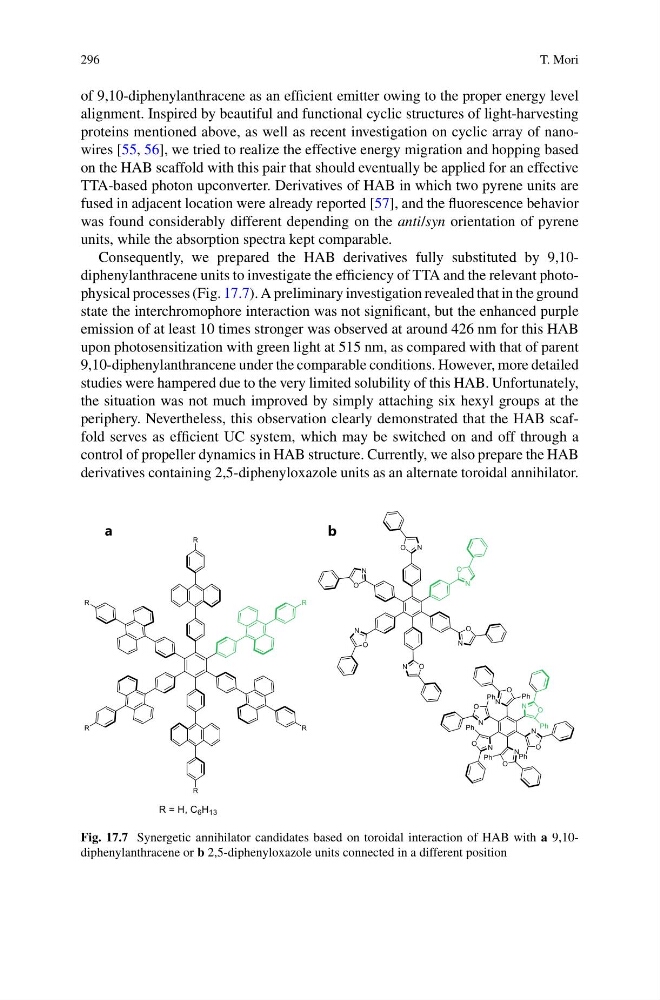
Consequently, we prepared the HAB derivatives fully substituted by 9,10diphenylanthracene units to investigate the efficiency of TTA and the relevant photophysical processes (Fig. 17.7). A preliminary investigation revealed that in the ground
state the interchromophore interaction was not significant, but the enhanced purple
emission of at least 10 times stronger was observed at around 426 nm for this HAB
upon photosensitization with green light at 515 nm, as compared with that of parent
9,10-diphenylanthrancene under the comparable conditions. However, more detailed
studies were hampered due to the very limited solubility of this HAB. Unfortunately,
the situation was not much improved by simply attaching six hexyl groups at the
periphery. Nevertheless, this observation clearly demonstrated that the HAB scaffold serves as efficient UC system, which may be switched on and off through a
control of propeller dynamics in HAB structure. Currently, we also prepare the HAB
derivatives containing 2,5-diphenyloxazole units as an alternate toroidal annihilator.
Fig. 17.7 Synergetic annihilator candidates based on toroidal interaction of HAB with a 9,10diphenylanthracene or b 2,5-diphenyloxazole units connected in a different position
T. Mori
of 9,10-diphenylanthracene as an efficient emitter owing to the proper energy level
alignment. Inspired by beautiful and functional cyclic structures of light-harvesting
proteins mentioned above, as well as recent investigation on cyclic array of nanowires [55, 56], we tried to realize the effective energy migration and hopping based
on the HAB scaffold with this pair that should eventually be applied for an effective
TTA-based photon upconverter. Derivatives of HAB in which two pyrene units are
fused in adjacent location were already reported [57], and the fluorescence behavior
was found considerably different depending on the anti/syn orientation of pyrene
units, while the absorption spectra kept comparable.
Consequently, we prepared the HAB derivatives fully substituted by 9,10diphenylanthracene units to investigate the efficiency of TTA and the relevant photophysical processes (Fig. 17.7). A preliminary investigation revealed that in the ground
state the interchromophore interaction was not significant, but the enhanced purple
emission of at least 10 times stronger was observed at around 426 nm for this HAB
upon photosensitization with green light at 515 nm, as compared with that of parent
9,10-diphenylanthrancene under the comparable conditions. However, more detailed
studies were hampered due to the very limited solubility of this HAB. Unfortunately,
the situation was not much improved by simply attaching six hexyl groups at the
periphery. Nevertheless, this observation clearly demonstrated that the HAB scaffold serves as efficient UC system, which may be switched on and off through a
control of propeller dynamics in HAB structure. Currently, we also prepare the HAB
derivatives containing 2,5-diphenyloxazole units as an alternate toroidal annihilator.
Fig. 17.7 Synergetic annihilator candidates based on toroidal interaction of HAB with a 9,10diphenylanthracene or b 2,5-diphenyloxazole units connected in a different position