

1 Advanced Control of Photochemical Reactions …
19
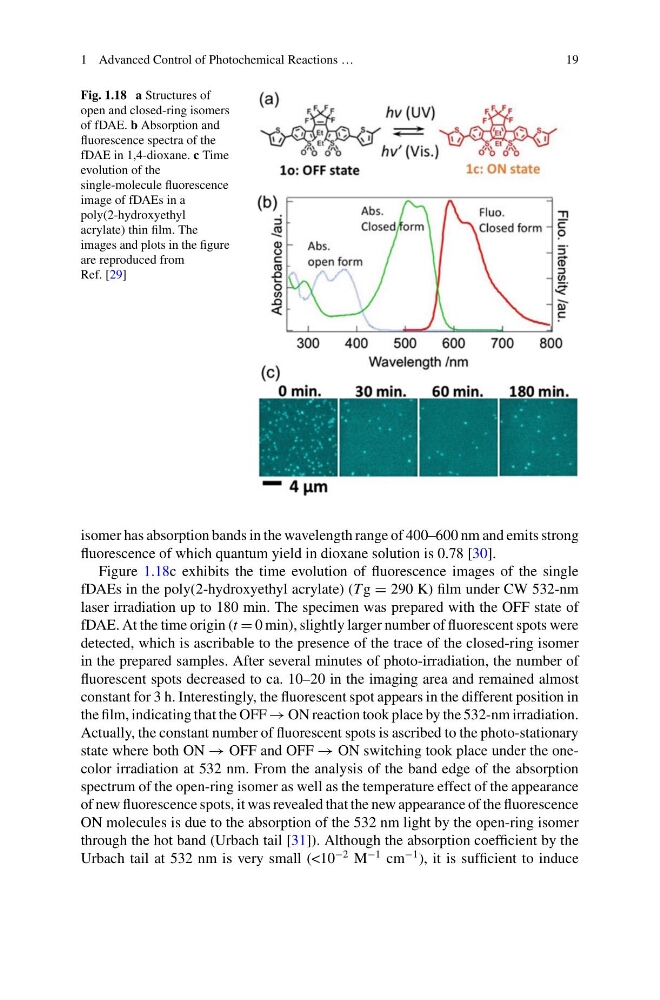
Fig. 1.18 a Structures of
open and closed-ring isomers
of fDAE. b Absorption and
fluorescence spectra of the
fDAE in 1,4-dioxane. c Time
evolution of the
single-molecule fluorescence
image of fDAEs in a
poly(2-hydroxyethyl
acrylate) thin film. The
images and plots in the figure
are reproduced from
Ref. [29]
isomer has absorption bands in the wavelength range of 400–600 nm and emits strong
fluorescence of which quantum yield in dioxane solution is 0.78 [30].
Figure 1.18c exhibits the time evolution of fluorescence images of the single
fDAEs in the poly(2-hydroxyethyl acrylate) (T g = 290 K) film under CW 532-nm
laser irradiation up to 180 min. The specimen was prepared with the OFF state of
fDAE. At the time origin (t = 0 min), slightly larger number of fluorescent spots were
detected, which is ascribable to the presence of the trace of the closed-ring isomer
in the prepared samples. After several minutes of photo-irradiation, the number of
fluorescent spots decreased to ca. 10–20 in the imaging area and remained almost
constant for 3 h. Interestingly, the fluorescent spot appears in the different position in
the film, indicating that the OFF → ON reaction took place by the 532-nm irradiation.
Actually, the constant number of fluorescent spots is ascribed to the photo-stationary
state where both ON → OFF and OFF → ON switching took place under the onecolor irradiation at 532 nm. From the analysis of the band edge of the absorption
spectrum of the open-ring isomer as well as the temperature effect of the appearance
of new fluorescence spots, it was revealed that the new appearance of the fluorescence
ON molecules is due to the absorption of the 532 nm light by the open-ring isomer
through the hot band (Urbach tail [31]). Although the absorption coefficient by the
Urbach tail at 532 nm is very small (<10
−2 M
−1 cm
−1 ), it is sufficient to induce
19
Fig. 1.18 a Structures of
open and closed-ring isomers
of fDAE. b Absorption and
fluorescence spectra of the
fDAE in 1,4-dioxane. c Time
evolution of the
single-molecule fluorescence
image of fDAEs in a
poly(2-hydroxyethyl
acrylate) thin film. The
images and plots in the figure
are reproduced from
Ref. [29]
isomer has absorption bands in the wavelength range of 400–600 nm and emits strong
fluorescence of which quantum yield in dioxane solution is 0.78 [30].
Figure 1.18c exhibits the time evolution of fluorescence images of the single
fDAEs in the poly(2-hydroxyethyl acrylate) (T g = 290 K) film under CW 532-nm
laser irradiation up to 180 min. The specimen was prepared with the OFF state of
fDAE. At the time origin (t = 0 min), slightly larger number of fluorescent spots were
detected, which is ascribable to the presence of the trace of the closed-ring isomer
in the prepared samples. After several minutes of photo-irradiation, the number of
fluorescent spots decreased to ca. 10–20 in the imaging area and remained almost
constant for 3 h. Interestingly, the fluorescent spot appears in the different position in
the film, indicating that the OFF → ON reaction took place by the 532-nm irradiation.
Actually, the constant number of fluorescent spots is ascribed to the photo-stationary
state where both ON → OFF and OFF → ON switching took place under the onecolor irradiation at 532 nm. From the analysis of the band edge of the absorption
spectrum of the open-ring isomer as well as the temperature effect of the appearance
of new fluorescence spots, it was revealed that the new appearance of the fluorescence
ON molecules is due to the absorption of the 532 nm light by the open-ring isomer
through the hot band (Urbach tail [31]). Although the absorption coefficient by the
Urbach tail at 532 nm is very small (<10
−2 M
−1 cm
−1 ), it is sufficient to induce