

15 Creation of Molecularly Integrated Multi-responsive …
269
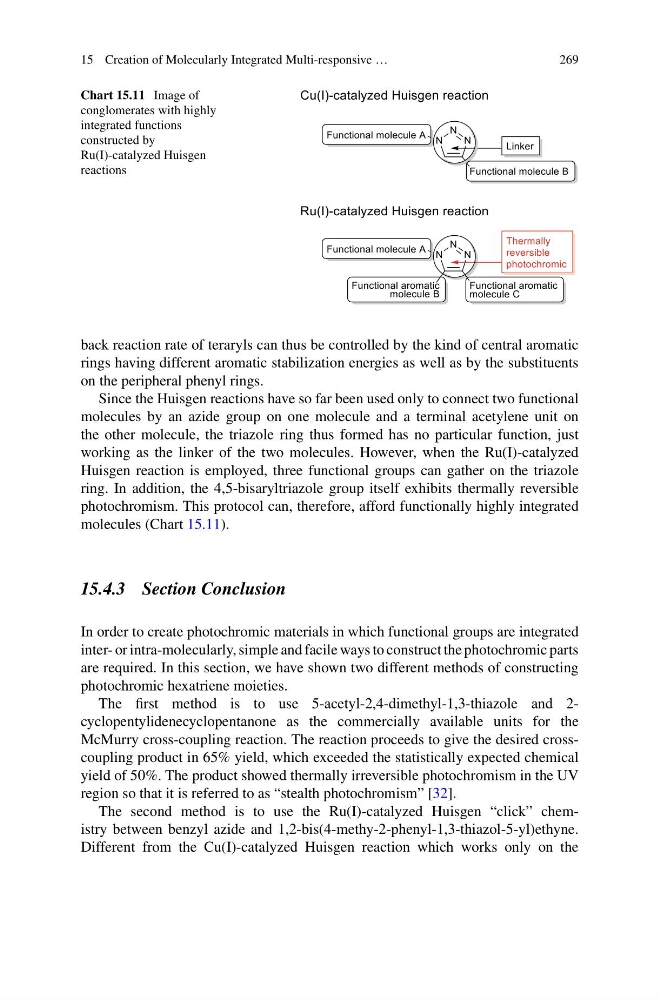
Chart 15.11 Image of
conglomerates with highly
integrated functions
constructed by
Ru(I)-catalyzed Huisgen
reactions
back reaction rate of teraryls can thus be controlled by the kind of central aromatic
rings having different aromatic stabilization energies as well as by the substituents
on the peripheral phenyl rings.
Since the Huisgen reactions have so far been used only to connect two functional
molecules by an azide group on one molecule and a terminal acetylene unit on
the other molecule, the triazole ring thus formed has no particular function, just
working as the linker of the two molecules. However, when the Ru(I)-catalyzed
Huisgen reaction is employed, three functional groups can gather on the triazole
ring. In addition, the 4,5-bisaryltriazole group itself exhibits thermally reversible
photochromism. This protocol can, therefore, afford functionally highly integrated
molecules (Chart 15.11).
15.4.3 Section Conclusion
In order to create photochromic materials in which functional groups are integrated
inter- or intra-molecularly, simple and facile ways to construct the photochromic parts
are required. In this section, we have shown two different methods of constructing
photochromic hexatriene moieties.
The first method is to use 5-acetyl-2,4-dimethyl-1,3-thiazole and 2cyclopentylidenecyclopentanone as the commercially available units for the
McMurry cross-coupling reaction. The reaction proceeds to give the desired crosscoupling product in 65% yield, which exceeded the statistically expected chemical
yield of 50%. The product showed thermally irreversible photochromism in the UV
region so that it is referred to as “stealth photochromism” [32].
The second method is to use the Ru(I)-catalyzed Huisgen “click” chemistry between benzyl azide and 1,2-bis(4-methy-2-phenyl-1,3-thiazol-5-yl)ethyne.
Different from the Cu(I)-catalyzed Huisgen reaction which works only on the
269
Chart 15.11 Image of
conglomerates with highly
integrated functions
constructed by
Ru(I)-catalyzed Huisgen
reactions
back reaction rate of teraryls can thus be controlled by the kind of central aromatic
rings having different aromatic stabilization energies as well as by the substituents
on the peripheral phenyl rings.
Since the Huisgen reactions have so far been used only to connect two functional
molecules by an azide group on one molecule and a terminal acetylene unit on
the other molecule, the triazole ring thus formed has no particular function, just
working as the linker of the two molecules. However, when the Ru(I)-catalyzed
Huisgen reaction is employed, three functional groups can gather on the triazole
ring. In addition, the 4,5-bisaryltriazole group itself exhibits thermally reversible
photochromism. This protocol can, therefore, afford functionally highly integrated
molecules (Chart 15.11).
15.4.3 Section Conclusion
In order to create photochromic materials in which functional groups are integrated
inter- or intra-molecularly, simple and facile ways to construct the photochromic parts
are required. In this section, we have shown two different methods of constructing
photochromic hexatriene moieties.
The first method is to use 5-acetyl-2,4-dimethyl-1,3-thiazole and 2cyclopentylidenecyclopentanone as the commercially available units for the
McMurry cross-coupling reaction. The reaction proceeds to give the desired crosscoupling product in 65% yield, which exceeded the statistically expected chemical
yield of 50%. The product showed thermally irreversible photochromism in the UV
region so that it is referred to as “stealth photochromism” [32].
The second method is to use the Ru(I)-catalyzed Huisgen “click” chemistry between benzyl azide and 1,2-bis(4-methy-2-phenyl-1,3-thiazol-5-yl)ethyne.
Different from the Cu(I)-catalyzed Huisgen reaction which works only on the