

268
Y. Yokoyama
The thermal back reaction rate is faster when the aromatic stabilization energy [42]
of the central aromatic ring is large. It is natural that the closed forms lose aromaticity
for three aromatic rings simultaneously when they cyclize, and the thiazole rings on
both sides are common to all compounds.
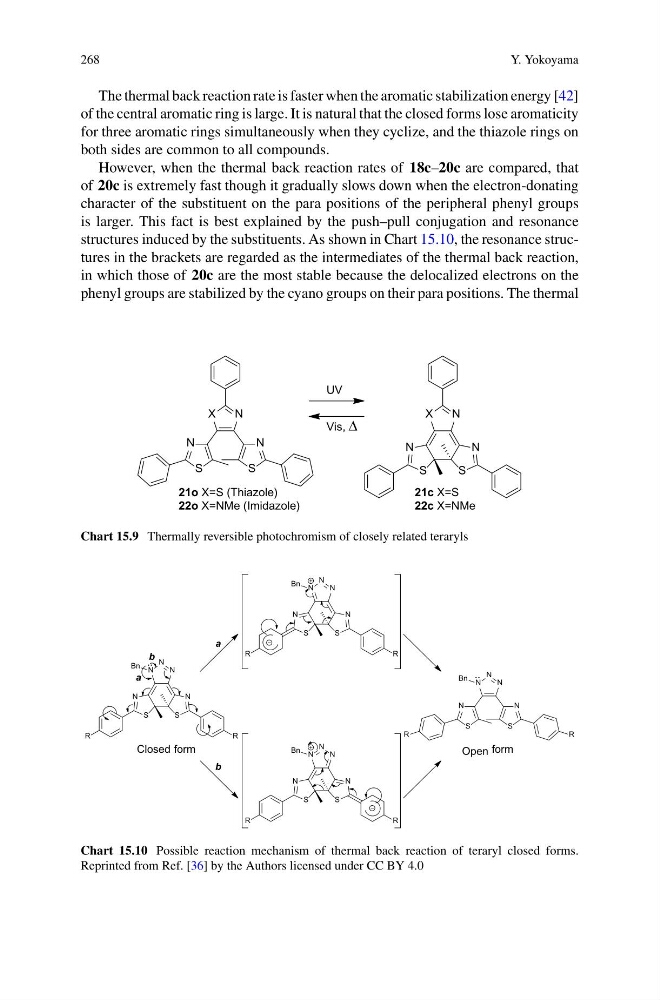
However, when the thermal back reaction rates of 18c–20c are compared, that
of 20c is extremely fast though it gradually slows down when the electron-donating
character of the substituent on the para positions of the peripheral phenyl groups
is larger. This fact is best explained by the push–pull conjugation and resonance
structures induced by the substituents. As shown in Chart 15.10, the resonance structures in the brackets are regarded as the intermediates of the thermal back reaction,
in which those of 20c are the most stable because the delocalized electrons on the
phenyl groups are stabilized by the cyano groups on their para positions. The thermal
N
X
N
S
S
N
N
X
N
S
S
N
21o X=S (Thiazole)
22o X=NMe (Imidazole)
21c X=S
22c X=NMe
UV
Vis, Δ
Chart 15.9 Thermally reversible photochromism of closely related teraryls
N
N
N
N
S
S
N
Bn
R
R
N
N
N
N
S
S
N
Bn
R
R
N
N
N
N
S
S
N
Bn
R
R
N
N
N
Bn
N
S
S
N
R
R
Closed form
Open form
a
b
a
b
Chart 15.10 Possible reaction mechanism of thermal back reaction of teraryl closed forms.
Reprinted from Ref. [36] by the Authors licensed under CC BY 4.0
Y. Yokoyama
The thermal back reaction rate is faster when the aromatic stabilization energy [42]
of the central aromatic ring is large. It is natural that the closed forms lose aromaticity
for three aromatic rings simultaneously when they cyclize, and the thiazole rings on
both sides are common to all compounds.
However, when the thermal back reaction rates of 18c–20c are compared, that
of 20c is extremely fast though it gradually slows down when the electron-donating
character of the substituent on the para positions of the peripheral phenyl groups
is larger. This fact is best explained by the push–pull conjugation and resonance
structures induced by the substituents. As shown in Chart 15.10, the resonance structures in the brackets are regarded as the intermediates of the thermal back reaction,
in which those of 20c are the most stable because the delocalized electrons on the
phenyl groups are stabilized by the cyano groups on their para positions. The thermal
N
X
N
S
S
N
N
X
N
S
S
N
21o X=S (Thiazole)
22o X=NMe (Imidazole)
21c X=S
22c X=NMe
UV
Vis, Δ
Chart 15.9 Thermally reversible photochromism of closely related teraryls
N
N
N
N
S
S
N
Bn
R
R
N
N
N
N
S
S
N
Bn
R
R
N
N
N
N
S
S
N
Bn
R
R
N
N
N
Bn
N
S
S
N
R
R
Closed form
Open form
a
b
a
b
Chart 15.10 Possible reaction mechanism of thermal back reaction of teraryl closed forms.
Reprinted from Ref. [36] by the Authors licensed under CC BY 4.0