

266
Y. Yokoyama
15.4.2 “Click” Reactions for the Construction of Teraryls [36]
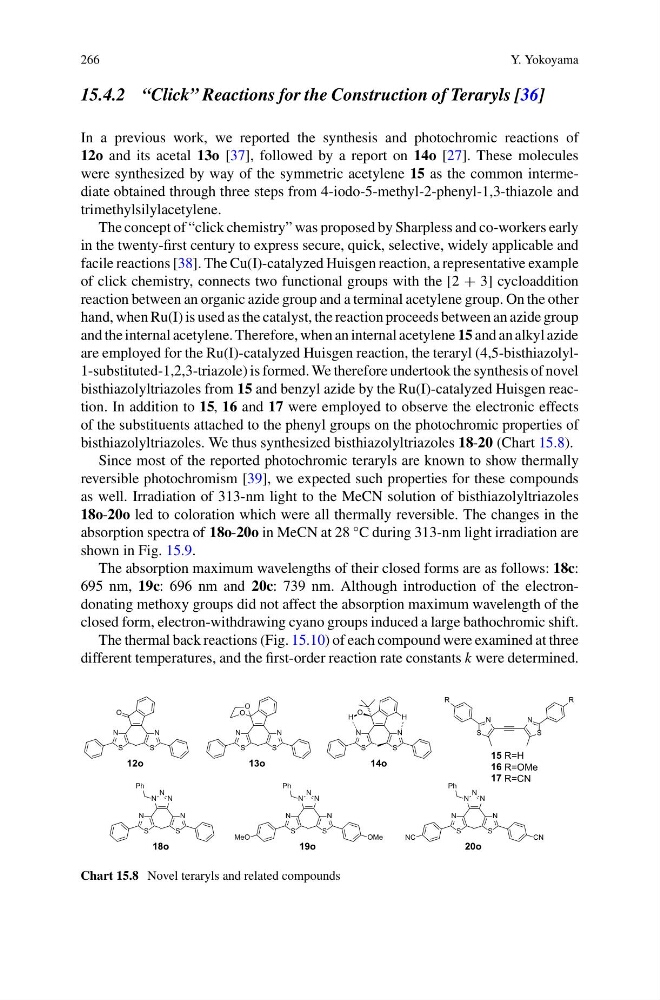
In a previous work, we reported the synthesis and photochromic reactions of
12o and its acetal 13o [37], followed by a report on 14o [27]. These molecules
were synthesized by way of the symmetric acetylene 15 as the common intermediate obtained through three steps from 4-iodo-5-methyl-2-phenyl-1,3-thiazole and
trimethylsilylacetylene.
The concept of “click chemistry” was proposed by Sharpless and co-workers early
in the twenty-first century to express secure, quick, selective, widely applicable and
facile reactions [38]. The Cu(I)-catalyzed Huisgen reaction, a representative example
of click chemistry, connects two functional groups with the [2 + 3] cycloaddition
reaction between an organic azide group and a terminal acetylene group. On the other
hand, when Ru(I) is used as the catalyst, the reaction proceeds between an azide group
and the internal acetylene. Therefore, when an internal acetylene 15 and an alkyl azide
are employed for the Ru(I)-catalyzed Huisgen reaction, the teraryl (4,5-bisthiazolyl1-substituted-1,2,3-triazole) is formed. We therefore undertook the synthesis of novel
bisthiazolyltriazoles from 15 and benzyl azide by the Ru(I)-catalyzed Huisgen reaction. In addition to 15, 16 and 17 were employed to observe the electronic effects
of the substituents attached to the phenyl groups on the photochromic properties of
bisthiazolyltriazoles. We thus synthesized bisthiazolyltriazoles 18-20 (Chart 15.8).
Since most of the reported photochromic teraryls are known to show thermally
reversible photochromism [39], we expected such properties for these compounds
as well. Irradiation of 313-nm light to the MeCN solution of bisthiazolyltriazoles
18o-20o led to coloration which were all thermally reversible. The changes in the
absorption spectra of 18o-20o in MeCN at 28 °C during 313-nm light irradiation are
shown in Fig. 15.9.
The absorption maximum wavelengths of their closed forms are as follows: 18c:
695 nm, 19c: 696 nm and 20c: 739 nm. Although introduction of the electrondonating methoxy groups did not affect the absorption maximum wavelength of the
closed form, electron-withdrawing cyano groups induced a large bathochromic shift.
The thermal back reactions (Fig. 15.10) of each compound were examined at three
different temperatures, and the first-order reaction rate constants k were determined.
N
S
S
N
O
N
S
S
N
O
O
N
S
S
N
H
O
H
S
N
N
S
12o
13o
14o
15 R=H
16 R=OMe
17 R=CN
N
S
S
N
18o
N
N
N
Ph
N
S
S
N
19o
N
N
N
Ph
MeO
OMe
N
S
S
N
20o
N
N
N
Ph
NC
CN
R
R
Chart 15.8 Novel teraryls and related compounds
Y. Yokoyama
15.4.2 “Click” Reactions for the Construction of Teraryls [36]
In a previous work, we reported the synthesis and photochromic reactions of
12o and its acetal 13o [37], followed by a report on 14o [27]. These molecules
were synthesized by way of the symmetric acetylene 15 as the common intermediate obtained through three steps from 4-iodo-5-methyl-2-phenyl-1,3-thiazole and
trimethylsilylacetylene.
The concept of “click chemistry” was proposed by Sharpless and co-workers early
in the twenty-first century to express secure, quick, selective, widely applicable and
facile reactions [38]. The Cu(I)-catalyzed Huisgen reaction, a representative example
of click chemistry, connects two functional groups with the [2 + 3] cycloaddition
reaction between an organic azide group and a terminal acetylene group. On the other
hand, when Ru(I) is used as the catalyst, the reaction proceeds between an azide group
and the internal acetylene. Therefore, when an internal acetylene 15 and an alkyl azide
are employed for the Ru(I)-catalyzed Huisgen reaction, the teraryl (4,5-bisthiazolyl1-substituted-1,2,3-triazole) is formed. We therefore undertook the synthesis of novel
bisthiazolyltriazoles from 15 and benzyl azide by the Ru(I)-catalyzed Huisgen reaction. In addition to 15, 16 and 17 were employed to observe the electronic effects
of the substituents attached to the phenyl groups on the photochromic properties of
bisthiazolyltriazoles. We thus synthesized bisthiazolyltriazoles 18-20 (Chart 15.8).
Since most of the reported photochromic teraryls are known to show thermally
reversible photochromism [39], we expected such properties for these compounds
as well. Irradiation of 313-nm light to the MeCN solution of bisthiazolyltriazoles
18o-20o led to coloration which were all thermally reversible. The changes in the
absorption spectra of 18o-20o in MeCN at 28 °C during 313-nm light irradiation are
shown in Fig. 15.9.
The absorption maximum wavelengths of their closed forms are as follows: 18c:
695 nm, 19c: 696 nm and 20c: 739 nm. Although introduction of the electrondonating methoxy groups did not affect the absorption maximum wavelength of the
closed form, electron-withdrawing cyano groups induced a large bathochromic shift.
The thermal back reactions (Fig. 15.10) of each compound were examined at three
different temperatures, and the first-order reaction rate constants k were determined.
N
S
S
N
O
N
S
S
N
O
O
N
S
S
N
H
O
H
S
N
N
S
12o
13o
14o
15 R=H
16 R=OMe
17 R=CN
N
S
S
N
18o
N
N
N
Ph
N
S
S
N
19o
N
N
N
Ph
MeO
OMe
N
S
S
N
20o
N
N
N
Ph
NC
CN
R
R
Chart 15.8 Novel teraryls and related compounds