

15 Creation of Molecularly Integrated Multi-responsive …
265
phenyl group or the hexafluoropropano-bridge are carefully removed, the absorption
maximum in the visible region may shift toward shorter wavelengths. If the absorption band in the longest wavelength is hidden in the UV region, photochromism
will occur by the alternate irradiation of two different UV lights. In such a case,
the molecular structure must be exceptionally simple, and the simple structure can
considerably facilitate its synthesis. We have thus designed the arylbutadiene 11o
with its possible synthetic pathway depicted in Chart 15.7.
The coupling reaction of two different carbonyl substrates may lead to two homocoupling products and one cross-coupling product. If the reaction proceeds statistically, the chemical yield of 11o, the cross-coupling product, does not exceed 50%.
However, the McMurry coupling reaction proceeded smoothly to provide 11o in
65% yield. These results are in good accordance with the fact that the McMurry
coupling of an aromatic ketone and an aliphatic ketone predominantly yields the
cross-coupling product rather than the homo-coupling products [34].
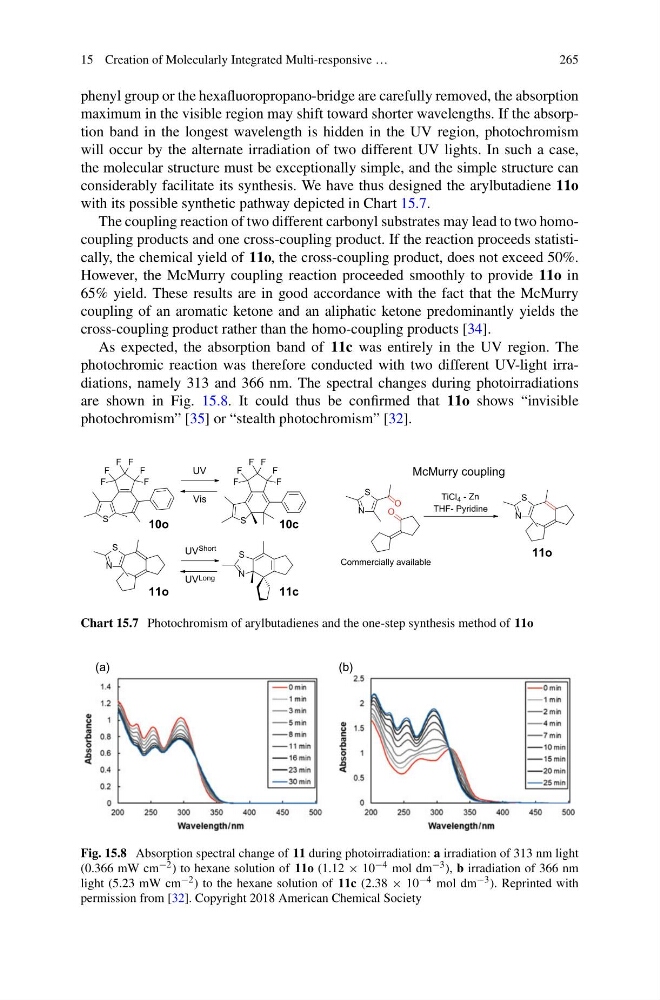
As expected, the absorption band of 11c was entirely in the UV region. The
photochromic reaction was therefore conducted with two different UV-light irradiations, namely 313 and 366 nm. The spectral changes during photoirradiations
are shown in Fig. 15.8. It could thus be confirmed that 11o shows “invisible
photochromism” [35] or “stealth photochromism” [32].
O
S
N
O
S
N
S
N
UV
Vis
UV Short
UV Long
F
F
F
F
F
F
S
F
F
F
F
F
F
S
McMurry coupling
Commercially available
S
N
TiCl 4 - Zn
THF- Pyridine
10o
10c
11o
11c
11o
Chart 15.7 Photochromism of arylbutadienes and the one-step synthesis method of 11o
(a)
(b)
Fig. 15.8 Absorption spectral change of 11 during photoirradiation: a irradiation of 313 nm light
(0.366 mW cm −2 ) to hexane solution of 11o (1.12 × 10 −4 mol dm −3 ), b irradiation of 366 nm
light (5.23 mW cm −2 ) to the hexane solution of 11c (2.38 × 10 −4 mol dm −3 ). Reprinted with
permission from [32]. Copyright 2018 American Chemical Society
265
phenyl group or the hexafluoropropano-bridge are carefully removed, the absorption
maximum in the visible region may shift toward shorter wavelengths. If the absorption band in the longest wavelength is hidden in the UV region, photochromism
will occur by the alternate irradiation of two different UV lights. In such a case,
the molecular structure must be exceptionally simple, and the simple structure can
considerably facilitate its synthesis. We have thus designed the arylbutadiene 11o
with its possible synthetic pathway depicted in Chart 15.7.
The coupling reaction of two different carbonyl substrates may lead to two homocoupling products and one cross-coupling product. If the reaction proceeds statistically, the chemical yield of 11o, the cross-coupling product, does not exceed 50%.
However, the McMurry coupling reaction proceeded smoothly to provide 11o in
65% yield. These results are in good accordance with the fact that the McMurry
coupling of an aromatic ketone and an aliphatic ketone predominantly yields the
cross-coupling product rather than the homo-coupling products [34].
As expected, the absorption band of 11c was entirely in the UV region. The
photochromic reaction was therefore conducted with two different UV-light irradiations, namely 313 and 366 nm. The spectral changes during photoirradiations
are shown in Fig. 15.8. It could thus be confirmed that 11o shows “invisible
photochromism” [35] or “stealth photochromism” [32].
O
S
N
O
S
N
S
N
UV
Vis
UV Short
UV Long
F
F
F
F
F
F
S
F
F
F
F
F
F
S
McMurry coupling
Commercially available
S
N
TiCl 4 - Zn
THF- Pyridine
10o
10c
11o
11c
11o
Chart 15.7 Photochromism of arylbutadienes and the one-step synthesis method of 11o
(a)
(b)
Fig. 15.8 Absorption spectral change of 11 during photoirradiation: a irradiation of 313 nm light
(0.366 mW cm −2 ) to hexane solution of 11o (1.12 × 10 −4 mol dm −3 ), b irradiation of 366 nm
light (5.23 mW cm −2 ) to the hexane solution of 11c (2.38 × 10 −4 mol dm −3 ). Reprinted with
permission from [32]. Copyright 2018 American Chemical Society