

262
Y. Yokoyama
(a)
(b)
Major
Minor
Major
(Minor)
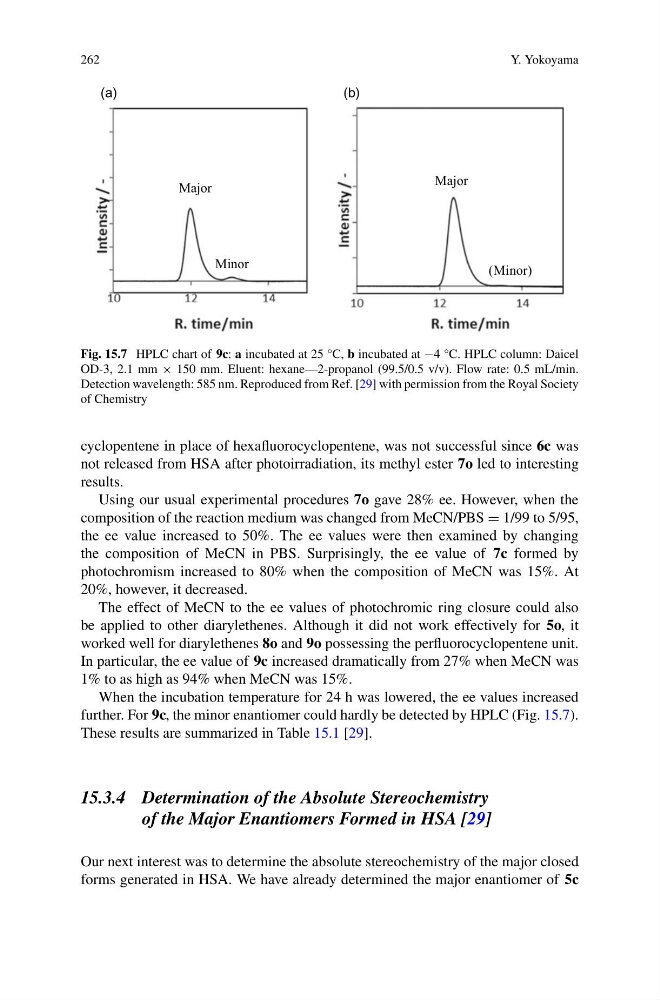
Fig. 15.7 HPLC chart of 9c: a incubated at 25 °C, b incubated at −4 °C. HPLC column: Daicel
OD-3, 2.1 mm × 150 mm. Eluent: hexane—2-propanol (99.5/0.5 v/v). Flow rate: 0.5 mL/min.
Detection wavelength: 585 nm. Reproduced from Ref. [29] with permission from the Royal Society
of Chemistry
cyclopentene in place of hexafluorocyclopentene, was not successful since 6c was
not released from HSA after photoirradiation, its methyl ester 7o led to interesting
results.
Using our usual experimental procedures 7o gave 28% ee. However, when the
composition of the reaction medium was changed from MeCN/PBS = 1/99 to 5/95,
the ee value increased to 50%. The ee values were then examined by changing
the composition of MeCN in PBS. Surprisingly, the ee value of 7c formed by
photochromism increased to 80% when the composition of MeCN was 15%. At
20%, however, it decreased.
The effect of MeCN to the ee values of photochromic ring closure could also
be applied to other diarylethenes. Although it did not work effectively for 5o, it
worked well for diarylethenes 8o and 9o possessing the perfluorocyclopentene unit.
In particular, the ee value of 9c increased dramatically from 27% when MeCN was
1% to as high as 94% when MeCN was 15%.
When the incubation temperature for 24 h was lowered, the ee values increased
further. For 9c, the minor enantiomer could hardly be detected by HPLC (Fig. 15.7).
These results are summarized in Table 15.1 [29].
15.3.4 Determination of the Absolute Stereochemistry
of the Major Enantiomers Formed in HSA [29]
Our next interest was to determine the absolute stereochemistry of the major closed
forms generated in HSA. We have already determined the major enantiomer of 5c
Y. Yokoyama
(a)
(b)
Major
Minor
Major
(Minor)
Fig. 15.7 HPLC chart of 9c: a incubated at 25 °C, b incubated at −4 °C. HPLC column: Daicel
OD-3, 2.1 mm × 150 mm. Eluent: hexane—2-propanol (99.5/0.5 v/v). Flow rate: 0.5 mL/min.
Detection wavelength: 585 nm. Reproduced from Ref. [29] with permission from the Royal Society
of Chemistry
cyclopentene in place of hexafluorocyclopentene, was not successful since 6c was
not released from HSA after photoirradiation, its methyl ester 7o led to interesting
results.
Using our usual experimental procedures 7o gave 28% ee. However, when the
composition of the reaction medium was changed from MeCN/PBS = 1/99 to 5/95,
the ee value increased to 50%. The ee values were then examined by changing
the composition of MeCN in PBS. Surprisingly, the ee value of 7c formed by
photochromism increased to 80% when the composition of MeCN was 15%. At
20%, however, it decreased.
The effect of MeCN to the ee values of photochromic ring closure could also
be applied to other diarylethenes. Although it did not work effectively for 5o, it
worked well for diarylethenes 8o and 9o possessing the perfluorocyclopentene unit.
In particular, the ee value of 9c increased dramatically from 27% when MeCN was
1% to as high as 94% when MeCN was 15%.
When the incubation temperature for 24 h was lowered, the ee values increased
further. For 9c, the minor enantiomer could hardly be detected by HPLC (Fig. 15.7).
These results are summarized in Table 15.1 [29].
15.3.4 Determination of the Absolute Stereochemistry
of the Major Enantiomers Formed in HSA [29]
Our next interest was to determine the absolute stereochemistry of the major closed
forms generated in HSA. We have already determined the major enantiomer of 5c