

15 Creation of Molecularly Integrated Multi-responsive …
261
F
F
F F
F
F
S
S
*
*
(R,R) -5c (Minor)
OH
OH
F
F
F
F
F
F
S
S
(S,S)-5c (Major)
*
*
OH
OH
F
F
F F
F
F
S
S
HO
OH
MeCN-PBS
>
63% ee at r. t. incubation
71% ee at -4 °C incubation
313 nm light
10 eq HSA
5o
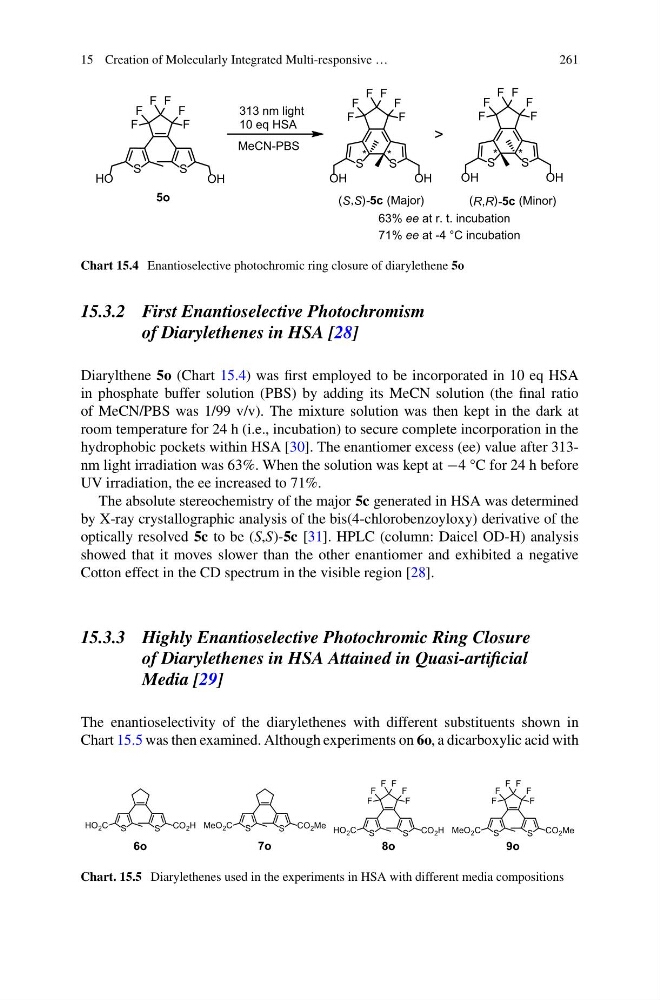
Chart 15.4 Enantioselective photochromic ring closure of diarylethene 5o
15.3.2 First Enantioselective Photochromism
of Diarylethenes in HSA [28]
Diarylthene 5o (Chart 15.4) was first employed to be incorporated in 10 eq HSA
in phosphate buffer solution (PBS) by adding its MeCN solution (the final ratio
of MeCN/PBS was 1/99 v/v). The mixture solution was then kept in the dark at
room temperature for 24 h (i.e., incubation) to secure complete incorporation in the
hydrophobic pockets within HSA [30]. The enantiomer excess (ee) value after 313nm light irradiation was 63%. When the solution was kept at −4 °C for 24 h before
UV irradiation, the ee increased to 71%.
The absolute stereochemistry of the major 5c generated in HSA was determined
by X-ray crystallographic analysis of the bis(4-chlorobenzoyloxy) derivative of the
optically resolved 5c to be (S,S)-5c [31]. HPLC (column: Daicel OD-H) analysis
showed that it moves slower than the other enantiomer and exhibited a negative
Cotton effect in the CD spectrum in the visible region [28].
15.3.3 Highly Enantioselective Photochromic Ring Closure
of Diarylethenes in HSA Attained in Quasi-artificial
Media [29]
The enantioselectivity of the diarylethenes with different substituents shown in
Chart 15.5 was then examined. Although experiments on 6o, a dicarboxylic acid with
S
S
HO 2 C
CO 2 H
6o
S
S
MeO 2 C
CO 2 Me
7o
F
F
F F
F
F
S
S
HO 2 C
CO 2 H
8o
F
F
F F
F
F
S
S
MeO 2 C
CO 2 Me
9o
Chart. 15.5 Diarylethenes used in the experiments in HSA with different media compositions
261
F
F
F F
F
F
S
S
*
*
(R,R) -5c (Minor)
OH
OH
F
F
F
F
F
F
S
S
(S,S)-5c (Major)
*
*
OH
OH
F
F
F F
F
F
S
S
HO
OH
MeCN-PBS
>
63% ee at r. t. incubation
71% ee at -4 °C incubation
313 nm light
10 eq HSA
5o
Chart 15.4 Enantioselective photochromic ring closure of diarylethene 5o
15.3.2 First Enantioselective Photochromism
of Diarylethenes in HSA [28]
Diarylthene 5o (Chart 15.4) was first employed to be incorporated in 10 eq HSA
in phosphate buffer solution (PBS) by adding its MeCN solution (the final ratio
of MeCN/PBS was 1/99 v/v). The mixture solution was then kept in the dark at
room temperature for 24 h (i.e., incubation) to secure complete incorporation in the
hydrophobic pockets within HSA [30]. The enantiomer excess (ee) value after 313nm light irradiation was 63%. When the solution was kept at −4 °C for 24 h before
UV irradiation, the ee increased to 71%.
The absolute stereochemistry of the major 5c generated in HSA was determined
by X-ray crystallographic analysis of the bis(4-chlorobenzoyloxy) derivative of the
optically resolved 5c to be (S,S)-5c [31]. HPLC (column: Daicel OD-H) analysis
showed that it moves slower than the other enantiomer and exhibited a negative
Cotton effect in the CD spectrum in the visible region [28].
15.3.3 Highly Enantioselective Photochromic Ring Closure
of Diarylethenes in HSA Attained in Quasi-artificial
Media [29]
The enantioselectivity of the diarylethenes with different substituents shown in
Chart 15.5 was then examined. Although experiments on 6o, a dicarboxylic acid with
S
S
HO 2 C
CO 2 H
6o
S
S
MeO 2 C
CO 2 Me
7o
F
F
F F
F
F
S
S
HO 2 C
CO 2 H
8o
F
F
F F
F
F
S
S
MeO 2 C
CO 2 Me
9o
Chart. 15.5 Diarylethenes used in the experiments in HSA with different media compositions