

258
Y. Yokoyama
(a)
(b)
(c)
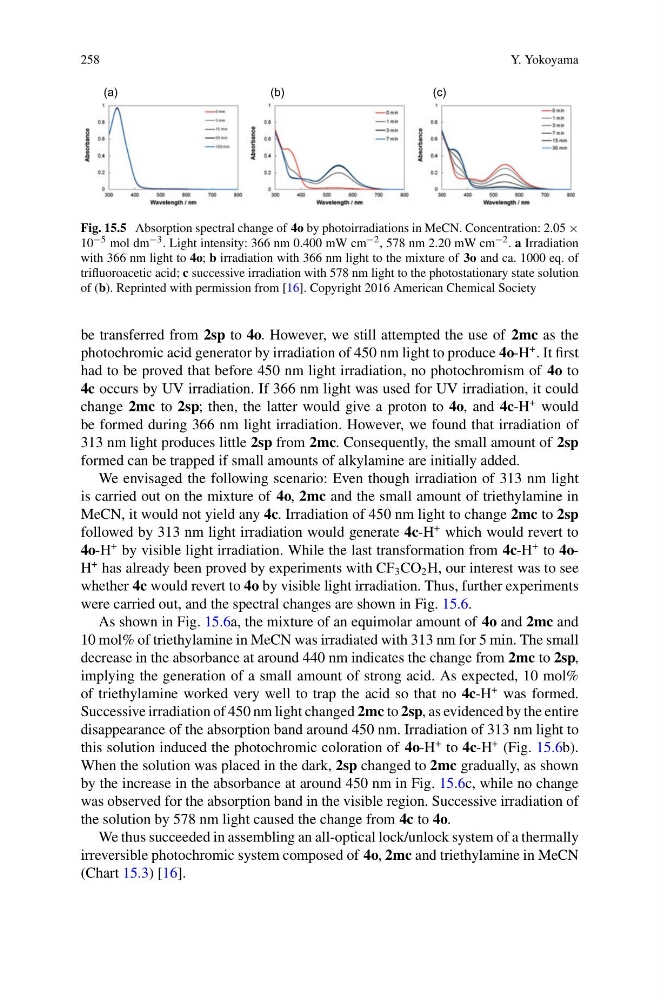
Fig. 15.5 Absorption spectral change of 4o by photoirradiations in MeCN. Concentration: 2.05 ×
10 −5 mol dm −3 . Light intensity: 366 nm 0.400 mW cm −2 , 578 nm 2.20 mW cm −2 . a Irradiation
with 366 nm light to 4o; b irradiation with 366 nm light to the mixture of 3o and ca. 1000 eq. of
trifluoroacetic acid; c successive irradiation with 578 nm light to the photostationary state solution
of (b). Reprinted with permission from [16]. Copyright 2016 American Chemical Society
be transferred from 2sp to 4o. However, we still attempted the use of 2mc as the
photochromic acid generator by irradiation of 450 nm light to produce 4o-H
+ . It first
had to be proved that before 450 nm light irradiation, no photochromism of 4o to
4c occurs by UV irradiation. If 366 nm light was used for UV irradiation, it could
change 2mc to 2sp; then, the latter would give a proton to 4o, and 4c-H
+ would
be formed during 366 nm light irradiation. However, we found that irradiation of
313 nm light produces little 2sp from 2mc. Consequently, the small amount of 2sp
formed can be trapped if small amounts of alkylamine are initially added.
We envisaged the following scenario: Even though irradiation of 313 nm light
is carried out on the mixture of 4o, 2mc and the small amount of triethylamine in
MeCN, it would not yield any 4c. Irradiation of 450 nm light to change 2mc to 2sp
followed by 313 nm light irradiation would generate 4c-H
+ which would revert to
4o-H
+ by visible light irradiation. While the last transformation from 4c-H
+ to 4oH
+ has already been proved by experiments with CF 3 CO 2 H, our interest was to see
whether 4c would revert to 4o by visible light irradiation. Thus, further experiments
were carried out, and the spectral changes are shown in Fig. 15.6.
As shown in Fig. 15.6a, the mixture of an equimolar amount of 4o and 2mc and
10 mol% of triethylamine in MeCN was irradiated with 313 nm for 5 min. The small
decrease in the absorbance at around 440 nm indicates the change from 2mc to 2sp,
implying the generation of a small amount of strong acid. As expected, 10 mol%
of triethylamine worked very well to trap the acid so that no 4c-H
+ was formed.
Successive irradiation of 450 nm light changed 2mc to 2sp, as evidenced by the entire
disappearance of the absorption band around 450 nm. Irradiation of 313 nm light to
this solution induced the photochromic coloration of 4o-H
+ to 4c-H
+ (Fig. 15.6b).
When the solution was placed in the dark, 2sp changed to 2mc gradually, as shown
by the increase in the absorbance at around 450 nm in Fig. 15.6c, while no change
was observed for the absorption band in the visible region. Successive irradiation of
the solution by 578 nm light caused the change from 4c to 4o.
We thus succeeded in assembling an all-optical lock/unlock system of a thermally
irreversible photochromic system composed of 4o, 2mc and triethylamine in MeCN
(Chart 15.3) [16].
Y. Yokoyama
(a)
(b)
(c)
Fig. 15.5 Absorption spectral change of 4o by photoirradiations in MeCN. Concentration: 2.05 ×
10 −5 mol dm −3 . Light intensity: 366 nm 0.400 mW cm −2 , 578 nm 2.20 mW cm −2 . a Irradiation
with 366 nm light to 4o; b irradiation with 366 nm light to the mixture of 3o and ca. 1000 eq. of
trifluoroacetic acid; c successive irradiation with 578 nm light to the photostationary state solution
of (b). Reprinted with permission from [16]. Copyright 2016 American Chemical Society
be transferred from 2sp to 4o. However, we still attempted the use of 2mc as the
photochromic acid generator by irradiation of 450 nm light to produce 4o-H
+ . It first
had to be proved that before 450 nm light irradiation, no photochromism of 4o to
4c occurs by UV irradiation. If 366 nm light was used for UV irradiation, it could
change 2mc to 2sp; then, the latter would give a proton to 4o, and 4c-H
+ would
be formed during 366 nm light irradiation. However, we found that irradiation of
313 nm light produces little 2sp from 2mc. Consequently, the small amount of 2sp
formed can be trapped if small amounts of alkylamine are initially added.
We envisaged the following scenario: Even though irradiation of 313 nm light
is carried out on the mixture of 4o, 2mc and the small amount of triethylamine in
MeCN, it would not yield any 4c. Irradiation of 450 nm light to change 2mc to 2sp
followed by 313 nm light irradiation would generate 4c-H
+ which would revert to
4o-H
+ by visible light irradiation. While the last transformation from 4c-H
+ to 4oH
+ has already been proved by experiments with CF 3 CO 2 H, our interest was to see
whether 4c would revert to 4o by visible light irradiation. Thus, further experiments
were carried out, and the spectral changes are shown in Fig. 15.6.
As shown in Fig. 15.6a, the mixture of an equimolar amount of 4o and 2mc and
10 mol% of triethylamine in MeCN was irradiated with 313 nm for 5 min. The small
decrease in the absorbance at around 440 nm indicates the change from 2mc to 2sp,
implying the generation of a small amount of strong acid. As expected, 10 mol%
of triethylamine worked very well to trap the acid so that no 4c-H
+ was formed.
Successive irradiation of 450 nm light changed 2mc to 2sp, as evidenced by the entire
disappearance of the absorption band around 450 nm. Irradiation of 313 nm light to
this solution induced the photochromic coloration of 4o-H
+ to 4c-H
+ (Fig. 15.6b).
When the solution was placed in the dark, 2sp changed to 2mc gradually, as shown
by the increase in the absorbance at around 450 nm in Fig. 15.6c, while no change
was observed for the absorption band in the visible region. Successive irradiation of
the solution by 578 nm light caused the change from 4c to 4o.
We thus succeeded in assembling an all-optical lock/unlock system of a thermally
irreversible photochromic system composed of 4o, 2mc and triethylamine in MeCN
(Chart 15.3) [16].