

15 Creation of Molecularly Integrated Multi-responsive …
257
Figure 15.4 shows the four different colors generated only by alternating the
irradiation light wavelength and application of heat.
Thus, we have synthesized a photochromic and strong acid generator spiropyran
2mc which works in organic solvents. By making use of the large difference in
the pK a values for 2mc and 2sp, we have succeeded in controlling the continuous
shift of the absorption bands of 3c by light irradiation and thermal treatment. It is
well known that when photochromism induces a change in color of the solution
or material by photoirradiation, it occurs between two “remote” wavelengths. The
system we showed in this section exhibits “continuous” change of the absorption
band by photoirradiation. It is the “fine-tuning” of the absorption band position of a
compound controlled by the photochromism of another compound. Since this system
uses two different photochromic compounds, four distinctive states with regard to
the absorption spectra can be generated independently just by light irradiation and
thermal treatment [9].
15.2.2 All-Optical On/Off Switching of the Photochromic
Reaction of Diarylethene [16]
The construction of all-optical control for the position of the absorption band of a
photochromic diarylethene was successfully carried out by photochromism of the
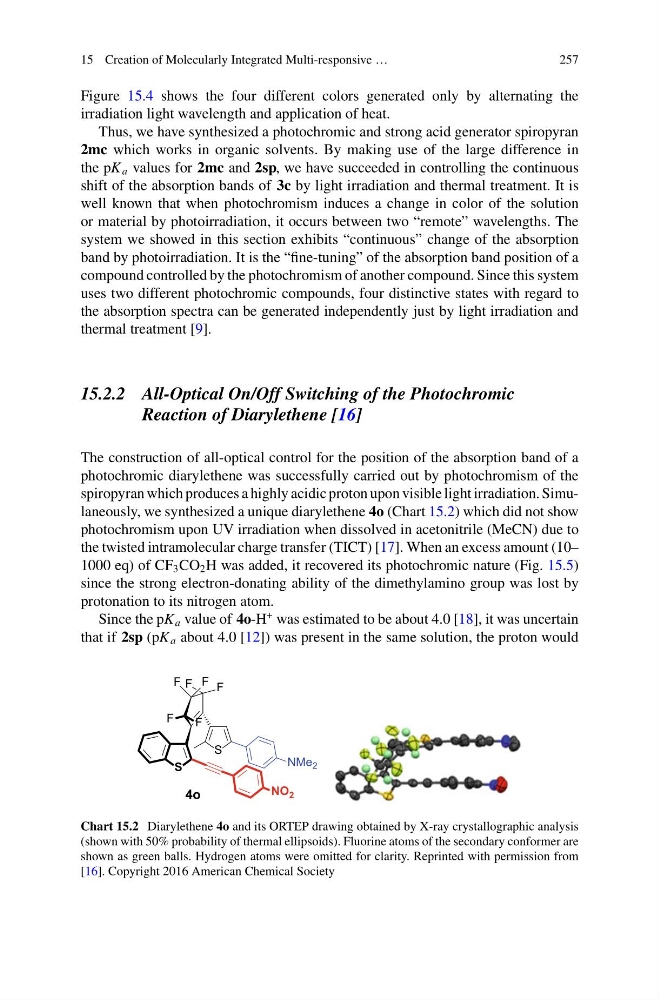
spiropyran which produces a highly acidic proton upon visible light irradiation. Simulaneously, we synthesized a unique diarylethene 4o (Chart 15.2) which did not show
photochromism upon UV irradiation when dissolved in acetonitrile (MeCN) due to
the twisted intramolecular charge transfer (TICT) [17]. When an excess amount (10–
1000 eq) of CF 3 CO 2 H was added, it recovered its photochromic nature (Fig. 15.5)
since the strong electron-donating ability of the dimethylamino group was lost by
protonation to its nitrogen atom.
Since the pK a value of 4o-H
+ was estimated to be about 4.0 [18], it was uncertain
that if 2sp (pK a about 4.0 [12]) was present in the same solution, the proton would
S
S
NMe 2
NO 2
F
F
F
F
F
F
4o
Chart 15.2 Diarylethene 4o and its ORTEP drawing obtained by X-ray crystallographic analysis
(shown with 50% probability of thermal ellipsoids). Fluorine atoms of the secondary conformer are
shown as green balls. Hydrogen atoms were omitted for clarity. Reprinted with permission from
[16]. Copyright 2016 American Chemical Society
257
Figure 15.4 shows the four different colors generated only by alternating the
irradiation light wavelength and application of heat.
Thus, we have synthesized a photochromic and strong acid generator spiropyran
2mc which works in organic solvents. By making use of the large difference in
the pK a values for 2mc and 2sp, we have succeeded in controlling the continuous
shift of the absorption bands of 3c by light irradiation and thermal treatment. It is
well known that when photochromism induces a change in color of the solution
or material by photoirradiation, it occurs between two “remote” wavelengths. The
system we showed in this section exhibits “continuous” change of the absorption
band by photoirradiation. It is the “fine-tuning” of the absorption band position of a
compound controlled by the photochromism of another compound. Since this system
uses two different photochromic compounds, four distinctive states with regard to
the absorption spectra can be generated independently just by light irradiation and
thermal treatment [9].
15.2.2 All-Optical On/Off Switching of the Photochromic
Reaction of Diarylethene [16]
The construction of all-optical control for the position of the absorption band of a
photochromic diarylethene was successfully carried out by photochromism of the
spiropyran which produces a highly acidic proton upon visible light irradiation. Simulaneously, we synthesized a unique diarylethene 4o (Chart 15.2) which did not show
photochromism upon UV irradiation when dissolved in acetonitrile (MeCN) due to
the twisted intramolecular charge transfer (TICT) [17]. When an excess amount (10–
1000 eq) of CF 3 CO 2 H was added, it recovered its photochromic nature (Fig. 15.5)
since the strong electron-donating ability of the dimethylamino group was lost by
protonation to its nitrogen atom.
Since the pK a value of 4o-H
+ was estimated to be about 4.0 [18], it was uncertain
that if 2sp (pK a about 4.0 [12]) was present in the same solution, the proton would
S
S
NMe 2
NO 2
F
F
F
F
F
F
4o
Chart 15.2 Diarylethene 4o and its ORTEP drawing obtained by X-ray crystallographic analysis
(shown with 50% probability of thermal ellipsoids). Fluorine atoms of the secondary conformer are
shown as green balls. Hydrogen atoms were omitted for clarity. Reprinted with permission from
[16]. Copyright 2016 American Chemical Society