

15 Creation of Molecularly Integrated Multi-responsive …
255
(a)
(b)
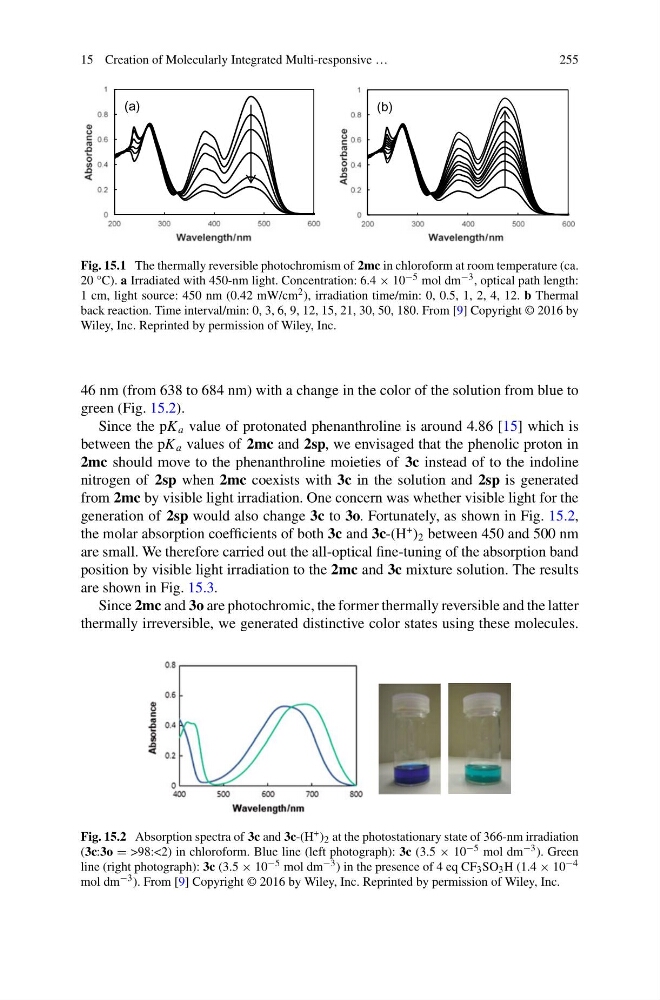
Fig. 15.1 The thermally reversible photochromism of 2mc in chloroform at room temperature (ca.
20 °C). a Irradiated with 450-nm light. Concentration: 6.4 × 10 −5 mol dm −3 , optical path length:
1 cm, light source: 450 nm (0.42 mW/cm 2 ), irradiation time/min: 0, 0.5, 1, 2, 4, 12. b Thermal
back reaction. Time interval/min: 0, 3, 6, 9, 12, 15, 21, 30, 50, 180. From [9] Copyright © 2016 by
Wiley, Inc. Reprinted by permission of Wiley, Inc.
46 nm (from 638 to 684 nm) with a change in the color of the solution from blue to
green (Fig. 15.2).
Since the pK a value of protonated phenanthroline is around 4.86 [15] which is
between the pK a values of 2mc and 2sp, we envisaged that the phenolic proton in
2mc should move to the phenanthroline moieties of 3c instead of to the indoline
nitrogen of 2sp when 2mc coexists with 3c in the solution and 2sp is generated
from 2mc by visible light irradiation. One concern was whether visible light for the
generation of 2sp would also change 3c to 3o. Fortunately, as shown in Fig. 15.2,
the molar absorption coefficients of both 3c and 3c-(H
+ ) 2 between 450 and 500 nm
are small. We therefore carried out the all-optical fine-tuning of the absorption band
position by visible light irradiation to the 2mc and 3c mixture solution. The results
are shown in Fig. 15.3.
Since 2mc and 3o are photochromic, the former thermally reversible and the latter
thermally irreversible, we generated distinctive color states using these molecules.
Fig. 15.2 Absorption spectra of 3c and 3c-(H + ) 2 at the photostationary state of 366-nm irradiation
(3c:3o = >98:<2) in chloroform. Blue line (left photograph): 3c (3.5 × 10 −5 mol dm −3 ). Green
line (right photograph): 3c (3.5 × 10 −5 mol dm −3 ) in the presence of 4 eq CF 3 SO 3 H (1.4 × 10 −4
mol dm −3 ). From [9] Copyright © 2016 by Wiley, Inc. Reprinted by permission of Wiley, Inc.
255
(a)
(b)
Fig. 15.1 The thermally reversible photochromism of 2mc in chloroform at room temperature (ca.
20 °C). a Irradiated with 450-nm light. Concentration: 6.4 × 10 −5 mol dm −3 , optical path length:
1 cm, light source: 450 nm (0.42 mW/cm 2 ), irradiation time/min: 0, 0.5, 1, 2, 4, 12. b Thermal
back reaction. Time interval/min: 0, 3, 6, 9, 12, 15, 21, 30, 50, 180. From [9] Copyright © 2016 by
Wiley, Inc. Reprinted by permission of Wiley, Inc.
46 nm (from 638 to 684 nm) with a change in the color of the solution from blue to
green (Fig. 15.2).
Since the pK a value of protonated phenanthroline is around 4.86 [15] which is
between the pK a values of 2mc and 2sp, we envisaged that the phenolic proton in
2mc should move to the phenanthroline moieties of 3c instead of to the indoline
nitrogen of 2sp when 2mc coexists with 3c in the solution and 2sp is generated
from 2mc by visible light irradiation. One concern was whether visible light for the
generation of 2sp would also change 3c to 3o. Fortunately, as shown in Fig. 15.2,
the molar absorption coefficients of both 3c and 3c-(H
+ ) 2 between 450 and 500 nm
are small. We therefore carried out the all-optical fine-tuning of the absorption band
position by visible light irradiation to the 2mc and 3c mixture solution. The results
are shown in Fig. 15.3.
Since 2mc and 3o are photochromic, the former thermally reversible and the latter
thermally irreversible, we generated distinctive color states using these molecules.
Fig. 15.2 Absorption spectra of 3c and 3c-(H + ) 2 at the photostationary state of 366-nm irradiation
(3c:3o = >98:<2) in chloroform. Blue line (left photograph): 3c (3.5 × 10 −5 mol dm −3 ). Green
line (right photograph): 3c (3.5 × 10 −5 mol dm −3 ) in the presence of 4 eq CF 3 SO 3 H (1.4 × 10 −4
mol dm −3 ). From [9] Copyright © 2016 by Wiley, Inc. Reprinted by permission of Wiley, Inc.