

254
Y. Yokoyama
(Sect. 15.3). As a secondary objective, we aimed to establish short-step synthetic
pathways for the photochromic molecules in order to allow a more facile process for
the construction of complex systems (Sect. 15.4).
15.2 Photon-Working Conjugate of Photochromic
Acid-Generating Spiropyran and Diarylethenes
15.2.1 Fine-Tuning of the Absorption Wavelength
of Bisphenanthrolinodiarylethene [9]
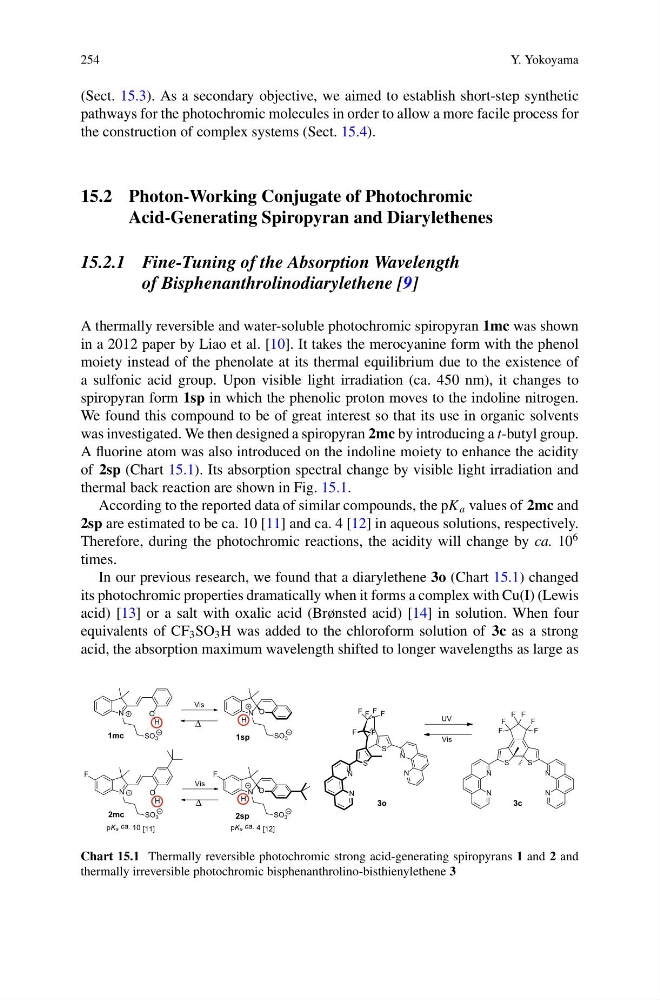
A thermally reversible and water-soluble photochromic spiropyran 1mc was shown
in a 2012 paper by Liao et al. [10]. It takes the merocyanine form with the phenol
moiety instead of the phenolate at its thermal equilibrium due to the existence of
a sulfonic acid group. Upon visible light irradiation (ca. 450 nm), it changes to
spiropyran form 1sp in which the phenolic proton moves to the indoline nitrogen.
We found this compound to be of great interest so that its use in organic solvents
was investigated. We then designed a spiropyran 2mc by introducing a t-butyl group.
A fluorine atom was also introduced on the indoline moiety to enhance the acidity
of 2sp (Chart 15.1). Its absorption spectral change by visible light irradiation and
thermal back reaction are shown in Fig. 15.1.
According to the reported data of similar compounds, the pK a values of 2mc and
2sp are estimated to be ca. 10 [11] and ca. 4 [12] in aqueous solutions, respectively.
Therefore, during the photochromic reactions, the acidity will change by ca. 10
6
times.
In our previous research, we found that a diarylethene 3o (Chart 15.1) changed
its photochromic properties dramatically when it forms a complex with Cu(I) (Lewis
acid) [13] or a salt with oxalic acid (Brønsted acid) [14] in solution. When four
equivalents of CF 3 SO 3 H was added to the chloroform solution of 3c as a strong
acid, the absorption maximum wavelength shifted to longer wavelengths as large as
N
SO 3
O
H
N
SO 3
O
H
N
SO 3
O
H
F
1mc
1sp
2mc
N
SO 3
O
H
2sp
F
Vis
Δ
Vis
Δ
pKa ca. 10 [11]
pKa ca. 4 [12]
S
S
N
N
N
F
F
F
F
F
F
S
S
F
F
F F
F
F
N
N
N
N
UV
Vis
3o
3c
N
Chart 15.1 Thermally reversible photochromic strong acid-generating spiropyrans 1 and 2 and
thermally irreversible photochromic bisphenanthrolino-bisthienylethene 3
Y. Yokoyama
(Sect. 15.3). As a secondary objective, we aimed to establish short-step synthetic
pathways for the photochromic molecules in order to allow a more facile process for
the construction of complex systems (Sect. 15.4).
15.2 Photon-Working Conjugate of Photochromic
Acid-Generating Spiropyran and Diarylethenes
15.2.1 Fine-Tuning of the Absorption Wavelength
of Bisphenanthrolinodiarylethene [9]
A thermally reversible and water-soluble photochromic spiropyran 1mc was shown
in a 2012 paper by Liao et al. [10]. It takes the merocyanine form with the phenol
moiety instead of the phenolate at its thermal equilibrium due to the existence of
a sulfonic acid group. Upon visible light irradiation (ca. 450 nm), it changes to
spiropyran form 1sp in which the phenolic proton moves to the indoline nitrogen.
We found this compound to be of great interest so that its use in organic solvents
was investigated. We then designed a spiropyran 2mc by introducing a t-butyl group.
A fluorine atom was also introduced on the indoline moiety to enhance the acidity
of 2sp (Chart 15.1). Its absorption spectral change by visible light irradiation and
thermal back reaction are shown in Fig. 15.1.
According to the reported data of similar compounds, the pK a values of 2mc and
2sp are estimated to be ca. 10 [11] and ca. 4 [12] in aqueous solutions, respectively.
Therefore, during the photochromic reactions, the acidity will change by ca. 10
6
times.
In our previous research, we found that a diarylethene 3o (Chart 15.1) changed
its photochromic properties dramatically when it forms a complex with Cu(I) (Lewis
acid) [13] or a salt with oxalic acid (Brønsted acid) [14] in solution. When four
equivalents of CF 3 SO 3 H was added to the chloroform solution of 3c as a strong
acid, the absorption maximum wavelength shifted to longer wavelengths as large as
N
SO 3
O
H
N
SO 3
O
H
N
SO 3
O
H
F
1mc
1sp
2mc
N
SO 3
O
H
2sp
F
Vis
Δ
Vis
Δ
pKa ca. 10 [11]
pKa ca. 4 [12]
S
S
N
N
N
F
F
F
F
F
F
S
S
F
F
F F
F
F
N
N
N
N
UV
Vis
3o
3c
N
Chart 15.1 Thermally reversible photochromic strong acid-generating spiropyrans 1 and 2 and
thermally irreversible photochromic bisphenanthrolino-bisthienylethene 3