

14
H. Miyasaka et al.
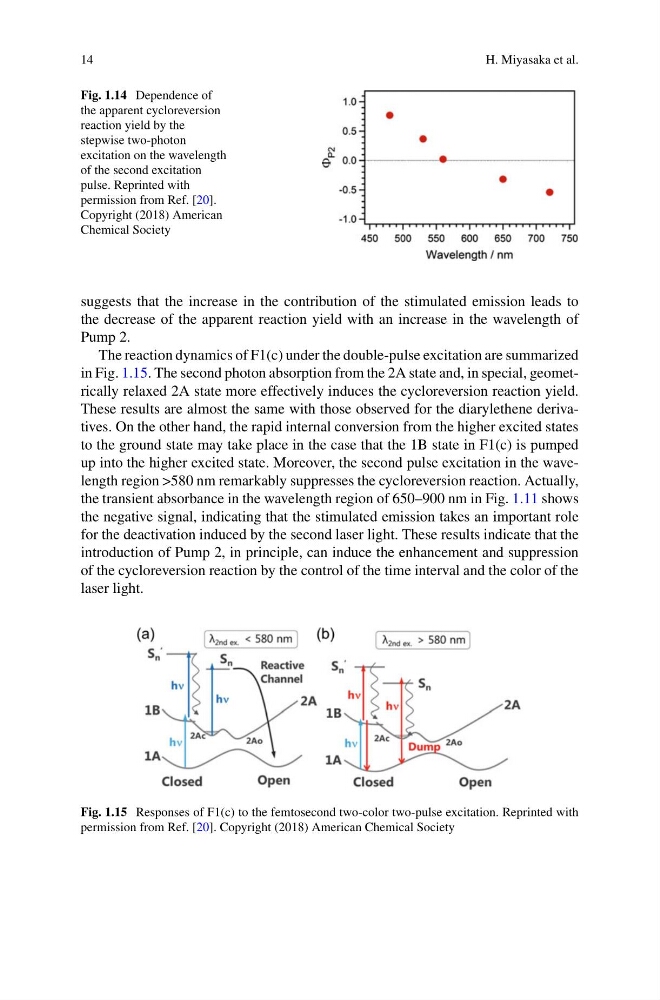
Fig. 1.14 Dependence of
the apparent cycloreversion
reaction yield by the
stepwise two-photon
excitation on the wavelength
of the second excitation
pulse. Reprinted with
permission from Ref. [20].
Copyright (2018) American
Chemical Society
suggests that the increase in the contribution of the stimulated emission leads to
the decrease of the apparent reaction yield with an increase in the wavelength of
Pump 2.
The reaction dynamics of F1(c) under the double-pulse excitation are summarized
in Fig. 1.15. The second photon absorption from the 2A state and, in special, geometrically relaxed 2A state more effectively induces the cycloreversion reaction yield.
These results are almost the same with those observed for the diarylethene derivatives. On the other hand, the rapid internal conversion from the higher excited states
to the ground state may take place in the case that the 1B state in F1(c) is pumped
up into the higher excited state. Moreover, the second pulse excitation in the wavelength region >580 nm remarkably suppresses the cycloreversion reaction. Actually,
the transient absorbance in the wavelength region of 650–900 nm in Fig. 1.11 shows
the negative signal, indicating that the stimulated emission takes an important role
for the deactivation induced by the second laser light. These results indicate that the
introduction of Pump 2, in principle, can induce the enhancement and suppression
of the cycloreversion reaction by the control of the time interval and the color of the
laser light.
Fig. 1.15 Responses of F1(c) to the femtosecond two-color two-pulse excitation. Reprinted with
permission from Ref. [20]. Copyright (2018) American Chemical Society
H. Miyasaka et al.
Fig. 1.14 Dependence of
the apparent cycloreversion
reaction yield by the
stepwise two-photon
excitation on the wavelength
of the second excitation
pulse. Reprinted with
permission from Ref. [20].
Copyright (2018) American
Chemical Society
suggests that the increase in the contribution of the stimulated emission leads to
the decrease of the apparent reaction yield with an increase in the wavelength of
Pump 2.
The reaction dynamics of F1(c) under the double-pulse excitation are summarized
in Fig. 1.15. The second photon absorption from the 2A state and, in special, geometrically relaxed 2A state more effectively induces the cycloreversion reaction yield.
These results are almost the same with those observed for the diarylethene derivatives. On the other hand, the rapid internal conversion from the higher excited states
to the ground state may take place in the case that the 1B state in F1(c) is pumped
up into the higher excited state. Moreover, the second pulse excitation in the wavelength region >580 nm remarkably suppresses the cycloreversion reaction. Actually,
the transient absorbance in the wavelength region of 650–900 nm in Fig. 1.11 shows
the negative signal, indicating that the stimulated emission takes an important role
for the deactivation induced by the second laser light. These results indicate that the
introduction of Pump 2, in principle, can induce the enhancement and suppression
of the cycloreversion reaction by the control of the time interval and the color of the
laser light.
Fig. 1.15 Responses of F1(c) to the femtosecond two-color two-pulse excitation. Reprinted with
permission from Ref. [20]. Copyright (2018) American Chemical Society