

184
N. Tamai and S. Masuo
10.6.1 Multiexciton Control of Single QDs Using Nanosized
AuCube
As a first AFM technique, AFM manipulation of a cubic-shaped gold nanoparticle
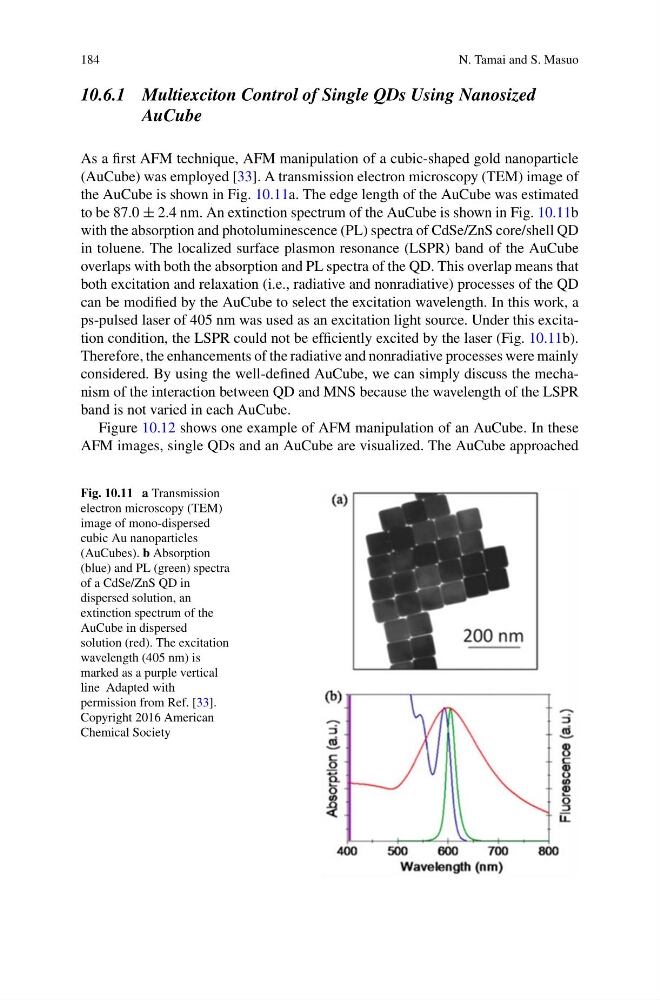
(AuCube) was employed [33]. A transmission electron microscopy (TEM) image of
the AuCube is shown in Fig. 10.11a. The edge length of the AuCube was estimated
to be 87.0 ± 2.4 nm. An extinction spectrum of the AuCube is shown in Fig. 10.11b
with the absorption and photoluminescence (PL) spectra of CdSe/ZnS core/shell QD
in toluene. The localized surface plasmon resonance (LSPR) band of the AuCube
overlaps with both the absorption and PL spectra of the QD. This overlap means that
both excitation and relaxation (i.e., radiative and nonradiative) processes of the QD
can be modified by the AuCube to select the excitation wavelength. In this work, a
ps-pulsed laser of 405 nm was used as an excitation light source. Under this excitation condition, the LSPR could not be efficiently excited by the laser (Fig. 10.11b).
Therefore, the enhancements of the radiative and nonradiative processes were mainly
considered. By using the well-defined AuCube, we can simply discuss the mechanism of the interaction between QD and MNS because the wavelength of the LSPR
band is not varied in each AuCube.
Figure 10.12 shows one example of AFM manipulation of an AuCube. In these
AFM images, single QDs and an AuCube are visualized. The AuCube approached
Fig. 10.11 a Transmission
electron microscopy (TEM)
image of mono-dispersed
cubic Au nanoparticles
(AuCubes). b Absorption
(blue) and PL (green) spectra
of a CdSe/ZnS QD in
dispersed solution, an
extinction spectrum of the
AuCube in dispersed
solution (red). The excitation
wavelength (405 nm) is
marked as a purple vertical
line Adapted with
permission from Ref. [33].
Copyright 2016 American
Chemical Society
N. Tamai and S. Masuo
10.6.1 Multiexciton Control of Single QDs Using Nanosized
AuCube
As a first AFM technique, AFM manipulation of a cubic-shaped gold nanoparticle
(AuCube) was employed [33]. A transmission electron microscopy (TEM) image of
the AuCube is shown in Fig. 10.11a. The edge length of the AuCube was estimated
to be 87.0 ± 2.4 nm. An extinction spectrum of the AuCube is shown in Fig. 10.11b
with the absorption and photoluminescence (PL) spectra of CdSe/ZnS core/shell QD
in toluene. The localized surface plasmon resonance (LSPR) band of the AuCube
overlaps with both the absorption and PL spectra of the QD. This overlap means that
both excitation and relaxation (i.e., radiative and nonradiative) processes of the QD
can be modified by the AuCube to select the excitation wavelength. In this work, a
ps-pulsed laser of 405 nm was used as an excitation light source. Under this excitation condition, the LSPR could not be efficiently excited by the laser (Fig. 10.11b).
Therefore, the enhancements of the radiative and nonradiative processes were mainly
considered. By using the well-defined AuCube, we can simply discuss the mechanism of the interaction between QD and MNS because the wavelength of the LSPR
band is not varied in each AuCube.
Figure 10.12 shows one example of AFM manipulation of an AuCube. In these
AFM images, single QDs and an AuCube are visualized. The AuCube approached
Fig. 10.11 a Transmission
electron microscopy (TEM)
image of mono-dispersed
cubic Au nanoparticles
(AuCubes). b Absorption
(blue) and PL (green) spectra
of a CdSe/ZnS QD in
dispersed solution, an
extinction spectrum of the
AuCube in dispersed
solution (red). The excitation
wavelength (405 nm) is
marked as a purple vertical
line Adapted with
permission from Ref. [33].
Copyright 2016 American
Chemical Society