

182
N. Tamai and S. Masuo
bleach amplitude observed in our experiments is probably due to ultrafast electron
transfer faster than the instrument response function from the 1S(e) state of CdSe
QDs to Au NPs.
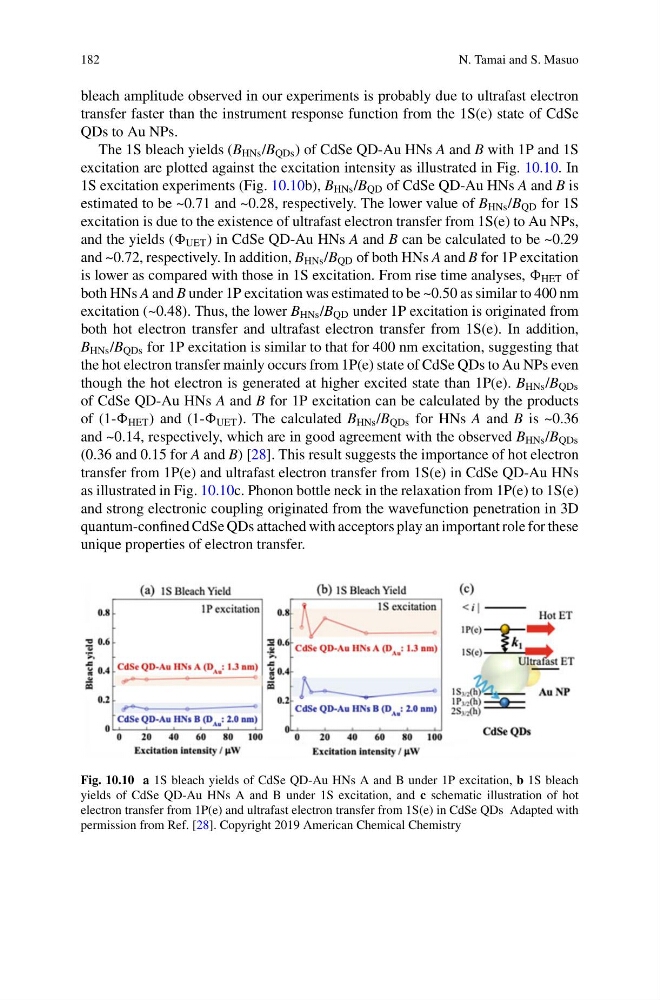
The 1S bleach yields (B HNs /B QDs ) of CdSe QD-Au HNs A and B with 1P and 1S
excitation are plotted against the excitation intensity as illustrated in Fig. 10.10. In
1S excitation experiments (Fig. 10.10b), B HNs /B QD of CdSe QD-Au HNs A and B is
estimated to be ~0.71 and ~0.28, respectively. The lower value of B HNs /B QD for 1S
excitation is due to the existence of ultrafast electron transfer from 1S(e) to Au NPs,
and the yields ( UET ) in CdSe QD-Au HNs A and B can be calculated to be ~0.29
and ~0.72, respectively. In addition, B HNs /B QD of both HNs A and B for 1P excitation
is lower as compared with those in 1S excitation. From rise time analyses, HET of
both HNs A and B under 1P excitation was estimated to be ~0.50 as similar to 400 nm
excitation (~0.48). Thus, the lower B HNs /B QD under 1P excitation is originated from
both hot electron transfer and ultrafast electron transfer from 1S(e). In addition,
B HNs /B QDs for 1P excitation is similar to that for 400 nm excitation, suggesting that
the hot electron transfer mainly occurs from 1P(e) state of CdSe QDs to Au NPs even
though the hot electron is generated at higher excited state than 1P(e). B HNs /B QDs
of CdSe QD-Au HNs A and B for 1P excitation can be calculated by the products
of (1- HET ) and (1- UET ). The calculated B HNs /B QDs for HNs A and B is ~0.36
and ~0.14, respectively, which are in good agreement with the observed B HNs /B QDs
(0.36 and 0.15 for A and B) [28]. This result suggests the importance of hot electron
transfer from 1P(e) and ultrafast electron transfer from 1S(e) in CdSe QD-Au HNs
as illustrated in Fig. 10.10c. Phonon bottle neck in the relaxation from 1P(e) to 1S(e)
and strong electronic coupling originated from the wavefunction penetration in 3D
quantum-confined CdSe QDs attached with acceptors play an important role for these
unique properties of electron transfer.
Fig. 10.10 a 1S bleach yields of CdSe QD-Au HNs A and B under 1P excitation, b 1S bleach
yields of CdSe QD-Au HNs A and B under 1S excitation, and c schematic illustration of hot
electron transfer from 1P(e) and ultrafast electron transfer from 1S(e) in CdSe QDs Adapted with
permission from Ref. [28]. Copyright 2019 American Chemical Chemistry
N. Tamai and S. Masuo
bleach amplitude observed in our experiments is probably due to ultrafast electron
transfer faster than the instrument response function from the 1S(e) state of CdSe
QDs to Au NPs.
The 1S bleach yields (B HNs /B QDs ) of CdSe QD-Au HNs A and B with 1P and 1S
excitation are plotted against the excitation intensity as illustrated in Fig. 10.10. In
1S excitation experiments (Fig. 10.10b), B HNs /B QD of CdSe QD-Au HNs A and B is
estimated to be ~0.71 and ~0.28, respectively. The lower value of B HNs /B QD for 1S
excitation is due to the existence of ultrafast electron transfer from 1S(e) to Au NPs,
and the yields ( UET ) in CdSe QD-Au HNs A and B can be calculated to be ~0.29
and ~0.72, respectively. In addition, B HNs /B QD of both HNs A and B for 1P excitation
is lower as compared with those in 1S excitation. From rise time analyses, HET of
both HNs A and B under 1P excitation was estimated to be ~0.50 as similar to 400 nm
excitation (~0.48). Thus, the lower B HNs /B QD under 1P excitation is originated from
both hot electron transfer and ultrafast electron transfer from 1S(e). In addition,
B HNs /B QDs for 1P excitation is similar to that for 400 nm excitation, suggesting that
the hot electron transfer mainly occurs from 1P(e) state of CdSe QDs to Au NPs even
though the hot electron is generated at higher excited state than 1P(e). B HNs /B QDs
of CdSe QD-Au HNs A and B for 1P excitation can be calculated by the products
of (1- HET ) and (1- UET ). The calculated B HNs /B QDs for HNs A and B is ~0.36
and ~0.14, respectively, which are in good agreement with the observed B HNs /B QDs
(0.36 and 0.15 for A and B) [28]. This result suggests the importance of hot electron
transfer from 1P(e) and ultrafast electron transfer from 1S(e) in CdSe QD-Au HNs
as illustrated in Fig. 10.10c. Phonon bottle neck in the relaxation from 1P(e) to 1S(e)
and strong electronic coupling originated from the wavefunction penetration in 3D
quantum-confined CdSe QDs attached with acceptors play an important role for these
unique properties of electron transfer.
Fig. 10.10 a 1S bleach yields of CdSe QD-Au HNs A and B under 1P excitation, b 1S bleach
yields of CdSe QD-Au HNs A and B under 1S excitation, and c schematic illustration of hot
electron transfer from 1P(e) and ultrafast electron transfer from 1S(e) in CdSe QDs Adapted with
permission from Ref. [28]. Copyright 2019 American Chemical Chemistry