

9 Photosynergetic Effects on Triplet–Triplet Annihilation …
165
P i (n) = n C (n+i)/2 2
−n
,
(9.9)
where n and i are often assumed to be the even integer number. To estimate the
encounter probability of two excitons starting both from the same triplet sensitizer,
we evaluate the following equation:
R 1D
n TTET , n rag
=
i≤|n TTET −n rag |
P i (n TTET )P i±1
n TTET − n rag
,
(9.10)
where n TTET and n lag are the number of TTET before the spontaneous emission from
the emitter and that of the lag time that the sensitizer absorbs the light and then the
intersystem crossing occurs in the sensitizer, respectively. Note here that ± in the
above equation means a sum of the i + 1 and i−1 terms.
Since the distribution function of the random walk is asymptotically given by the
normal distribution (Gaussian approximation) as
P(x, n) =
1
√
2π n
exp
−
x
2
2n
,
(9.11)
The encounter probability of two excitons are given by the overlap of two
distributions S 1D as
R 1D
n TTET · n lag
= 2
dx P(x, n TTET )P
x, n TTET − n lag
=
2
2π
2n TTET − n lag
≡ 2S 1D
(9.12)
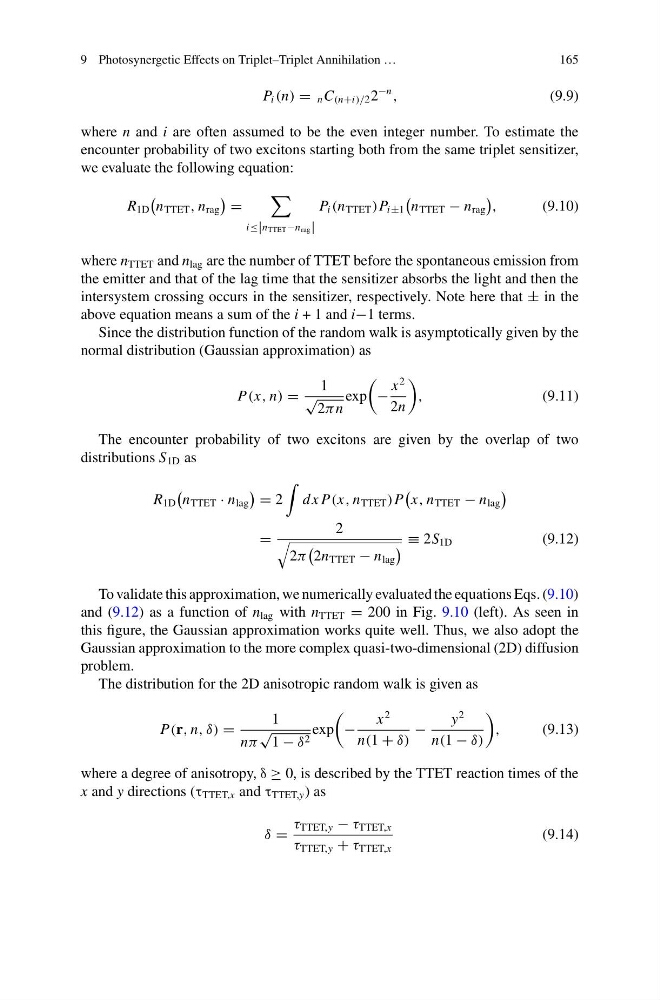
To validate this approximation, we numerically evaluated the equations Eqs. (9.10)
and (9.12) as a function of n lag with n TTET = 200 in Fig. 9.10 (left). As seen in
this figure, the Gaussian approximation works quite well. Thus, we also adopt the
Gaussian approximation to the more complex quasi-two-dimensional (2D) diffusion
problem.
The distribution for the 2D anisotropic random walk is given as
P(r, n, δ) =
1
nπ
√
1 − δ 2
exp
−
x
2
n(1 + δ)
−
y
2
n(1 − δ)
,
(9.13)
where a degree of anisotropy, δ ≥ 0, is described by the TTET reaction times of the
x and y directions (τ TTET,x and τ TTET,y ) as
δ =
τ TTET,y − τ TTET,x
τ TTET,y + τ TTET,x
(9.14)
165
P i (n) = n C (n+i)/2 2
−n
,
(9.9)
where n and i are often assumed to be the even integer number. To estimate the
encounter probability of two excitons starting both from the same triplet sensitizer,
we evaluate the following equation:
R 1D
n TTET , n rag
=
i≤|n TTET −n rag |
P i (n TTET )P i±1
n TTET − n rag
,
(9.10)
where n TTET and n lag are the number of TTET before the spontaneous emission from
the emitter and that of the lag time that the sensitizer absorbs the light and then the
intersystem crossing occurs in the sensitizer, respectively. Note here that ± in the
above equation means a sum of the i + 1 and i−1 terms.
Since the distribution function of the random walk is asymptotically given by the
normal distribution (Gaussian approximation) as
P(x, n) =
1
√
2π n
exp
−
x
2
2n
,
(9.11)
The encounter probability of two excitons are given by the overlap of two
distributions S 1D as
R 1D
n TTET · n lag
= 2
dx P(x, n TTET )P
x, n TTET − n lag
=
2
2π
2n TTET − n lag
≡ 2S 1D
(9.12)
To validate this approximation, we numerically evaluated the equations Eqs. (9.10)
and (9.12) as a function of n lag with n TTET = 200 in Fig. 9.10 (left). As seen in
this figure, the Gaussian approximation works quite well. Thus, we also adopt the
Gaussian approximation to the more complex quasi-two-dimensional (2D) diffusion
problem.
The distribution for the 2D anisotropic random walk is given as
P(r, n, δ) =
1
nπ
√
1 − δ 2
exp
−
x
2
n(1 + δ)
−
y
2
n(1 − δ)
,
(9.13)
where a degree of anisotropy, δ ≥ 0, is described by the TTET reaction times of the
x and y directions (τ TTET,x and τ TTET,y ) as
δ =
τ TTET,y − τ TTET,x
τ TTET,y + τ TTET,x
(9.14)