

9 Photosynergetic Effects on Triplet–Triplet Annihilation …
153
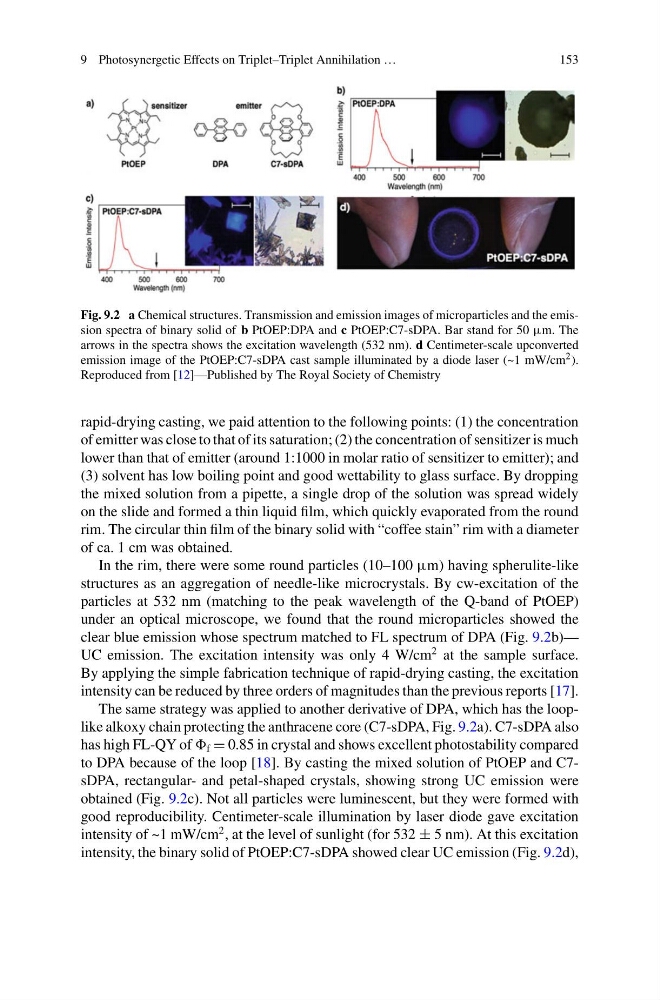
Fig. 9.2 a Chemical structures. Transmission and emission images of microparticles and the emission spectra of binary solid of b PtOEP:DPA and c PtOEP:C7-sDPA. Bar stand for 50 μm. The
arrows in the spectra shows the excitation wavelength (532 nm). d Centimeter-scale upconverted
emission image of the PtOEP:C7-sDPA cast sample illuminated by a diode laser (~1 mW/cm 2 ).
Reproduced from [12]—Published by The Royal Society of Chemistry
rapid-drying casting, we paid attention to the following points: (1) the concentration
of emitter was close to that of its saturation; (2) the concentration of sensitizer is much
lower than that of emitter (around 1:1000 in molar ratio of sensitizer to emitter); and
(3) solvent has low boiling point and good wettability to glass surface. By dropping
the mixed solution from a pipette, a single drop of the solution was spread widely
on the slide and formed a thin liquid film, which quickly evaporated from the round
rim. The circular thin film of the binary solid with “coffee stain” rim with a diameter
of ca. 1 cm was obtained.
In the rim, there were some round particles (10–100 μm) having spherulite-like
structures as an aggregation of needle-like microcrystals. By cw-excitation of the
particles at 532 nm (matching to the peak wavelength of the Q-band of PtOEP)
under an optical microscope, we found that the round microparticles showed the
clear blue emission whose spectrum matched to FL spectrum of DPA (Fig. 9.2b)—
UC emission. The excitation intensity was only 4 W/cm
2 at the sample surface.
By applying the simple fabrication technique of rapid-drying casting, the excitation
intensity can be reduced by three orders of magnitudes than the previous reports [17].
The same strategy was applied to another derivative of DPA, which has the looplike alkoxy chain protecting the anthracene core (C7-sDPA, Fig. 9.2a). C7-sDPA also
has high FL-QY of f = 0.85 in crystal and shows excellent photostability compared
to DPA because of the loop [18]. By casting the mixed solution of PtOEP and C7sDPA, rectangular- and petal-shaped crystals, showing strong UC emission were
obtained (Fig. 9.2c). Not all particles were luminescent, but they were formed with
good reproducibility. Centimeter-scale illumination by laser diode gave excitation
intensity of ~1 mW/cm
2 , at the level of sunlight (for 532 ± 5 nm). At this excitation
intensity, the binary solid of PtOEP:C7-sDPA showed clear UC emission (Fig. 9.2d),
153
Fig. 9.2 a Chemical structures. Transmission and emission images of microparticles and the emission spectra of binary solid of b PtOEP:DPA and c PtOEP:C7-sDPA. Bar stand for 50 μm. The
arrows in the spectra shows the excitation wavelength (532 nm). d Centimeter-scale upconverted
emission image of the PtOEP:C7-sDPA cast sample illuminated by a diode laser (~1 mW/cm 2 ).
Reproduced from [12]—Published by The Royal Society of Chemistry
rapid-drying casting, we paid attention to the following points: (1) the concentration
of emitter was close to that of its saturation; (2) the concentration of sensitizer is much
lower than that of emitter (around 1:1000 in molar ratio of sensitizer to emitter); and
(3) solvent has low boiling point and good wettability to glass surface. By dropping
the mixed solution from a pipette, a single drop of the solution was spread widely
on the slide and formed a thin liquid film, which quickly evaporated from the round
rim. The circular thin film of the binary solid with “coffee stain” rim with a diameter
of ca. 1 cm was obtained.
In the rim, there were some round particles (10–100 μm) having spherulite-like
structures as an aggregation of needle-like microcrystals. By cw-excitation of the
particles at 532 nm (matching to the peak wavelength of the Q-band of PtOEP)
under an optical microscope, we found that the round microparticles showed the
clear blue emission whose spectrum matched to FL spectrum of DPA (Fig. 9.2b)—
UC emission. The excitation intensity was only 4 W/cm
2 at the sample surface.
By applying the simple fabrication technique of rapid-drying casting, the excitation
intensity can be reduced by three orders of magnitudes than the previous reports [17].
The same strategy was applied to another derivative of DPA, which has the looplike alkoxy chain protecting the anthracene core (C7-sDPA, Fig. 9.2a). C7-sDPA also
has high FL-QY of f = 0.85 in crystal and shows excellent photostability compared
to DPA because of the loop [18]. By casting the mixed solution of PtOEP and C7sDPA, rectangular- and petal-shaped crystals, showing strong UC emission were
obtained (Fig. 9.2c). Not all particles were luminescent, but they were formed with
good reproducibility. Centimeter-scale illumination by laser diode gave excitation
intensity of ~1 mW/cm
2 , at the level of sunlight (for 532 ± 5 nm). At this excitation
intensity, the binary solid of PtOEP:C7-sDPA showed clear UC emission (Fig. 9.2d),