

138
K. Ueno
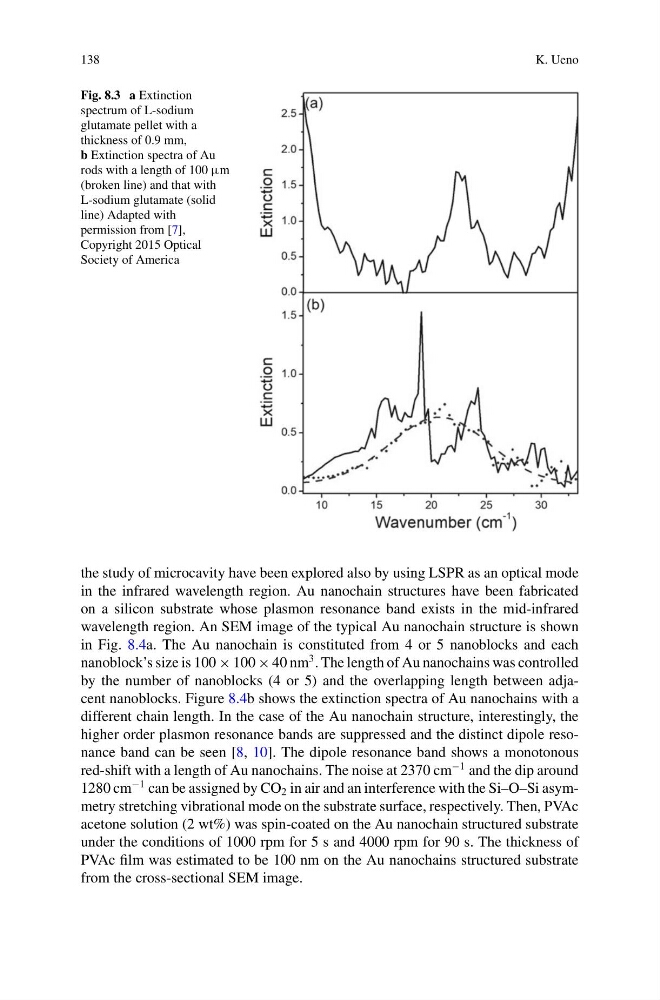
Fig. 8.3 a Extinction
spectrum of L-sodium
glutamate pellet with a
thickness of 0.9 mm,
b Extinction spectra of Au
rods with a length of 100 µm
(broken line) and that with
L-sodium glutamate (solid
line) Adapted with
permission from [7],
Copyright 2015 Optical
Society of America
the study of microcavity have been explored also by using LSPR as an optical mode
in the infrared wavelength region. Au nanochain structures have been fabricated
on a silicon substrate whose plasmon resonance band exists in the mid-infrared
wavelength region. An SEM image of the typical Au nanochain structure is shown
in Fig. 8.4a. The Au nanochain is constituted from 4 or 5 nanoblocks and each
nanoblock’s size is 100 × 100 × 40 nm
3 . The length of Au nanochains was controlled
by the number of nanoblocks (4 or 5) and the overlapping length between adjacent nanoblocks. Figure 8.4b shows the extinction spectra of Au nanochains with a
different chain length. In the case of the Au nanochain structure, interestingly, the
higher order plasmon resonance bands are suppressed and the distinct dipole resonance band can be seen [8, 10]. The dipole resonance band shows a monotonous
red-shift with a length of Au nanochains. The noise at 2370 cm
−1 and the dip around
1280 cm
−1 can be assigned by CO 2 in air and an interference with the Si–O–Si asymmetry stretching vibrational mode on the substrate surface, respectively. Then, PVAc
acetone solution (2 wt%) was spin-coated on the Au nanochain structured substrate
under the conditions of 1000 rpm for 5 s and 4000 rpm for 90 s. The thickness of
PVAc film was estimated to be 100 nm on the Au nanochains structured substrate
from the cross-sectional SEM image.
K. Ueno
Fig. 8.3 a Extinction
spectrum of L-sodium
glutamate pellet with a
thickness of 0.9 mm,
b Extinction spectra of Au
rods with a length of 100 µm
(broken line) and that with
L-sodium glutamate (solid
line) Adapted with
permission from [7],
Copyright 2015 Optical
Society of America
the study of microcavity have been explored also by using LSPR as an optical mode
in the infrared wavelength region. Au nanochain structures have been fabricated
on a silicon substrate whose plasmon resonance band exists in the mid-infrared
wavelength region. An SEM image of the typical Au nanochain structure is shown
in Fig. 8.4a. The Au nanochain is constituted from 4 or 5 nanoblocks and each
nanoblock’s size is 100 × 100 × 40 nm
3 . The length of Au nanochains was controlled
by the number of nanoblocks (4 or 5) and the overlapping length between adjacent nanoblocks. Figure 8.4b shows the extinction spectra of Au nanochains with a
different chain length. In the case of the Au nanochain structure, interestingly, the
higher order plasmon resonance bands are suppressed and the distinct dipole resonance band can be seen [8, 10]. The dipole resonance band shows a monotonous
red-shift with a length of Au nanochains. The noise at 2370 cm
−1 and the dip around
1280 cm
−1 can be assigned by CO 2 in air and an interference with the Si–O–Si asymmetry stretching vibrational mode on the substrate surface, respectively. Then, PVAc
acetone solution (2 wt%) was spin-coated on the Au nanochain structured substrate
under the conditions of 1000 rpm for 5 s and 4000 rpm for 90 s. The thickness of
PVAc film was estimated to be 100 nm on the Au nanochains structured substrate
from the cross-sectional SEM image.