

7 Plasmon-Associated Control of Chemical Reaction at Nanometer …
131
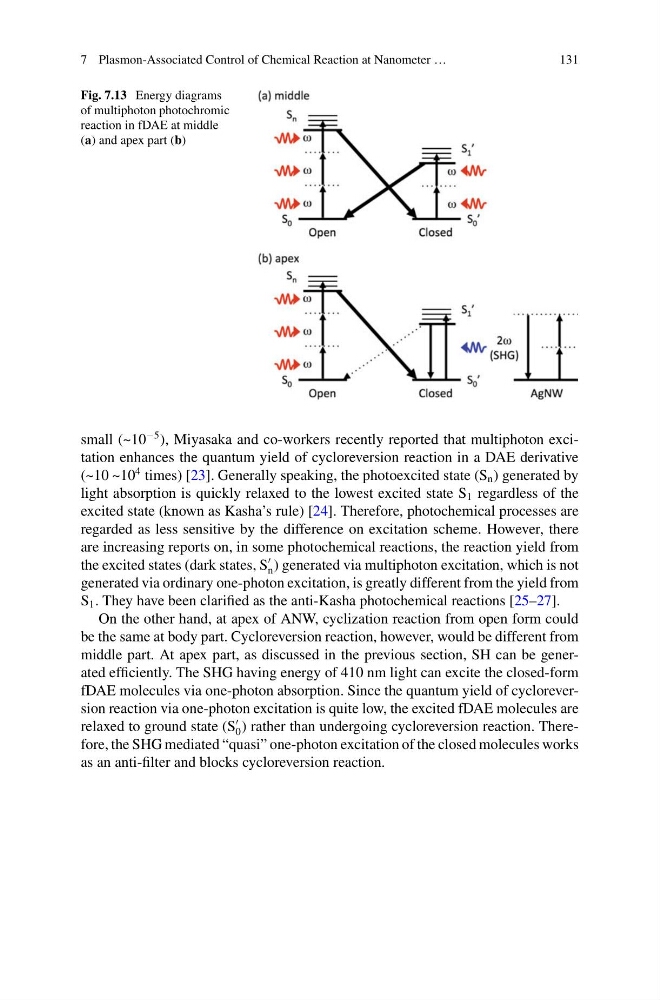
Fig. 7.13 Energy diagrams
of multiphoton photochromic
reaction in fDAE at middle
(a) and apex part (b)
small (~10
−5 ), Miyasaka and co-workers recently reported that multiphoton excitation enhances the quantum yield of cycloreversion reaction in a DAE derivative
(~10 ~10
4 times) [23]. Generally speaking, the photoexcited state (S n ) generated by
light absorption is quickly relaxed to the lowest excited state S 1 regardless of the
excited state (known as Kasha’s rule) [24]. Therefore, photochemical processes are
regarded as less sensitive by the difference on excitation scheme. However, there
are increasing reports on, in some photochemical reactions, the reaction yield from
the excited states (dark states, S
n ) generated via multiphoton excitation, which is not
generated via ordinary one-photon excitation, is greatly different from the yield from
S 1 . They have been clarified as the anti-Kasha photochemical reactions [25–27].
On the other hand, at apex of ANW, cyclization reaction from open form could
be the same at body part. Cycloreversion reaction, however, would be different from
middle part. At apex part, as discussed in the previous section, SH can be generated efficiently. The SHG having energy of 410 nm light can excite the closed-form
fDAE molecules via one-photon absorption. Since the quantum yield of cycloreversion reaction via one-photon excitation is quite low, the excited fDAE molecules are
relaxed to ground state (S
0 ) rather than undergoing cycloreversion reaction. Therefore, the SHG mediated “quasi” one-photon excitation of the closed molecules works
as an anti-filter and blocks cycloreversion reaction.
131
Fig. 7.13 Energy diagrams
of multiphoton photochromic
reaction in fDAE at middle
(a) and apex part (b)
small (~10
−5 ), Miyasaka and co-workers recently reported that multiphoton excitation enhances the quantum yield of cycloreversion reaction in a DAE derivative
(~10 ~10
4 times) [23]. Generally speaking, the photoexcited state (S n ) generated by
light absorption is quickly relaxed to the lowest excited state S 1 regardless of the
excited state (known as Kasha’s rule) [24]. Therefore, photochemical processes are
regarded as less sensitive by the difference on excitation scheme. However, there
are increasing reports on, in some photochemical reactions, the reaction yield from
the excited states (dark states, S
n ) generated via multiphoton excitation, which is not
generated via ordinary one-photon excitation, is greatly different from the yield from
S 1 . They have been clarified as the anti-Kasha photochemical reactions [25–27].
On the other hand, at apex of ANW, cyclization reaction from open form could
be the same at body part. Cycloreversion reaction, however, would be different from
middle part. At apex part, as discussed in the previous section, SH can be generated efficiently. The SHG having energy of 410 nm light can excite the closed-form
fDAE molecules via one-photon absorption. Since the quantum yield of cycloreversion reaction via one-photon excitation is quite low, the excited fDAE molecules are
relaxed to ground state (S
0 ) rather than undergoing cycloreversion reaction. Therefore, the SHG mediated “quasi” one-photon excitation of the closed molecules works
as an anti-filter and blocks cycloreversion reaction.