

130
S. Toyouchi et al.
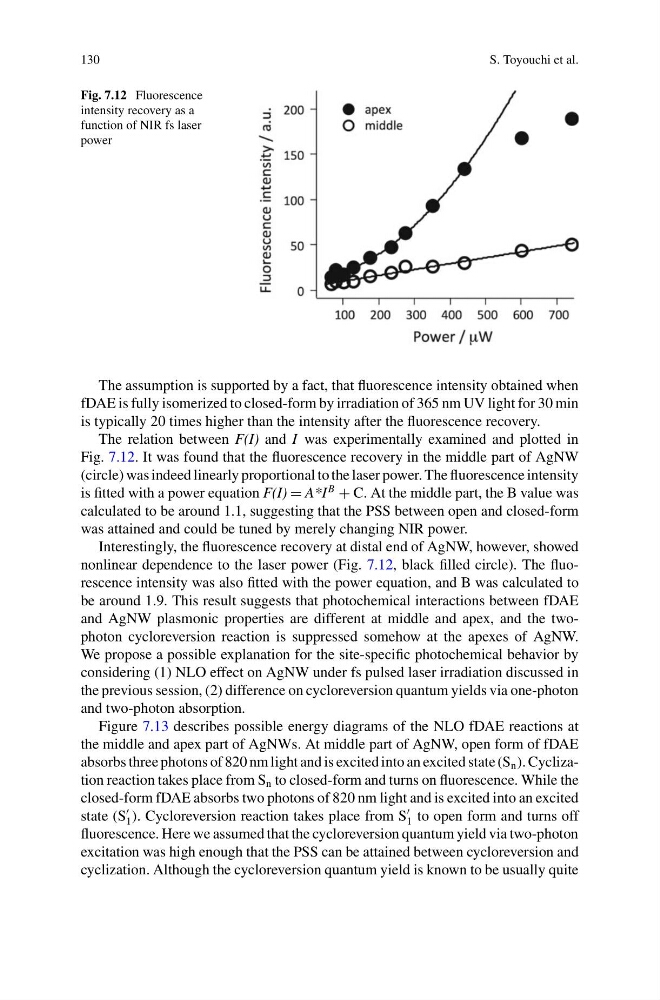
Fig. 7.12 Fluorescence
intensity recovery as a
function of NIR fs laser
power
The assumption is supported by a fact, that fluorescence intensity obtained when
fDAE is fully isomerized to closed-form by irradiation of 365 nm UV light for 30 min
is typically 20 times higher than the intensity after the fluorescence recovery.
The relation between F(I) and I was experimentally examined and plotted in
Fig. 7.12. It was found that the fluorescence recovery in the middle part of AgNW
(circle) was indeed linearly proportional to the laser power. The fluorescence intensity
is fitted with a power equation F(I) = A*I
B
+ C. At the middle part, the B value was
calculated to be around 1.1, suggesting that the PSS between open and closed-form
was attained and could be tuned by merely changing NIR power.
Interestingly, the fluorescence recovery at distal end of AgNW, however, showed
nonlinear dependence to the laser power (Fig. 7.12, black filled circle). The fluorescence intensity was also fitted with the power equation, and B was calculated to
be around 1.9. This result suggests that photochemical interactions between fDAE
and AgNW plasmonic properties are different at middle and apex, and the twophoton cycloreversion reaction is suppressed somehow at the apexes of AgNW.
We propose a possible explanation for the site-specific photochemical behavior by
considering (1) NLO effect on AgNW under fs pulsed laser irradiation discussed in
the previous session, (2) difference on cycloreversion quantum yields via one-photon
and two-photon absorption.
Figure 7.13 describes possible energy diagrams of the NLO fDAE reactions at
the middle and apex part of AgNWs. At middle part of AgNW, open form of fDAE
absorbs three photons of 820 nm light and is excited into an excited state (S n ). Cyclization reaction takes place from S n to closed-form and turns on fluorescence. While the
closed-form fDAE absorbs two photons of 820 nm light and is excited into an excited
state (S
1 ). Cycloreversion reaction takes place from S
1 to open form and turns off
fluorescence. Here we assumed that the cycloreversion quantum yield via two-photon
excitation was high enough that the PSS can be attained between cycloreversion and
cyclization. Although the cycloreversion quantum yield is known to be usually quite
S. Toyouchi et al.
Fig. 7.12 Fluorescence
intensity recovery as a
function of NIR fs laser
power
The assumption is supported by a fact, that fluorescence intensity obtained when
fDAE is fully isomerized to closed-form by irradiation of 365 nm UV light for 30 min
is typically 20 times higher than the intensity after the fluorescence recovery.
The relation between F(I) and I was experimentally examined and plotted in
Fig. 7.12. It was found that the fluorescence recovery in the middle part of AgNW
(circle) was indeed linearly proportional to the laser power. The fluorescence intensity
is fitted with a power equation F(I) = A*I
B
+ C. At the middle part, the B value was
calculated to be around 1.1, suggesting that the PSS between open and closed-form
was attained and could be tuned by merely changing NIR power.
Interestingly, the fluorescence recovery at distal end of AgNW, however, showed
nonlinear dependence to the laser power (Fig. 7.12, black filled circle). The fluorescence intensity was also fitted with the power equation, and B was calculated to
be around 1.9. This result suggests that photochemical interactions between fDAE
and AgNW plasmonic properties are different at middle and apex, and the twophoton cycloreversion reaction is suppressed somehow at the apexes of AgNW.
We propose a possible explanation for the site-specific photochemical behavior by
considering (1) NLO effect on AgNW under fs pulsed laser irradiation discussed in
the previous session, (2) difference on cycloreversion quantum yields via one-photon
and two-photon absorption.
Figure 7.13 describes possible energy diagrams of the NLO fDAE reactions at
the middle and apex part of AgNWs. At middle part of AgNW, open form of fDAE
absorbs three photons of 820 nm light and is excited into an excited state (S n ). Cyclization reaction takes place from S n to closed-form and turns on fluorescence. While the
closed-form fDAE absorbs two photons of 820 nm light and is excited into an excited
state (S
1 ). Cycloreversion reaction takes place from S
1 to open form and turns off
fluorescence. Here we assumed that the cycloreversion quantum yield via two-photon
excitation was high enough that the PSS can be attained between cycloreversion and
cyclization. Although the cycloreversion quantum yield is known to be usually quite