

118
S. Toyouchi et al.
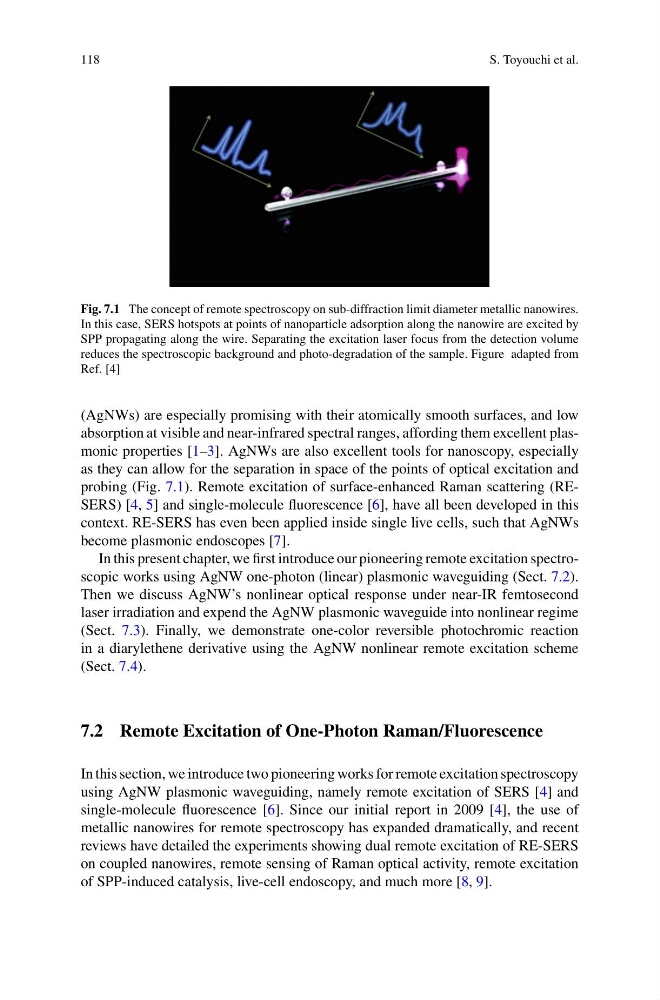
Fig. 7.1 The concept of remote spectroscopy on sub-diffraction limit diameter metallic nanowires.
In this case, SERS hotspots at points of nanoparticle adsorption along the nanowire are excited by
SPP propagating along the wire. Separating the excitation laser focus from the detection volume
reduces the spectroscopic background and photo-degradation of the sample. Figure adapted from
Ref. [4]
(AgNWs) are especially promising with their atomically smooth surfaces, and low
absorption at visible and near-infrared spectral ranges, affording them excellent plasmonic properties [1–3]. AgNWs are also excellent tools for nanoscopy, especially
as they can allow for the separation in space of the points of optical excitation and
probing (Fig. 7.1). Remote excitation of surface-enhanced Raman scattering (RESERS) [4, 5] and single-molecule fluorescence [6], have all been developed in this
context. RE-SERS has even been applied inside single live cells, such that AgNWs
become plasmonic endoscopes [7].
In this present chapter, we first introduce our pioneering remote excitation spectroscopic works using AgNW one-photon (linear) plasmonic waveguiding (Sect. 7.2).
Then we discuss AgNW’s nonlinear optical response under near-IR femtosecond
laser irradiation and expend the AgNW plasmonic waveguide into nonlinear regime
(Sect. 7.3). Finally, we demonstrate one-color reversible photochromic reaction
in a diarylethene derivative using the AgNW nonlinear remote excitation scheme
(Sect. 7.4).
7.2 Remote Excitation of One-Photon Raman/Fluorescence
In this section, we introduce two pioneering works for remote excitation spectroscopy
using AgNW plasmonic waveguiding, namely remote excitation of SERS [4] and
single-molecule fluorescence [6]. Since our initial report in 2009 [4], the use of
metallic nanowires for remote spectroscopy has expanded dramatically, and recent
reviews have detailed the experiments showing dual remote excitation of RE-SERS
on coupled nanowires, remote sensing of Raman optical activity, remote excitation
of SPP-induced catalysis, live-cell endoscopy, and much more [8, 9].
S. Toyouchi et al.
Fig. 7.1 The concept of remote spectroscopy on sub-diffraction limit diameter metallic nanowires.
In this case, SERS hotspots at points of nanoparticle adsorption along the nanowire are excited by
SPP propagating along the wire. Separating the excitation laser focus from the detection volume
reduces the spectroscopic background and photo-degradation of the sample. Figure adapted from
Ref. [4]
(AgNWs) are especially promising with their atomically smooth surfaces, and low
absorption at visible and near-infrared spectral ranges, affording them excellent plasmonic properties [1–3]. AgNWs are also excellent tools for nanoscopy, especially
as they can allow for the separation in space of the points of optical excitation and
probing (Fig. 7.1). Remote excitation of surface-enhanced Raman scattering (RESERS) [4, 5] and single-molecule fluorescence [6], have all been developed in this
context. RE-SERS has even been applied inside single live cells, such that AgNWs
become plasmonic endoscopes [7].
In this present chapter, we first introduce our pioneering remote excitation spectroscopic works using AgNW one-photon (linear) plasmonic waveguiding (Sect. 7.2).
Then we discuss AgNW’s nonlinear optical response under near-IR femtosecond
laser irradiation and expend the AgNW plasmonic waveguide into nonlinear regime
(Sect. 7.3). Finally, we demonstrate one-color reversible photochromic reaction
in a diarylethene derivative using the AgNW nonlinear remote excitation scheme
(Sect. 7.4).
7.2 Remote Excitation of One-Photon Raman/Fluorescence
In this section, we introduce two pioneering works for remote excitation spectroscopy
using AgNW plasmonic waveguiding, namely remote excitation of SERS [4] and
single-molecule fluorescence [6]. Since our initial report in 2009 [4], the use of
metallic nanowires for remote spectroscopy has expanded dramatically, and recent
reviews have detailed the experiments showing dual remote excitation of RE-SERS
on coupled nanowires, remote sensing of Raman optical activity, remote excitation
of SPP-induced catalysis, live-cell endoscopy, and much more [8, 9].