

110
K. Imaeda and K. Imura
spectral features and excitation rate of molecular fluorescence are locally modulated
by the sample position. This fact indicates that mesoscopic structures can be used
for the spatially selective modulation of optical functions of molecular systems at
the subwavelength scale.
Although the metallic nanohole array has been exploited in various optical applications, its operation spectral range is relatively narrow. To increase the versatility
of plasmonic fields for a wide variety of applications, the fabrication of plasmonic
substrates with a wide spectral range is highly desirable. Two-dimensional closedpacked assembly of nanoparticles exhibits broad spectral features. However, the
local field enhancement of the assembly is relatively low because spatially confined
fields are substantially delocalized over the assembly [81]. Hence, the state-of-the-art
application of the assembly is partially limited, whereas the large preparation area
is advantageous for practical applications [82–84]. The combination of plasmonic
nanostructures and photonic microstructures is the most promising means of simultaneously realizing a broad optical response and intense field enhancement. Recently,
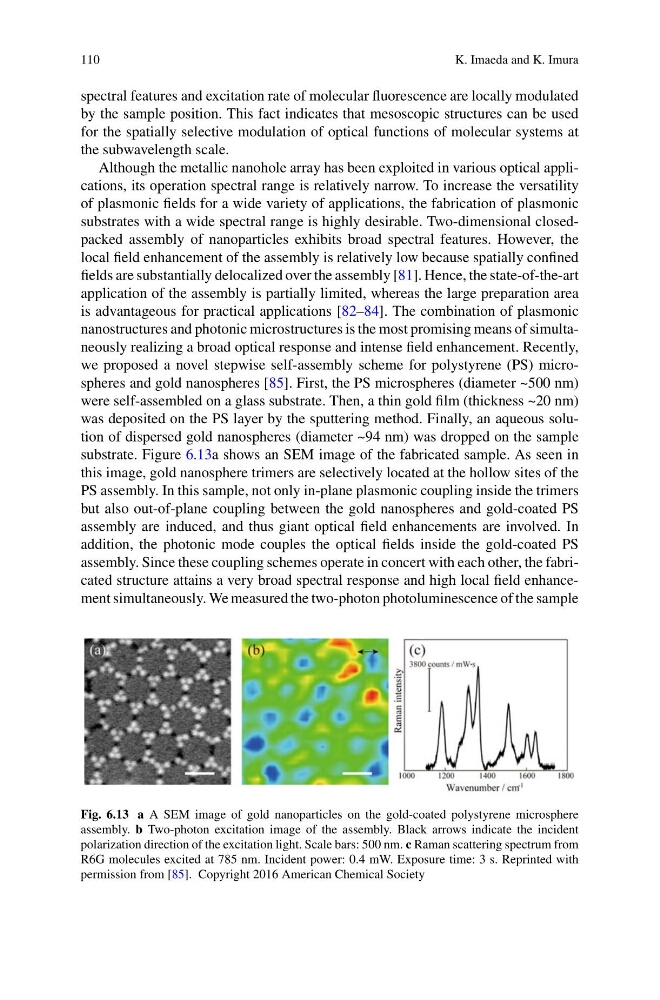
we proposed a novel stepwise self-assembly scheme for polystyrene (PS) microspheres and gold nanospheres [85]. First, the PS microspheres (diameter ~500 nm)
were self-assembled on a glass substrate. Then, a thin gold film (thickness ~20 nm)
was deposited on the PS layer by the sputtering method. Finally, an aqueous solution of dispersed gold nanospheres (diameter ~94 nm) was dropped on the sample
substrate. Figure 6.13a shows an SEM image of the fabricated sample. As seen in
this image, gold nanosphere trimers are selectively located at the hollow sites of the
PS assembly. In this sample, not only in-plane plasmonic coupling inside the trimers
but also out-of-plane coupling between the gold nanospheres and gold-coated PS
assembly are induced, and thus giant optical field enhancements are involved. In
addition, the photonic mode couples the optical fields inside the gold-coated PS
assembly. Since these coupling schemes operate in concert with each other, the fabricated structure attains a very broad spectral response and high local field enhancement simultaneously. We measured the two-photon photoluminescence of the sample
Fig. 6.13 a A SEM image of gold nanoparticles on the gold-coated polystyrene microsphere
assembly. b Two-photon excitation image of the assembly. Black arrows indicate the incident
polarization direction of the excitation light. Scale bars: 500 nm. c Raman scattering spectrum from
R6G molecules excited at 785 nm. Incident power: 0.4 mW. Exposure time: 3 s. Reprinted with
permission from [85]. Copyright 2016 American Chemical Society
K. Imaeda and K. Imura
spectral features and excitation rate of molecular fluorescence are locally modulated
by the sample position. This fact indicates that mesoscopic structures can be used
for the spatially selective modulation of optical functions of molecular systems at
the subwavelength scale.
Although the metallic nanohole array has been exploited in various optical applications, its operation spectral range is relatively narrow. To increase the versatility
of plasmonic fields for a wide variety of applications, the fabrication of plasmonic
substrates with a wide spectral range is highly desirable. Two-dimensional closedpacked assembly of nanoparticles exhibits broad spectral features. However, the
local field enhancement of the assembly is relatively low because spatially confined
fields are substantially delocalized over the assembly [81]. Hence, the state-of-the-art
application of the assembly is partially limited, whereas the large preparation area
is advantageous for practical applications [82–84]. The combination of plasmonic
nanostructures and photonic microstructures is the most promising means of simultaneously realizing a broad optical response and intense field enhancement. Recently,
we proposed a novel stepwise self-assembly scheme for polystyrene (PS) microspheres and gold nanospheres [85]. First, the PS microspheres (diameter ~500 nm)
were self-assembled on a glass substrate. Then, a thin gold film (thickness ~20 nm)
was deposited on the PS layer by the sputtering method. Finally, an aqueous solution of dispersed gold nanospheres (diameter ~94 nm) was dropped on the sample
substrate. Figure 6.13a shows an SEM image of the fabricated sample. As seen in
this image, gold nanosphere trimers are selectively located at the hollow sites of the
PS assembly. In this sample, not only in-plane plasmonic coupling inside the trimers
but also out-of-plane coupling between the gold nanospheres and gold-coated PS
assembly are induced, and thus giant optical field enhancements are involved. In
addition, the photonic mode couples the optical fields inside the gold-coated PS
assembly. Since these coupling schemes operate in concert with each other, the fabricated structure attains a very broad spectral response and high local field enhancement simultaneously. We measured the two-photon photoluminescence of the sample
Fig. 6.13 a A SEM image of gold nanoparticles on the gold-coated polystyrene microsphere
assembly. b Two-photon excitation image of the assembly. Black arrows indicate the incident
polarization direction of the excitation light. Scale bars: 500 nm. c Raman scattering spectrum from
R6G molecules excited at 785 nm. Incident power: 0.4 mW. Exposure time: 3 s. Reprinted with
permission from [85]. Copyright 2016 American Chemical Society